

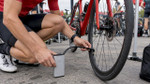
Eflator Bicycle Pump Battery Life: 3 to 6 Inflations, Always Pack Backup
Posted by Matt Russ on 10th Oct 2026
Eflator Portable Pump Battery Life for Cyclists: 3 to 6 Inflations, Pack Backup

Most high-performance portable inflators deliver roughly 3 to 6 full road-tire inflations per charge, with larger-capacity units pushing past 8 inflations before needing a recharge. The single spec that matters most when shopping is battery capacity paired with charge speed: look for 400 to 600mAh, a visible battery indicator, and USB-C charging that completes in 20 to 45 minutes. We recommend pairing any compact pump with a backup plan for long rides, since even a strong charge has limits once you’re hours from an outlet.
TL;DR:
- Inflation counts depend on tire volume and target pressure: a 29 by 2.4 inch mountain tire took about 80 seconds to reach 25 psi.
- Cold temperatures reduce usable capacity, while smaller pumps may pause under repeated load; allow 5 to 10 minutes between full inflations.
- Before a long ride, charge the pump to at least 80%, check its battery indicator, and carry a CO2 cartridge or hand pump as backup.
- A 20 to 30 minute quick charge can restore one full inflation, but it requires a fast charging source rated at 18 watts or higher.
- Use quick top offs for gradual pressure loss and reserve full inflations for actual flats, because topping up consumes far less battery.
Table of Contents
- What changes how many inflations you get
- Benchmarks: timed inflations and charging windows
- How to read pump specs without falling for marketing spin
- Ride-day tactics to avoid getting stranded
- Recommended maintenance practices to prolong battery longevity
- How battery replacement and upgrades affect long-term usability
- Compatibility with charging equipment and power banks on rides
- Coach Matt’s perspective and rule of thumb
- Where to find pumps and backups built for race-day reliability
- FAQ
- Sources
What changes how many inflations you get
Manufacturers list battery capacity in mAh (milliamp hours) or sometimes Wh (watt hours). Wh gives a cleaner read on usable energy because it accounts for voltage, but most consumer pump listings stick with mAh, so you’re comparing apples to apples within that metric rather than across it.
Tire size and target pressure drive how much of that capacity you actually use. A 700x25c road tire inflated to 100 psi demands far less air volume than a 29x2.4 mountain tire at 25 psi, but the road tire’s higher pressure target still pulls meaningful current from the motor. Timed testing on a Topeak e-Booster showed a 29x2.4 MTB tire reaching 0 to 25 psi in about 80 seconds, while a 700x28c road tire climbed from 0 to 85 psi in roughly two minutes. Our tubeless pressure guide breaks down typical target PSI by tire type if you want to plan your energy budget before you buy.
Cold weather is the factor riders underestimate most, as lithium-ion cells lose usable capacity as temperature drops. Lithium-ion cells lose usable capacity as temperature drops, so a pump rated for six inflations at room temperature may only manage four or five on a frosty morning.
Motor and compressor design also matter. Smaller motors run hotter under repeated load, and many units include thermal protection that pauses operation mid-inflation to prevent damage, which can catch you off guard if you’re racing a clock at a checkpoint.
- Capacity (mAh/Wh) sets your energy ceiling, but tire size and target pressure determine how fast you spend it.
- Cold temperatures can quietly cut usable capacity by 10 to 20%, so plan accordingly.
- Thermal protection may interrupt back-to-back inflations on smaller units, especially in warm conditions.
Pro Tip: Check a pump’s rated capacity against both your tire size and your coldest typical ride temperature, not just the sunny-day marketing number.
Benchmarks: timed inflations and charging windows
Real-world numbers beat vague claims every time. Group testing across 12 portable inflators found that compact pumps with quick-charge features can restore enough capacity for at least one full inflation in roughly 20 to 30 minutes, a detail that matters far more on race day than shaving a few grams off carry weight.
Many compact electric pumps deliver about 4 inflations per charge, with full charging taking around 25 to 45 minutes. That range holds across most jersey-pocket-sized units we see riders carrying to events.
A few concrete benchmarks worth comparing against any product you’re considering:
- 29x2.4 MTB tire: 0 to 25 psi in about 80 seconds in lab testing.
- 700x28c road tire: 0 to 85 psi in roughly 2 minutes.
- Compact units (350 to 420mAh): typically 2 to 5 full inflations per charge, depending on target pressure.
- Larger-capacity units (400 to 600mAh and above): 4 to 8, occasionally more, inflations per charge.
The distinction between a full inflation and a top-up changes everything about how far a charge actually stretches. Testing from Bicycling found that topping off a tire that’s already partially inflated uses far less battery than inflating from completely flat, meaning a pump rated for four full inflations might handle a dozen or more quick top-ups over a training block. That’s why we tell riders to treat the manufacturer’s inflations-per-charge number as a worst-case guide, not a hard ceiling.
How to read pump specs without falling for marketing spin
Product pages love vague phrases like “multiple uses per charge.” Here’s how to cut through that and compare pumps on specs that actually predict performance:
- Trust hard numbers: mAh or Wh capacity, a stated inflations-per-charge figure, and a charge-time listed in minutes.
- Be skeptical of anything phrased as “multiple” or “several” uses without a number attached; that phrasing usually means the figure wasn’t flattering.
- Prioritize USB-C fast charging, since it’s now common across better models and cuts downtime significantly.
- Look for a visible battery level indicator rather than a single status light; a percentage readout or multi-bar display tells you far more before you commit to a full inflation.
- Confirm auto-shutoff accuracy at target pressure, since overshooting wastes battery and risks over-inflating tires, particularly on hookless rims with tighter pressure ceilings.
- Weigh the capacity-versus-size trade-off against your actual use case: a daily trainer doesn’t need the same battery as a multi-day bikepacking setup.
Higher capacity almost always means more weight and bulk, so decide what you’re optimizing for before you shop rather than after.
Ride-day tactics to avoid getting stranded
A charged pump is only useful if you’ve prepped it correctly and have a fallback plan.
Before you leave, charge to at least 80% for anything longer than a quick loop, and glance at the LED or percentage indicator rather than assuming it’s topped off from last time. Pack a CO2 cartridge or a lightweight hand pump as insurance. Our CO2 cartridge size guide walks through which cartridge size matches your tire volume if you want a true backup rather than a token one.
On the ride itself, reserve full inflations for genuine flats and lean on quick top-ups to manage slow pressure loss, since top-ups cost far less battery. If you’re stopped at a long aid station or rest break, a 20 to 30 minute quick-charge window can restore enough charge for one more full inflation.
For multi-day trips, consider a larger off-bike inflator at basecamp rather than relying on a pocket unit for every tire on the trip, and stash a power bank if you expect several consecutive inflations. Cool-down periods of 5 to 10 minutes between repeated inflations protect both motor and battery from thermal stress.
- Charge to 80%+ before long rides and verify the indicator, not memory.
- Carry CO2 or a hand pump as a genuine backup, not an afterthought.
- Allow 5 to 10 minutes of cool-down between back-to-back full inflations.
Pro Tip: Use quick top-ups liberally during a ride; save full flat-to-target inflations for actual flats, since that’s where battery drain concentrates.
Recommended maintenance practices to prolong battery longevity
Lithium-ion batteries degrade fastest when left fully charged or fully drained for extended periods, so store your pump at a partial charge, somewhere around 40 to 60%, if it’s going to sit unused for weeks between events.
Avoid charging immediately after a ride in direct sun or a hot car; letting the unit cool to room temperature first reduces thermal stress on the cells. Overheating during both use and charging is one of the more common ways repeated-use batteries lose capacity faster than expected.
A full discharge-and-recharge every month or two helps battery management systems recalibrate their capacity readings, which keeps your indicator accurate.
Keep charging contacts clean and dry. Corrosion or debris on USB-C ports is a common, avoidable cause of slow or failed charging that gets mistaken for battery decline. Wipe contacts with a dry cloth after muddy or wet rides before plugging in.
Finally, don’t let the pump sit at 0% for long stretches. A deeply discharged lithium cell that’s stored that way for months can lose capacity permanently, which is a quiet way to turn a six-inflation pump into a three-inflation pump within a season.

How battery replacement and upgrades affect long-term usability
Not every portable pump offers a replaceable battery, and that detail affects how long the unit stays useful. Sealed units with non-removable cells eventually hit a point where charge time stretches and inflation counts drop, with no way to restore original performance short of replacing the whole pump.
Models with user-replaceable or swappable battery packs extend usable life considerably, since a fresh cell restores near-original capacity without buying a new inflator. That’s a meaningful consideration if you’re investing in a higher-end unit you plan to keep for several seasons of racing or training.
Some manufacturers offer upgraded battery packs as accessories, letting you step up capacity after the fact if your riding shifted from commuting to longer events. Checking whether a battery is replaceable before you buy is worth the extra two minutes on a product page, especially for a pump you’re expecting to use several times a week rather than occasionally.
Compatibility with charging equipment and power banks on rides
Most current portable pumps charge over USB-C, which means they’re compatible with the same power banks and wall adapters you likely already carry for a phone or bike computer. That shared standard is a real convenience on multi-day trips, since you’re not packing a dedicated charger just for your pump.
Charging speed does depend on the output of whatever you’re plugging into, though. A standard 5-watt USB brick will charge a pump far slower than a USB-C power delivery adapter rated for 18 watts or higher, so if you’re chasing that 20 to 30 minute quick-charge window, confirm your charging source supports fast charging rather than just assuming any USB-C cable gets you there.
For bikepacking or stage races, a mid-size power bank in the 10,000 to 20,000mAh range can recharge a pump several times over, which is a more practical solution than carrying a dedicated inflator charger separately. Just confirm your pump’s input wattage matches what your power bank outputs, since a mismatch won’t damage the pump but will slow charging considerably.
Coach Matt’s perspective and rule of thumb
For daily training, I tell riders to choose pumps with 400mAh or more. For race support or multi-day trips, step up to a larger-capacity unit or plan a genuine backup rather than trusting one charge to cover a whole event. We weigh weight, charge convenience, and indicator visibility above raw spec sheet claims when evaluating what’s worth stocking.
— Coach Matt
Where to find pumps and backups built for race-day reliability
We stock our pumps and inflation systems category with options chosen for real charge-time and inflation performance, not just marketing copy, alongside the CO2 cartridges and manual backups you need for genuine ride-day insurance.
If you’re deciding between a pocket-sized emergency unit and a larger workshop-capable inflator, our post on choosing an eflator breaks down the weight and capacity trade-offs between a 108-gram pocket backup and a 426-gram workshop unit. For riders training for a specific event or distance, coach-backed buying advice tailored to mileage and climate is available.
- Shop our curated pumps and inflation systems for charge-tested options.
- Pair any pump with a CO2 cartridge sized for your tire volume.
- Browse tires if you’re also rethinking pressure needs alongside your inflator choice.
FAQ
How many inflations does a portable pump battery really get?
Most compact pumps manage 3 to 6 full inflations per charge, while larger-capacity units can reach 8 or more. Topping off a partially inflated tire uses much less battery than inflating from flat, so everyday use often stretches further than the rated figure.
How long does it take to charge a portable bike pump?
Full charges typically take 25 to 45 minutes on most compact units. Several models offer a quick-charge window of 20 to 30 minutes, which restores enough capacity for one full inflation and is useful for roadside fixes.
Does cold weather affect portable pump battery life?
Yes, lithium-ion batteries lose usable capacity as temperature drops, so a pump’s cold-weather performance can fall noticeably short of its room-temperature rating.
What battery capacity should I look for in a portable pump?
We recommend 400 to 600mAh for reliable training and race-day support, paired with a visible battery indicator and USB-C quick-charge capability. Smaller 300 to 350mAh units still work for occasional top-ups but deliver fewer full inflations per charge.
Can I recharge my pump with a power bank mid-ride?
Yes, most current pumps charge over standard USB-C, which makes them compatible with the same power banks used for phones or bike computers. Charging speed depends on your power bank’s output, so a higher-wattage USB-C power delivery source will recharge the pump faster than a basic USB brick.
Sources
- Best electric bike pumps 2026: I test 12 portable inflators — Cycling Weekly
- Topeak e-Booster Digital Electric Pump review — GoBikeReview
- Flextail Tiny Bike Pump review — BikeRadar