

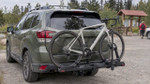
Carbon Frame on a Rack: How to Carry It Without Damage
Posted by Matt Russ on 24th Oct 2026
Carbon Frame on a Rack: How to Carry It Without Damage

You can carry a carbon frame on a car rack safely. The safest choice is a rack that holds the bike by its wheels and never touches the frame: a platform hitch rack, or a roof rack that grips the front wheel or fork. If a rack has to clamp the tubes, you can still use it, but only with the right precautions and a gentle hand on the knobs.
This guide covers which rack types suit carbon, which ones to treat with caution, how to load the bike, and what to check before you drive.
TL;DR
- Wheel-holding platform racks and fork- or wheel-mounted roof racks are the best match for carbon, because nothing clamps the tubes.
- Overtightening is the classic mistake. Carbon handles load along its tubes much better than it handles a squeeze across them.
- Hanging and trunk racks put pressure on the frame. Use them only if the bike’s manufacturer allows it, and keep contact points padded and snug rather than cranked down.
- Check weight limits, exhaust position and your vehicle’s new height before every trip, and drive more gently with a loaded rack.
- Remove lights, computers and loose bags before you drive off, and lock the bike to the rack when you stop.
Table of Contents
- Why carbon needs a different kind of rack
- The four main rack types, ranked for carbon
- If you must clamp a carbon frame
- How to load a carbon bike properly
- Before you drive: vehicle checks
- Our perspective: what we tell riders who ask
- Pack the kit that goes with the rack
- FAQ
- Sources
Why carbon needs a different kind of rack
A carbon frame is built from layers of fiber laid in specific directions. That makes it stiff and light in the ways a rider needs: pedaling, braking and cornering loads run along the tubes. What it does not like is a concentrated squeeze across a thin tube wall. A standard frame clamp does exactly that.

Damage from this kind of pressure is not always visible. A hairline crack or crushed layer can sit under the paint until the next hard ride. That is why the advice from carbon owners is almost always the same: avoid frame contact where you can, and when you can’t, be gentle and consistent.
The Wirecutter rack testers describe how hanging racks need to clamp the frame. They note that padded clamps stabilize the bikes by gripping them, and that this can make owners of carbon-fiber bikes flinch a little. That instinct is sound.
The four main rack types, ranked for carbon
| Rack type | Touches the frame? | Fit for carbon |
|---|---|---|
| Platform hitch rack (wheel-hold arms) | No, if it holds by the wheels | Best choice |
| Roof rack, front wheel or fork mount | No | Excellent |
| Hanging hitch or trunk rack | Yes, top tube and seat tube | Use with caution |
| Roof rack, frame clamp | Yes | Check with the bike maker first |
Platform hitch racks
A platform rack carries the bike on trays. Arms hold the wheels, and nothing grips the tubes. Because they sit at the rear of the car, they are easy to load: you lift the bike only a short way, which also lowers the chance of knocking a frame against the car.
Hitch racks fit square receivers under the rear bumper. Bicycling’s rack testers explain that these are 1-1/4 inch or 2 inch receivers, and that hitch racks are more stable than other types. Check which size your vehicle has before you shop.
Two cautions apply even with a platform rack:
- Some wheel-arm designs include a hook or arm that rests on the top of the front tire. That is fine. Be careful only if an arm swings down near the downtube or fork crown, and pad it if it can touch the paint.
- Bikes loaded side by side can rub. Put the heaviest bike closest to the car and keep handlebars, pedals and derailleurs from touching the next bike. Foam sleeves or a spare cloth between contact points help.
Weight matters too. Heavier e-bikes need a rack rated for them, and your hitch has its own tongue-weight limit. We cover how to check that in our guide to testing your hitch rack weight limit with a bathroom scale.
Roof racks that hold the wheel or fork
Many roof carriers grip the bike by the front wheel or the fork instead of the frame. That keeps carbon tubes out of the equation. A roof test from Rosenberry Rooms notes that wheel-based roof racks tend to carry around 44 to 45 pounds, which suits most non-electric road, gravel and mountain bikes.
Fork-mount carriers are a separate case. As the reviewers at Trail Addicts point out, many roof carriers are less suitable for carbon bikes, and a design that mounts on the front fork axle rather than the frame changes that. The trade-off is that you remove the front wheel, which then needs somewhere to travel inside the car.
Roof racks have a few other things to watch:
- Height. A bike on the roof raises your vehicle well past its normal height. Garages, drive-through lanes and low parking structures become hazards. Many riders leave a note on the dash or the mirror as a reminder.
- Lifting. Putting a bike on a roof takes technique, and a dropped bike is a bigger risk to carbon than any clamp. Practice in the driveway first.
- Aero drag and noise. Expect more wind noise and lower fuel economy than with a rear rack.
Hanging and trunk racks
Hanging racks hold the bike by the top tube. Trunk racks use straps and hooks on the car’s hatch or trunk lid, often with frame-contact cradles. Both put pressure on carbon tubes that were never designed for it.
The cheap trunk-strap approach brings more problems: swaying, bike-to-bike contact and paint scratches on the car. If a rack like this is your only option, treat it as a short-trip solution and follow the steps below.
Step-through, sloping or very small frames also need extra thought. Hanging racks expect a level top tube, so an adapter bar that creates a temporary one is usually required. Check the weight limit of the adapter, and never use one that the rack maker does not support.
If you must clamp a carbon frame
Sometimes the rack you have is the rack you’ve got. These steps lower the risk:
- Ask the bike manufacturer first. Some brands publish guidance on racks and clamps. Some void warranties for clamp damage. A quick email or call to the brand tells you where you stand.
- Clamp the right tube. Where a rack has to grip, the seatpost (a metal post, not carbon, if you have one) or a section of the frame the maker approves is safer than a thin top tube or downtube.
- Use a proper frame protector. A purpose-made carbon adapter spreads the clamp load over a bigger area with a soft liner. It only fits racks designed for it, usually ones with torque-limiting knobs.
- Snug, not tight. Tighten until the bike no longer shifts when you push it, then stop. Reaching for “one more turn” is where most damage starts.
- Pad the contact points. Foam pipe insulation on hooks and cradles helps with scuffing, but it does not make a crushing clamp safe. Padding is not a substitute for lower clamp force.
- Inspect afterward. Wipe the frame down and look at each clamp point in good light. A tap with a fingernail can reveal a dull spot or a hollow sound.
How to load a carbon bike properly
Good loading habits matter as much as rack choice.
- Clean the contact points. Grit under a strap or arm acts like sandpaper on paint and carbon.
- Remove what can come off. Take off your bike computer, lights, saddle bag, bottles and any frame-mounted bag. Loose items fly off at highway speed, and mounts can crack under vibration.
- Secure the wheels. Wheel straps should be snug but not tight enough to deform a deep-section carbon rim. Keep straps off brake tracks.
- Control the cranks. Point the drive-side crank away from the car and the other bike, and use a strap to stop it spinning against the frame.
- Mind the disc rotors. Keep fingers and straps away from rotors. Contact can contaminate pads and hurt braking.
- Do the shake test. Grab the saddle and handlebars and push firmly. The bike and rack should move as one. If the bike rocks inside the rack, tighten the wheel straps. Do not squeeze the frame harder.
If you carry bikes on a rack for a lot of trips, a separate bike bags and rack range can help you pack the rest of your kit in the car rather than on the bike.
Before you drive: vehicle checks
The rack is only part of the system. Rack makers consistently point out that driving behavior has to change once a rack is loaded: lower speeds, longer following distances and more room for braking, because the car handles differently and catches more wind.
Here is a short pre-trip list:
- Exhaust. Check where your tailpipe sits relative to the tires. Hot exhaust gas can damage rubber and carbon, and some vehicles, especially trucks and some SUVs, need a spacer or a different rack position.
- Lights and plates. A rear-mounted rack can block your license plate or taillights. Check local rules and add a light board if needed.
- Backing up. Backup cameras and parking sensors may not account for the rack’s length. Reverse slowly and get out to look.
- Hatch access. Platform racks that tilt or swing away make trunk access easier. Otherwise, unload first.
- Weight. Add up the weight of the bikes and the rack, then compare it with the rack’s and the vehicle’s ratings.
A quick two-minute check of the bike itself is also worth doing before you set off. A pre-ride checklist covering the ABC and M checks works well at the trailhead, and it doubles as a way to spot anything that shifted on the drive.
We also suggest locking the bike to the rack at every stop. A rack that is secure on the car is not the same as a bike that is secure on the rack. Our guide on locking a bike to a rack that stays put walks through what to inspect first.
Our perspective: what we tell riders who ask
We sell performance gear to riders who spend real money on their bikes, so a question about carbon and racks comes up all the time. Our answer is simple: buy the rack for the bike you have, not the bike you had when you bought the rack.
If you own one carbon bike and drive to rides often, a wheel-holding platform rack is the investment that pays off most. Having no clamp pressure on the frame means one fewer thing to think about. That peace of mind is worth more than the saving from a cheaper hanging rack.
If you travel less, or share a car with a partner who rides an aluminum bike, a roof rack that holds the bike by the wheel or fork can work well. Just plan for the height, and treat the garage entry like a hazard.

If you already own a clamp-style rack, you are not forced to throw it out. Contact the bike’s maker, use a proper protector where the rack allows it, and tighten only until the bike stops moving. We have seen far more problems from overtightening than from the clamp itself.
Whatever you choose, bring the tools and the basics with you. A flat or a loose bolt at the trailhead is easier to fix with a pump, a spare tube and a multi-tool in the trunk than without them.
— Coach Matt
Pack the kit that goes with the rack
Once the bike is secure, the rest of the trip comes down to the gear in the trunk. At Sport Factory Pro Shop we curate performance cycling products from trusted brands, and a few categories are especially useful for rack days:
- Pumps and inflation systems, including floor pumps for the trailhead and mini pumps for the ride.
- Tires, from road to gravel and mountain, if your bike needs fresh rubber after a long trip.
- Bike lights, because a drive home after dusk often means a ride that ends in the dark.
If you are still deciding on a rack, browse our bike racks for cars and trucks. And when the bike is home, our bicycle storage solutions help you keep the frame off the floor and away from knocks.
FAQ
Can I put a carbon bike on a trunk rack?
It is possible, but it is the option with the most risk. Trunk racks use straps and cradles that press on the frame, and the bike can sway as you drive. If you use one, check with the bike’s manufacturer, keep the straps snug rather than tight, and pad every contact point. For regular trips, a platform or wheel-mount rack is a better long-term choice.
Are hitch racks safe for carbon frames?
Platform hitch racks that hold the bike by its wheels are among the safest options, since the frame is not touched. Hanging hitch racks that grip the top tube are a different story. Choose a platform design, then check that the rack and your hitch can handle the weight of your bikes.
Is a roof rack better than a hitch rack for carbon?
Neither is automatically better. A roof rack that holds the front wheel or fork keeps the frame untouched and keeps the back of the car clear, but it adds height and needs more lifting. A platform hitch rack is easier to load and has no frame contact, but needs a receiver. Pick the one that fits your car and your habits.
Do I need an adapter for a step-through or sloping frame?
On a hanging rack, usually yes. These racks need a level top tube, so an adapter bar creates one. Check that the adapter’s weight limit covers your bike. A platform rack avoids the issue because it holds the wheels, not the frame.
What is the most common mistake with carbon and racks?
Overtightening. Carbon tubes are strong along their length but vulnerable to squeezing from the side. Tighten only until the bike stops moving, never more, and look over the clamp points after each trip.
Sources
- Best Bike Racks for Cars, SUVs & Trucks, Bicycling
- The 7 Best Bike Racks & Carriers for Cars and Trucks, Wirecutter
- 8 Best Roof Mounted Bike Racks, Rosenberry Rooms
- Roof bike carrier review, Trail Addicts