

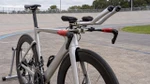
Aero Bar Tilt: How Much Angle Is Right for You
Posted by Matt Russ on 20th Oct 2026
Aero Bar Tilt: How Much Angle Is Right for You

Most riders should start with their aero extensions close to level, then tilt them up in small steps, a few degrees at a time, until they can hold the position comfortably for the full length of their event. There is no single correct number. Today’s pros often run far more tilt than riders did a decade ago, but the best angle for you is the one that lets you stay down, breathe, steer and keep producing power.
This guide explains what aero bar tilt is, why more tilt has become popular, what the UCI rulebook allows, and how to test your own angle on the trainer and the road.
TL;DR
- Aero bar tilt is the upward angle of your extensions relative to flat. Raising the tips changes where your hands, forearms, shoulders and head sit.
- Pro positions have moved toward an “up and out” style, and Slowtwitch reports 10 to 20 degrees of added tilt in that approach. It is a starting point to test, not a target.
- The UCI has raised the maximum forearm support inclination from 15 to 30 degrees for road time trials.
- Change one thing at a time, ride each setting long enough to judge it, and keep your torque specs and pad placement in order.
Table of Contents
- What aero bar tilt actually means
- Why riders are running more tilt than they used to
- What tilt changes on the bike
- What the UCI allows
- How to find your angle: a step-by-step test
- Aero bar tilt for triathletes versus road time trialists
- Common mistakes with aero bar tilt
- Our perspective on tilt
- Bars that make tilt adjustment easier
- FAQ
- Sources
What aero bar tilt actually means
Tilt describes how far the front of your extensions points up compared with a level line. Zero degrees means the extensions run parallel to the ground. Ten degrees means the tips sit noticeably higher than the elbow pads.
The word gets used for two slightly different things, and mixing them up causes confusion on forums:
- Extension tilt: the angle of the bars you hold, which sets your hand and wrist position.
- Forearm support (pad) angle: the angle of the surface your arms rest on. This is the figure the UCI regulates.
On many setups the two are linked, because the whole extension assembly rotates in the clamp on the base bar. On others, the pads and the extensions can be adjusted separately. Check your own system before you start turning bolts. Our aerobar fit guide walks through bench setup and torque to spec so you do not damage carbon while experimenting.
Why riders are running more tilt than they used to
For years the advice was simple: get low and flat. In recent seasons, many top triathletes and time trialists have moved to a different idea. Slowtwitch describes an “up and out” philosophy that raises the front end by roughly 40 to 60 mm and extends reach by roughly 60 to 100 mm compared with older, flatter positions. Adding 10 to 20 degrees of tilt, the same report says, supports the upper body, relaxes the shoulders and creates room for the head.
The logic holds up from a physiology point of view. Slowtwitch also notes that a closed hip angle, which can come from bars that are too low or reach that is too long, can restrict the top of the pedal stroke. A position that costs you power can erase what it saves in drag.
Research points the same way. A 2024 paper in Sports Engineering argues that individual aerodynamic and physiological data are both needed to optimize time trial performance, because one size does not fit all. In plain terms, the most aerodynamic position is no use if you cannot breathe in it or keep coming out of it.
The prize for getting in the aero position at all is large. One conference study from Northern Michigan University measured about a 17.4% smaller frontal projection area in an aero position than on the brake hoods, against an 8.1% drop in peak power output. Tilt is a fine-tuning tool inside that bigger decision.

What tilt changes on the bike
When you raise the tips of the extensions, several things move at once.
Forearms and elbows
A slight upward angle tends to level the tops of the forearms, which is part of why riders describe tilted setups as more natural. If your forearms keep sliding forward on the pads, a bit of tilt can help hold you in place. Pad placement matters just as much, though, so check our six pad placement checks before blaming the angle.
Hands and wrists
More tilt brings your hands into a more neutral, handshake-style grip. Very flat extensions force the wrists to bend, which gets tiring on long rides. Too much tilt can push your hands into an awkward, reaching position and make the bar feel like a lever.

Shoulders and head
A higher hand position props up your upper body a little, and many riders find they can carry their head in a quieter, more stable spot. That is the “pocket” described in the pro-position reporting above. Whether it also lowers your drag depends on your build and flexibility. Not every body responds the same way.
Control and handling
Opinion across rider communities leans toward this trade-off: higher hands feel more relaxed, while flatter extensions give a sense of more control. Treat that as anecdotal rather than settled, and test it on a quiet road with real braking and cornering, not only on a trainer.

What the UCI allows
If you race UCI-sanctioned time trials, the rulebook caps your setup. Under the regulations that the UCI says took effect on 1 January 2023, the maximum inclination of the forearm support was increased from 15 to 30 degrees. The stated aim is to give riders more stability and to let different body sizes find a sustainable position.
The same update ties extension length and height to rider height:
| Rider height | Max horizontal distance, bottom bracket to extension end | Height difference, forearm support to highest point of extension |
|---|---|---|
| Under 180 cm | 80 cm | Less than 10 cm |
| 180 to 189.9 cm | See UCI page | See UCI page |
| 190 cm or taller | 85 cm | 14 cm |
The height limit matters for tilt. A steeper extension raises the tip relative to the pads, so you can reach the limit faster than you expect. Confirm the figures for your category on the UCI page, and check the rules of your own event, since USA Cycling events, local time trial series and triathlons can apply their own equipment rules. Always measure before race day, not in the start chute.
How to find your angle: a step-by-step test
Use this process on a trainer first, then confirm outside. Keep a notebook or phone note.
- Fix the basics. Set pad stack, pad reach and pad width before you touch tilt. Our guides on aerobar stack height and aero bar width explain why common rules of thumb are not your target.
- Start near level. Set the extensions at or near zero degrees. Use a digital level or a phone level app on the extension and record the number.
- Ride 20 to 30 minutes at race effort. Note neck, shoulder, wrist and lower back sensations, plus breathing and how often you pop up.
- Add 3 to 5 degrees. Change only the tilt. Torque the clamp to the manufacturer’s spec.
- Repeat the same test. Same duration, same power target, same time of day if you can.
- Compare. If you feel more stable and your power or heart rate holds, you are heading in the right direction. If your hands feel like they are climbing away from you, back off.
- Confirm on the road. Ride the setup on a route with turns, a headwind and a descent. Check that you can reach the brakes and shifters quickly and that the bike still tracks.
- Consider a wind tunnel or field test. If you want drag numbers, use a track, velodrome or aerodynamic testing session rather than guessing. The effect varies by rider.
A useful rule: if you cannot hold a position for the whole event, it is the wrong position, whatever the numbers claim. Our piece on tri cockpit setup and holdability covers that trade-off in more depth.
Aero bar tilt for triathletes versus road time trialists
The context changes the answer.
- Time trial (UCI-governed): you are inside the forearm angle and extension limits. Your tilt choice interacts with your reach and drop limits, so measure all of them together.
- Triathlon: you also have to run afterward, so a position that keeps your hips open and your breathing free is worth more than a few grams of drag. Our guide to increasing comfort in the aerobars for triathlon goes into this, and the aerobar selection guide helps match bars to race distance.
- Road cyclists and long-distance riders: a clip-on bar for gran fondos or ultra events leans toward comfort. Moderate tilt that you can hold for hours generally beats an aggressive angle you can hold for twenty minutes.
If you want to read more on why comfort has to come with the speed, this German-language guide on adjusting an e-bike for comfort and performance makes the same general point about setup for a different type of bike.
Common mistakes with aero bar tilt
- Copying a pro’s angle. Their flexibility, power, bike and event are not yours. Treat the pro figure as a place to start testing.
- Changing several variables at once. If you adjust tilt, reach and pad width in one session, you will not know what helped.
- Ignoring wrist angle. If your wrists hurt after 30 minutes, the tilt, the grip shape or the extension length is off.
- Over-torquing the clamp. Carbon extensions and bars can be damaged by too much clamp force. Use a torque wrench and the number printed on the part, and use carbon assembly paste where the manufacturer calls for it.
- Forgetting the rest of the cockpit. Bottle position, helmet and clothing all add or remove drag. Our post on aero bottle placement and our helmet aerodynamics versus cooling article are good next reads.
- Skipping the road test. A trainer cannot tell you how the bike feels in a crosswind.
Our perspective on tilt
We sell aerobar systems, and we hear the same question from riders again and again: “How steep should I go?” Our answer is that tilt is a comfort and holdability tool first, and an aero tool second. A rider who can stay relaxed in a slightly higher position will usually spend more of the race actually in it.
We also steer riders away from chasing a single trend number. A steep angle that works for a pro with years of position work may leave a newer rider with sore wrists and a bike that feels twitchy. Start modest, change one thing at a time, and let your own data decide. Pick bars with adjustability built in, so you can move through a range of angles without buying new parts.
The best setups we see are boring in the right way: the rider sits down, settles in, and forgets about the position.
— Coach Matt
Bars that make tilt adjustment easier
If your current extensions only offer a couple of fixed angles, testing is slow and frustrating. Browse our handlebars and aerobars to compare systems with adjustable extension angle, pad options and clamp designs. If you are also upgrading the rest of your kit, our bike components category covers pedals and more, and our team curates products from brands chosen for engineering quality and rider-focused features.
FAQ
What angle should aero bars be?
There is no single angle. Many riders start near level and add a few degrees at a time, and pro positions reported by Slowtwitch often involve 10 to 20 degrees of added tilt. Choose the angle you can hold comfortably for your whole event. If you race under UCI rules, stay within the 30 degree forearm support limit.
How high should I raise my aerobars?
Raise them until you can breathe freely, keep your hips open and hold the position without constant adjustments. Pad stack and extension height are interlinked, so adjust one change at a time. If you race UCI events, the allowed height difference between the forearm support and the highest point of the extension depends on your height category.
How much faster do aerobars make you?
The gain depends on the rider, but the potential is big. One university conference study found an aero position cut frontal projection area by about 17.4% compared with riding on the brake hoods. That came with a smaller loss in peak power, so the position has to be sustainable to pay off.
Does more tilt always make me more aerodynamic?
No. Wind tunnel results differ between riders, and some riders find extra tilt lowers drag while others do not. Comfort affects how long you hold the position, which affects your real-world speed. Test your own setup rather than assuming a trend applies to you.
Sources
- Aero Evolution: Kona Pro Bike Positions, Slowtwitch
- UCI Regulations for road cycling: changes for time trials, UCI
- Individual aerodynamic and physiological data are critical to optimise cycling time trial performance: one size does not fit all, Sports Engineering
- Power output, muscle activity, and frontal area of a cyclist in different cycling positions, Northern Michigan University