

Treadmill vs. Outdoor Running: Benefits, Differences, and How to Train Effectively
Many runners have a love-hate relationship with the treadmill. Running indoors lacks the fresh air, changing scenery, and social interaction that make outdoor running enjoyable. For some athletes, the treadmill is simply something to endure when the weather prevents them from training outside.
However, dismissing treadmill running as an inferior substitute for outdoor training overlooks its considerable benefits.
When used properly, a treadmill can be an effective tool for improving running economy, developing aerobic endurance, performing controlled interval workouts, and building strength through incline training.
It also provides a consistent training environment that can be particularly valuable for runners working on pacing, technique, or returning from certain injuries.
The key is understanding how treadmill running differs from outdoor running and when each training environment offers the greatest advantage.
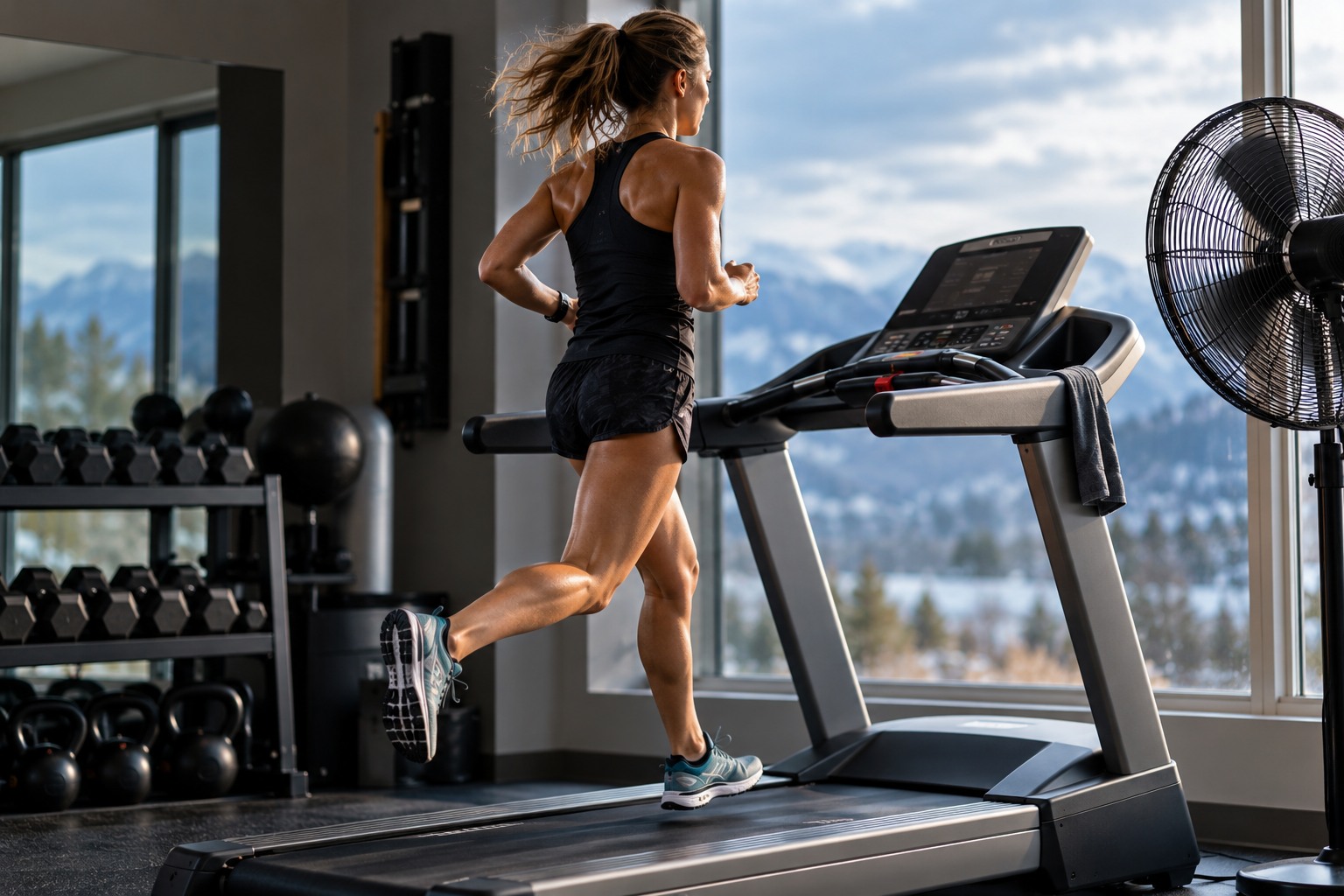
Choosing the Right Treadmill for Serious Running
Not all treadmills are created equal.
For runners who train frequently, treadmill construction, motor quality, running surface, and durability are important considerations.
Many commercial-grade treadmills offer more substantial frames, powerful motors, larger rollers, and sophisticated deck-cushioning systems compared with entry-level home models.
These features can contribute to a smoother running experience and greater durability under repeated use.
If you consider yourself a lifelong runner, I recommend investing in a quality treadmill rather than choosing a model primarily for its entertainment features.
In some cases, a refurbished commercial treadmill may be a better investment than a similarly priced new consumer model.
Important Treadmill Features to Consider
Running deck length: I generally recommend a running surface of at least 60 inches for taller runners or athletes performing faster workouts. Shorter runners may be comfortable on smaller decks, depending on their stride length.
Motor and drive system: Look for a motor designed for sustained running rather than occasional walking. Motor quality, cooling, and manufacturer support are more important than advertised peak horsepower alone.
Deck cushioning: A quality cushioning system can improve comfort and alter loading compared with some outdoor surfaces. However, cushioning varies considerably between models, and softer does not automatically mean better for every runner.
Frame stability: The treadmill should remain stable during faster running without excessive vibration or movement.
Maintenance requirements: Consider belt lubrication, deck replacement, service availability, and warranty coverage. Some commercial machines use low-maintenance belt and deck systems.
Controls and electronics: Simple, reliable speed and incline controls are often more valuable than elaborate screens and entertainment systems.
For runners purchasing used equipment, I recommend inspecting the belt, deck, motor, rollers, and maintenance history before buying.
A well-maintained commercial treadmill can provide years of reliable service.
Treadmill Running vs. Outdoor Running: What's the Difference?
One of the questions I am frequently asked is whether treadmill running changes running mechanics.
The answer is yes, but generally not as dramatically as some runners believe.
Treadmill and overground running share many fundamental biomechanical characteristics, including posture, limb movement, and the basic mechanics of the running gait.
Research comparing the two environments has identified differences in certain joint movements, muscle activation patterns, and stride characteristics. However, these differences are often relatively small and can vary with running speed, treadmill design, and individual technique.
In my experience analyzing video footage of runners both indoors and outdoors, many of the same mechanical tendencies remain apparent in both environments.
These include:
-
Excessive vertical movement.
-
Shoulder and upper-body rotation.
-
Arm-swing asymmetry.
-
Overstriding.
-
Postural limitations.
-
Differences in left-to-right gait mechanics.
The treadmill therefore provides an excellent controlled environment for observing and addressing running technique.
Should You Set the Treadmill at a 1% Incline?
You may have heard that setting a treadmill at a 1% incline makes indoor running equivalent to outdoor running.
This recommendation originated from research examining the additional energy required to overcome air resistance when running outdoors.
At certain faster running speeds, a 1% treadmill incline can approximate the energetic cost of outdoor running on level ground.
However, a 1% incline is not universally necessary or appropriate for every runner or speed.
At slower speeds, the difference in energy expenditure may be relatively small. Individual biomechanics, treadmill calibration, and environmental conditions also influence the comparison.
For most easy aerobic runs, a 0–1% incline is a reasonable starting point.
Rather than automatically adding an incline to every workout, adjust the grade according to the specific training objective.
Use the Treadmill to Improve Running Form and Economy
One of the treadmill's greatest advantages is its consistency.
Outdoors, runners must continuously adjust to changes in terrain, wind, surface conditions, and elevation.
On a treadmill, the running surface moves at a relatively constant speed, allowing the coach and athlete to focus more closely on movement patterns.
This controlled environment can be particularly useful for running gait analysis.
Identifying Running Asymmetries
When observing an athlete on a treadmill, I look for differences between the left and right sides of the body.
These might include uneven arm swing, differences in foot placement, altered hip movement, or inconsistent stride timing.
Even listening to footfalls can sometimes reveal differences in how an athlete contacts the running surface.
However, footfall sound alone cannot reliably diagnose an injury or determine how much force each leg produces.
Video analysis, combined with a proper assessment when needed, provides a more complete picture.
Improving Running Cadence
The treadmill is also useful for practicing stride rhythm.
A metronome can help runners experiment with cadence while maintaining a constant running speed.
For some athletes, a modest increase in cadence may reduce excessive overstriding or alter loading patterns.
However, there is no single ideal cadence that applies to every runner.
The objective should be to improve individual running mechanics rather than force everyone toward an arbitrary stride rate.
Treadmill Hill Workouts: Build Strength Without Running Downhill
Incline training is one of the most valuable applications of the treadmill.
Finding a long hill with a consistent grade outdoors can be difficult, particularly for athletes living in relatively flat areas.
The treadmill allows runners to select a precise incline and maintain it throughout the workout.
This makes it particularly useful for developing uphill running strength, muscular endurance, and aerobic capacity.
The Advantage of Eliminating Downhill Running
Outdoor hill repeats typically require athletes to run or walk downhill between efforts.
Downhill running places substantial eccentric loading on the quadriceps and can contribute to muscle damage and delayed-onset soreness, particularly when the athlete is unaccustomed to it.
Treadmill hill repeats allow runners to perform uphill efforts without the accompanying downhill running.
This can be useful when the objective is uphill conditioning rather than downhill adaptation.
It may also help certain athletes manage training stress, although uphill running introduces its own demands on the calves, Achilles tendons, and other tissues.
Sample Treadmill Hill Workout
Objective: Develop uphill muscular endurance and aerobic strength.
-
Warm up for 10–15 minutes at an easy pace.
-
Run 5 × 3 minutes at a 4–6% incline.
-
Maintain a controlled, moderately hard effort.
-
Recover for 2–3 minutes between repetitions at an easy pace and lower incline.
-
Cool down for 10 minutes.
The incline, speed, and number of repetitions should be adjusted to the athlete's fitness and training history.
Avoid holding the treadmill handrails during the uphill efforts, as this changes running mechanics and reduces the actual workload.
Treadmill Tempo Runs and Interval Training
Another major advantage of treadmill running is the ability to control speed precisely.
During outdoor tempo runs or intervals, pace can fluctuate because of terrain, wind, fatigue, or inconsistent pacing.
A treadmill allows the athlete to select a target speed and maintain it throughout the effort.
This creates a useful environment for learning what a particular pace feels like.
I have often found that athletes surprise themselves with the speeds they can sustain on a treadmill.
Because the belt maintains the selected speed, the runner must either match the pace or deliberately reduce it.
This can encourage consistency and improve an athlete's awareness of effort.
However, treadmill pace displays are not always perfectly calibrated, so the displayed speed should not automatically be treated as an exact measurement.
Example Treadmill Tempo Workout
Objective: Improve sustained aerobic performance and pacing consistency.
-
Warm up for 10–15 minutes.
-
Run 3 × 8 minutes at a comfortably hard, controlled tempo effort.
-
Recover with 3 minutes of easy running between intervals.
-
Cool down for 10 minutes.
For experienced athletes, a continuous tempo effort may also be appropriate.
The treadmill is particularly useful for this type of workout because the athlete can focus on breathing, posture, and maintaining consistent effort without worrying about terrain changes.
Why I Prefer Outdoor Running for Short Speed Workouts
Although treadmills are excellent for controlled tempo efforts and many interval sessions, I generally prefer the track or a suitable outdoor surface for short, high-speed repetitions.
True speed training often requires rapid acceleration, maximal or near-maximal running mechanics, and substantial recovery between efforts.
These elements can be difficult to reproduce safely on a conventional treadmill.
The time required for a treadmill belt to accelerate or decelerate also makes very short repetitions less practical.
For workouts involving maximal sprints or repetitions shorter than approximately 400 meters, outdoor training is often the better option.
Can Treadmill Running Reduce Injury Risk?
Treadmills are frequently promoted as a lower-impact alternative to outdoor running.
There is some basis for this claim, but the relationship between running surface and injury risk is more complicated than simply comparing hard and soft surfaces.
Many treadmills incorporate cushioning systems that alter the forces experienced during foot contact.
However, runners also adapt their leg stiffness, stride mechanics, and muscle activation to different surfaces.
A softer surface does not necessarily produce a proportionate reduction in tissue loading or guarantee a lower risk of injury.
For athletes managing recurring discomfort, the treadmill's greatest advantage may be the ability to control speed, incline, and workout duration.
This allows training stress to be adjusted more precisely.
Runners returning from injury should follow an individualized progression based on the affected tissue and the guidance of an appropriate healthcare professional.
Don't Overlook Heat and Hydration During Indoor Running
One of the most underestimated challenges of treadmill running is heat management.
When running outdoors, movement through the air helps remove heat from the body through convection and sweat evaporation.
Indoors, that airflow may be greatly reduced.
Even in a relatively cool room, treadmill running can produce substantial heat accumulation without adequate ventilation.
As body temperature rises, heart rate may increase and perceived exertion can become greater despite maintaining the same running pace.
This is why I strongly recommend placing a large fan in front of the treadmill.
Additional ventilation or air conditioning can also improve comfort and performance.
Athletes should begin workouts adequately hydrated and replace fluids according to workout duration, sweat losses, and environmental conditions.
For longer indoor sessions, having a water bottle readily accessible is particularly helpful.
Why Outdoor Running Still Matters
Despite its advantages, treadmill running should not completely replace outdoor training for competitive runners.
Running performance depends partly on adapting to the specific demands of the environment in which an athlete will compete.
Road Racing Requires Surface Adaptation
If you are preparing for a road race, your training should include sufficient outdoor running to become accustomed to pavement, changes in terrain, wind, and real-world pacing.
Treadmill fitness transfers well to outdoor running, but the environments are not identical.
Trail Running Requires Greater Terrain-Specific Skills
Trail racing introduces additional demands that cannot be fully replicated on a treadmill.
Uneven terrain, rocks, roots, turns, and changing grades require continuous adjustments in foot placement and balance.
These conditions challenge lower-leg strength, proprioception, and stability.
Athletes preparing for trail races should regularly train on terrain similar to what they expect to encounter in competition.
Outdoor Running Develops Independent Pacing
The treadmill controls your speed for you.
Outdoors, you must regulate pace independently using internal feedback, breathing, perceived exertion, and other available metrics.
Learning to maintain a consistent effort without relying on a moving belt is an important racing skill.
How Much of Your Running Should Be on a Treadmill?
For many competitive runners, I prefer to use treadmill training as a supplement to outdoor running rather than the exclusive training environment.
As a general coaching guideline, I often recommend that approximately 30–40% or less of training take place on the treadmill when outdoor conditions and individual circumstances permit.
However, this is a practical coaching preference, not a scientifically established maximum.
Some athletes can successfully perform a much greater percentage of their training indoors, particularly during periods of extreme weather or limited outdoor access.
The ideal balance depends on the athlete's goals, injury history, available training environment, and upcoming race demands.
The closer an athlete gets to an important outdoor competition, the more important it becomes to include training that reflects the actual race conditions.
Final Thoughts: The Treadmill Is a Training Tool, Not a Replacement
The treadmill offers several advantages that are difficult to reproduce outdoors.
It provides precise control over speed and incline, a consistent environment for evaluating running mechanics, and the convenience of training regardless of weather or daylight.
It can be particularly effective for tempo running, controlled intervals, hill repeats, and technique work.
However, outdoor running develops additional skills and adaptations that remain important for racing performance.
The most effective approach is to recognize the strengths and limitations of each environment.
Use the treadmill for the workouts it does particularly well, and use outdoor running to develop the specific abilities required for your next race.
A successful training program isn't built around a single piece of equipment. It's built around selecting the right tools to produce the desired adaptations.
Originally published in USA Triathlon
Coach Matt Russ enjoyed a professional coaching career spanning over two decades of working with professional endurance athletes. His athletes have achieved numerous regional, national, international and championship titles under his direction. Matt achieved the highest level of licensing by both USA Triathlon and USA Cycling, and was a licensed USA Track and Field Coach. His accomplishments include being named "Team USA" Coach for the Beijing World Championship. Head Coach and founder of The Sport Factory, a USA Triathlon Certified Performance Center, he has authored many articles on a wide variety of endurance related topics.