

Single vs Dual-Sided Power Meters: Do Cyclists Really Need Left/Right Power Analysis?
Posted by Matt Russ on 11th Mar 2026
With the rise of cycling power meters, riders now have access to more performance data than ever before. From training zones to advanced performance metrics, power data can dramatically improve structured training. But when it comes to choosing between a single-sided power meter and a dual-sided power meter, many cyclists wonder if the additional data is really necessary.
The truth is that not every rider needs left/right power analysis. As a coach and bike fitter, I always recommend purchasing training technology that you will actually use. Data is only valuable if it helps guide your training decisions.
Before investing in a dual-sided cycling power meter, it’s important to understand when the extra information can genuinely improve performance.
Why Data Consistency Matters More Than Absolute Accuracy
One common misconception about cycling power meters is that the most accurate device automatically produces the best training results. In reality, data consistency is far more important than absolute precision.
For example, if one power meter reads 1% lower than another, it is not a problem as long as it consistently reads 1% lower and remains the only device you are using. Consistent readings allow you to track progress, monitor training load, and analyze performance trends over time.
Because of this, many cyclists can train effectively with a single-sided power meter without losing meaningful insight into their performance.
When a Dual-Sided Power Meter Makes Sense
While single-sided power meters work well for most riders, there are two situations where a dual-sided power meter becomes extremely valuable:
-
Improving cycling technique and pedaling mechanics
-
Performing detailed bike fitting and position analysis
Both of these factors can significantly influence cycling performance and efficiency.
Using Left/Right Power Balance to Improve Cycling Technique
Most cyclists rarely analyze their pedaling mechanics. They simply ride. However, subtle adjustments in technique can lead to noticeable improvements in power output.
Small changes in the following areas can improve efficiency:
-
Knee alignment
-
Ankle movement
-
Hip stability
-
Pedaling symmetry
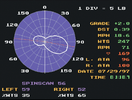
Humans are naturally asymmetrical. Many riders have muscle imbalances, slight leg length differences, or hip alignment issues. These asymmetries often show up clearly in left/right power balance data.
Nearly every cyclist will show some imbalance between legs, but if the difference reaches 5% or greater, it may indicate a mechanical or strength issue worth addressing.
One of the most common issues I see during bike fitting is a knee flaring outward on one side while the other tracks correctly. Ideally, the legs should move like pistons with alignment between the hip, knee, and foot. When a knee moves out of alignment, some of the rider’s power is lost.
Simply placing a cyclist in front of a mirror and working on knee tracking can improve alignment and increase power output from the weaker side.
Left/right power data can also reveal fatigue-related technique breakdown. If power begins dropping on one side during a hard effort or race, it may indicate that the rider is reverting to inefficient pedaling mechanics. Recognizing this in real time can allow the rider to correct their form and maintain stronger output.
How Dual-Sided Power Meters Improve Bike Fitting
Another major advantage of dual-sided power meters is their usefulness in professional bike fitting.
When adjusting a cyclist’s position, two goals guide every decision:
-
Improve leverage and mechanical advantage
-
Increase comfort and sustainability
The femur functions like a lever arm in cycling. When that lever arm is positioned more effectively, the rider can produce greater torque and higher wattage.
A thorough fitting process evaluates each leg independently. If correctable asymmetries exist—such as a leg length discrepancy—left/right power data can help identify them quickly.
Foot mechanics are another important factor. Some riders have varus or valgus foot alignment, which can differ between the left and right side. Addressing these differences individually creates a more stable platform and allows more power to transfer to the crank arms.
The benefit of left/right analysis is that it provides immediate feedback during fit adjustments.
It can also help evaluate equipment changes such as:
-
Saddle height and saddle type
-
Cleat placement
-
Shoe support or insoles
-
Crank length adjustments
Not every position change produces instant results, as riders often need time to adapt. However, revisiting the data after an acclimation period can reveal whether the changes produced meaningful improvements.
In some cases, power data can even provide objective feedback when testing different saddles.
Can Left/Right Power Analysis Help You Ride Faster?
Nearly every cyclist wants to improve performance. When used correctly, left/right power balance data can reveal opportunities for improvement that would otherwise go unnoticed.
In addition to improving power output, dual-sided power data can help:
-
Identify muscle imbalances
-
Detect bike fit issues
-
Reduce the risk of overuse injuries
-
Improve pedaling efficiency
For riders who are serious about optimizing performance or refining their bike position, a dual-sided power meter can be a powerful diagnostic tool.
Should You Buy a Single or Dual-Sided Power Meter?
When choosing between a single-sided and dual-sided power meter, the most important question is simple:
How will you use the data?
If your primary goal is tracking training load and monitoring fitness, a single-sided power meter is often more than sufficient.
However, if you want to analyze pedaling symmetry, refine your bike fit, or correct mechanical inefficiencies, a dual-sided power meter can provide valuable insights that improve performance over time.
Before making the investment, make sure you have a clear plan for how the data will support your training or fitting process.