

Does a Tri Bike Really Make You Faster? Bike Fit Explained
Posted by Coach Matt Russ on 1st Sep 2026
One of the most common misconceptions I encounter is that a triathlon bike is automatically faster than a road bike because it is more aerodynamic. While triathlon bikes are specifically designed to support an aerodynamic riding position, the bike itself does not guarantee a meaningful performance improvement. The real advantage comes from how well the bike allows the rider to position their body.
In cycling, the rider and their equipment account for the vast majority of aerodynamic drag. That means reducing your frontal area and improving your riding position can have a much greater impact on performance than simply purchasing a more expensive or aerodynamic bicycle.
The biggest advantage of a triathlon bike is its ability to help you maintain an efficient, aerodynamic position comfortably and safely.
What Makes a Triathlon Bike Different?
A properly fitted triathlon bike offers several important advantages:
-
Reduced aerodynamic drag: A more compact body position can reduce the amount of air resistance you encounter.
-
A lower torso angle: The frame and cockpit are designed to help riders achieve a more aerodynamic position than they might comfortably maintain on a conventional road bike.
-
Better support in the aero position: Properly fitted aerobars allow you to distribute your weight appropriately and maintain control while riding in your intended position.
-
Improved race-specific efficiency: A well-designed setup can help you sustain an aerodynamic position during the cycling leg of a triathlon without compromising your ability to run afterward.
 However, these advantages depend on the fit. Without the correct setup, a triathlon bike may offer little benefit over a road bike and could even compromise handling or comfort.
Why a Professional Triathlon Bike Fit Matters
In my experience, there is a meaningful difference between a dedicated triathlon shop with expertise in bike fitting and a general bicycle store that happens to sell triathlon bikes.
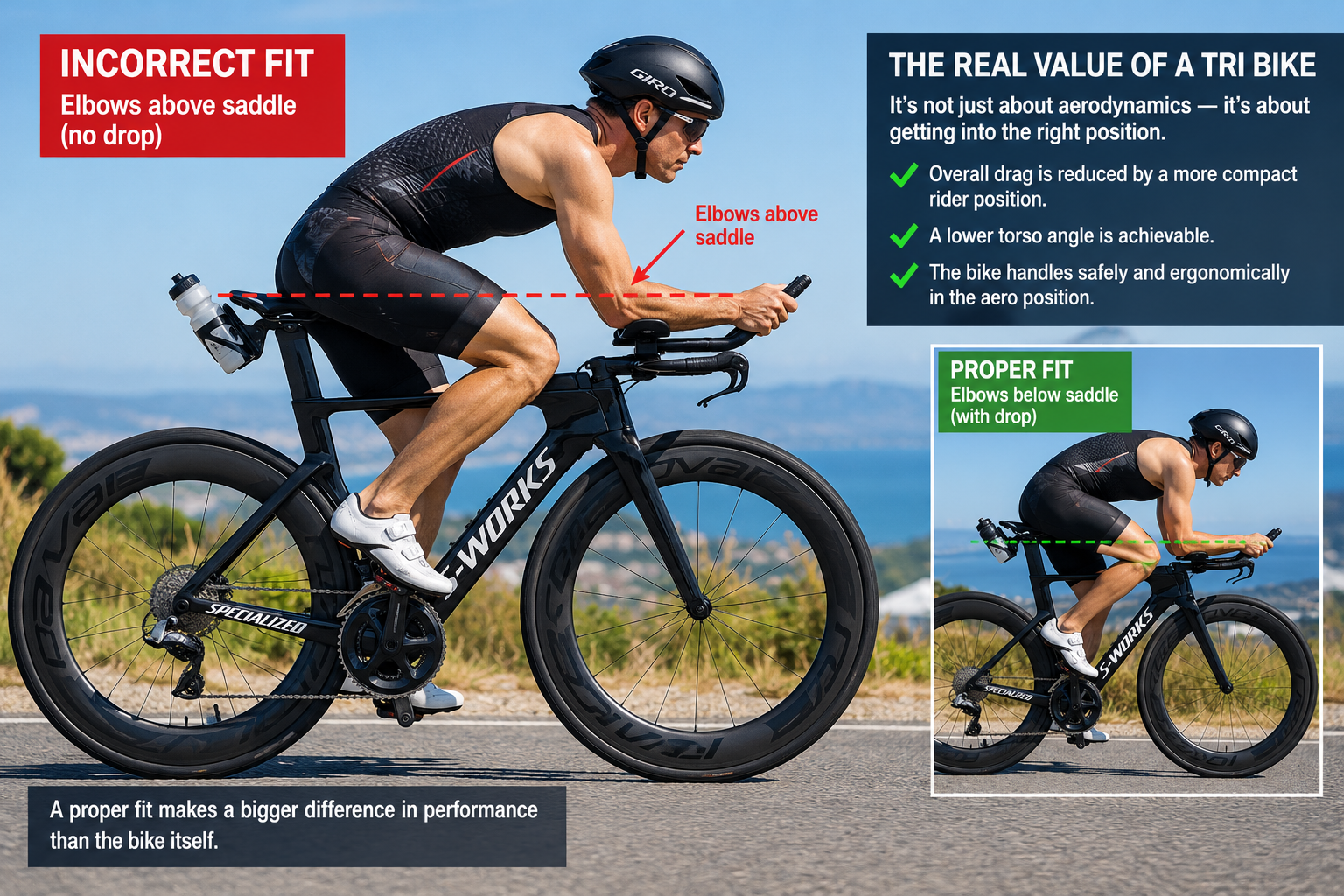
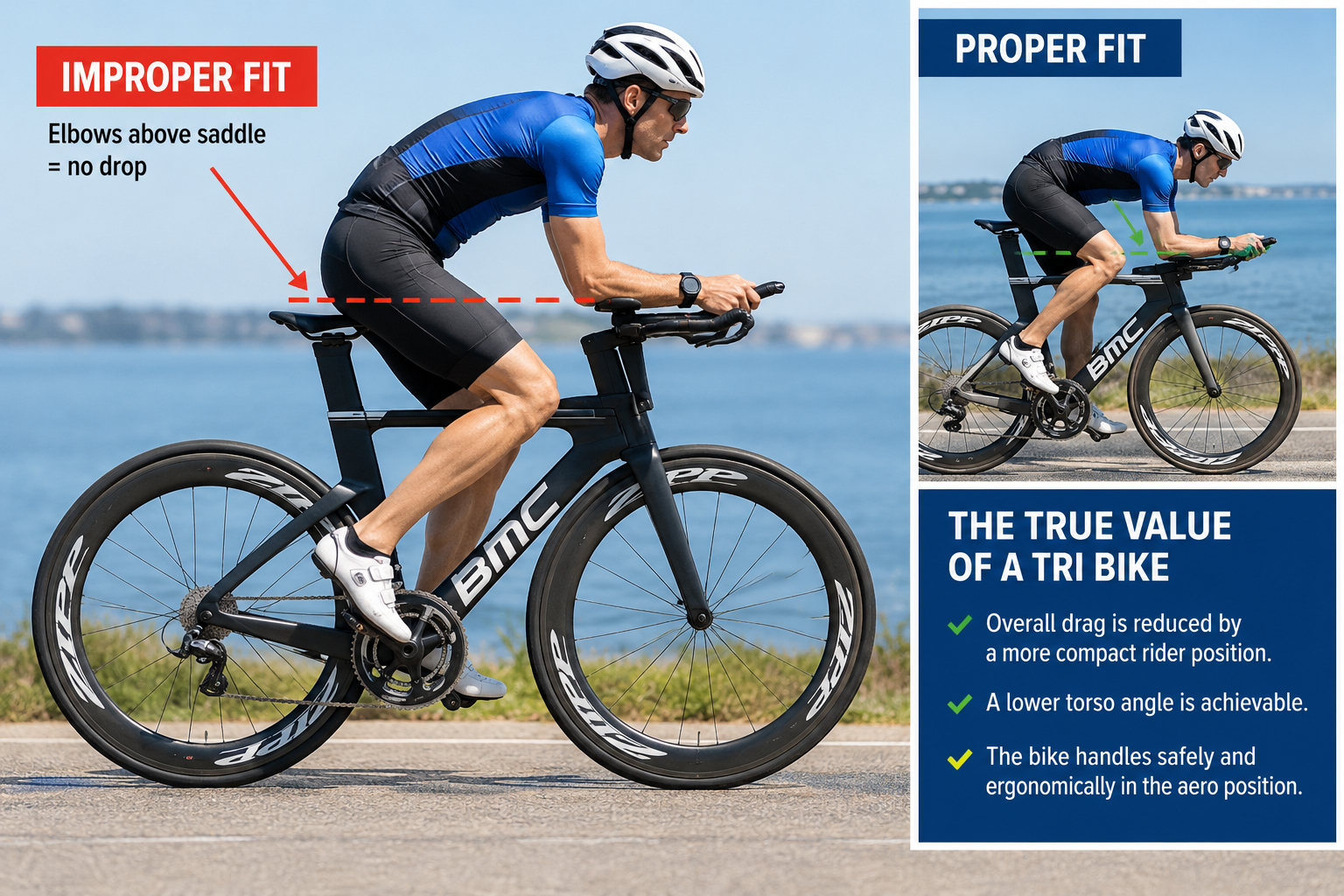
Consider a bike I once evaluated that had been fitted at a store in approximately 30 minutes. One of the measurements I use when evaluating a triathlon position is drop—the vertical distance between the top of the saddle and the aerobar pads.
Drop helps describe the rider's position, although it does not independently determine torso angle or aerodynamic efficiency. In this particular case, the rider's elbows were positioned above the saddle, leaving essentially no drop.
That setup raised an important question: Why spend money on a dedicated triathlon bike if the resulting position prevents you from taking advantage of its primary design benefits?
Depending on the rider and the road bike's setup, the athlete might actually be faster riding in the drops of a conventional road bike than sitting upright on a poorly fitted triathlon bike.
An unsuitable fit can also compromise stability and control in the aerobars. The solution is not simply to lower the handlebars as far as possible. The bike must be adjusted to accommodate the rider's mobility, strength, flexibility, proportions, and ability to control the bicycle safely.
Comfort, Aerodynamics, and Power: Finding the Right Balance
A more upright riding position can be comfortable, particularly for athletes with limited flexibility or a history of back or neck problems. But comfort alone does not determine whether a position is appropriate for racing.
The goal is to find the best balance among three factors:
-
Aerodynamics: Can you reduce your frontal area and maintain an efficient position?
-
Power production: Can you pedal effectively without compromising leverage or creating excessive muscular strain?
-
Comfort and control: Can you sustain the position for the duration of your race while maintaining safe handling?
An aggressive position that you cannot maintain is unlikely to deliver its intended benefits. Likewise, a comfortable position that is unnecessarily upright may leave significant aerodynamic gains unrealized.
Athletes with lower-back injuries, degenerative disc conditions, cervical nerve impingement, or other physical limitations may need a more upright position. These situations call for individualized assessment rather than a one-size-fits-all fitting formula.
Should You Use Clip-On Aerobars Before Buying a Triathlon Bike?
Before making the jump from a road bike to a dedicated triathlon bike, I generally like athletes to become comfortable riding in the drops of their road bikes for much of their time on flatter terrain, when conditions permit. This can help them become accustomed to a lower torso position.
Clip-on aerobars can also provide an affordable way to explore an aerodynamic position before committing to a new bike. However, they are not a universal solution. A road bike's geometry may limit how well it accommodates aerobars, and adding them can affect handling and weight distribution.
If you install clip-on aerobars, make sure the setup is appropriate for your frame, professionally assessed when necessary, and safe to control. Do not assume that every road bike can be converted into an effective triathlon bike simply by adding aerobars.
For athletes whose primary objective is performance, I prefer a gradual fitting process. Lowering the front end in small increments, often a few centimeters at a time when appropriate, can give the body an opportunity to adapt. Each adjustment should be evaluated for comfort, power, breathing, and control rather than made solely to achieve a lower position.
Is a Professional Bike Fit Worth the Money?
Absolutely, particularly when you consider the potential return on investment.
The athlete on the bike I evaluated had spent several hundred dollars on a fit. Although the initial setup was far from ideal, investing in a knowledgeable fitting could provide a greater performance benefit than upgrading the entire drivetrain, buying a $3,000 wheelset, or purchasing a $5,000 bicycle.
The exact gains vary by rider, equipment, course, and starting position, but the principle is straightforward: expensive equipment cannot compensate for a position that prevents you from using it effectively.
A proper triathlon bike fit can help you identify opportunities to improve aerodynamics, sustain power, and remain comfortable throughout the race. It can also help prevent you from spending money on upgrades that do not address your actual limitations.
The Bottom Line: Fit First, Equipment Second
If you have upgraded to a triathlon bike but have not realized an appreciable improvement in performance, do not give up on the bike just yet.
Remember that a triathlon bike is designed to facilitate a position that may help you go faster. The bicycle itself does not automatically deliver that performance gain.
Before investing in more equipment, have your position evaluated by an experienced bike fitter who understands the specific demands of triathlon. The right combination of aerodynamics, power, comfort, and control may be the most valuable upgrade you can make.
See also...
If you are considering clip-on aerobars, see our guide to selecting aerobars for your triathlon distance.Your foot position is another important part of bike fit. Learn more about how cleat rotation can help address cycling knee pain.Still deciding whether to buy a dedicated triathlon bike? Explore our guide to choosing a bicycle for triathlon. Before making major changes to your riding position, read our guide to getting more aerodynamic on your triathlon or time-trial bike. Before making major changes to your riding position, read our guide to getting more aerodynamic on your triathlon or time-trial bike.
Matt Russ enjoyed a professional coaching career spanning over two decades of working with professional endurance athletes. His athletes have achieved numerous regional, national, international and championship titles under his direction. Matt achieved the highest level of licensing by both USA Triathlon and USA Cycling, and was a licensed USA Track and Field Coach. His accomplishments include being named "Team USA" Coach for the 2011 Beijing World Championship. Head Coach and founder of The Sport Factory, a USA Triathlon Certified Performance Center, he has authored many articles on a wide variety of endurance related topics.