

Bike Fitting 101: How Cleat Rotation Can Reduce Knee Pain
By Coach Matt Russ
Knee pain is one of the most common problems I encounter during a professional bike fit. While there are many possible causes, one of the first places I look is the foot-to-pedal interface, and more specifically, cleat rotational adjustment.
Your cleat position may look like a small detail, but it can have a significant effect on knee alignment, pedaling efficiency, comfort, and injury risk. Unfortunately, many cyclists ride with their cleats installed in a generic “neutral” position that may have little to do with their individual biomechanics.
Why Cleat Rotation Matters
The foot/pedal interface has five primary adjustment components:
- Rotational adjustment
- Fore/aft position
- Medial/lateral position (stance width)
- Wedges for foot biomechanics
- Shims for leg-length discrepancies
In this article, I want to focus on rotational cleat adjustment because it is one of the most frequently overlooked aspects of a bike fit.
If you have ever had a bike shop install new cleats while you waited, you may have been told they would set them to “neutral.” In many cases, that simply means positioning the cleat somewhere near the middle of its available adjustment range.
That may be convenient, but neutral does not necessarily mean biomechanically correct.
Every cyclist has a unique combination of hip structure, leg alignment, foot position, arch height, and natural walking gait. Your cleat position should accommodate those characteristics rather than forcing your body into an arbitrary position.
Your Cycling Position Should Match Your Natural Biomechanics
Consider two cyclists: one is a 240-pound linebacker and the other is a 90-pound ballerina. Standing next to each other, they may have dramatically different body structures and biomechanics, yet traditionally their pedals may provide only a few millimeters of difference in stance width.
They are essentially being asked to use the same pedal spindle length and a very limited range of cleat adjustment.
That is a problem.
Stance width, or Q factor, determines how far apart your feet sit on the pedals. Ideally, the pedal system should allow the feet, knees, and hips to line up naturally.
Speedplay was one of the first pedal systems to address this issue to a significant degree, offering multiple pedal spindle lengths and greater cleat adjustment. This allowed bike fitters to select a spindle length that better matched an individual rider's anatomy.
Several pedal manufacturers now offer multiple spindle-length options.
From a fitter's perspective, the more adjustment range we have, the more effectively we can accommodate cyclists who fall outside the relatively narrow definition of “average.”
It's similar to bicycle frame sizing: producing more sizes costs more, while producing fewer sizes is more economical. The same principle applies to pedals.
When choosing pedals, consider your body size, bicycle frame size, and individual biomechanics—not simply the pedal's weight or appearance.
Start Your Bike Fit by Looking at How You Walk
One of my favorite ways to begin a bike fit is surprisingly simple: I watch the rider walk toward me and away from me.
Walking provides valuable clues about natural biomechanics.
I look for things such as:
- Does the rider walk pigeon-toed or with the feet turned outward?
- Does one foot naturally rotate farther outward than the other?
- Is one hip higher than the other?
- Are the feet flat or highly arched?
- Are the hips relatively wide or narrow?
- Is there an obvious asymmetry between the left and right sides?
These observations help establish a starting point for cleat positioning.
When adjusting cleat rotation, my goal is not to force the rider's foot into a predetermined position. I want the cleat to accommodate the rider's natural position.
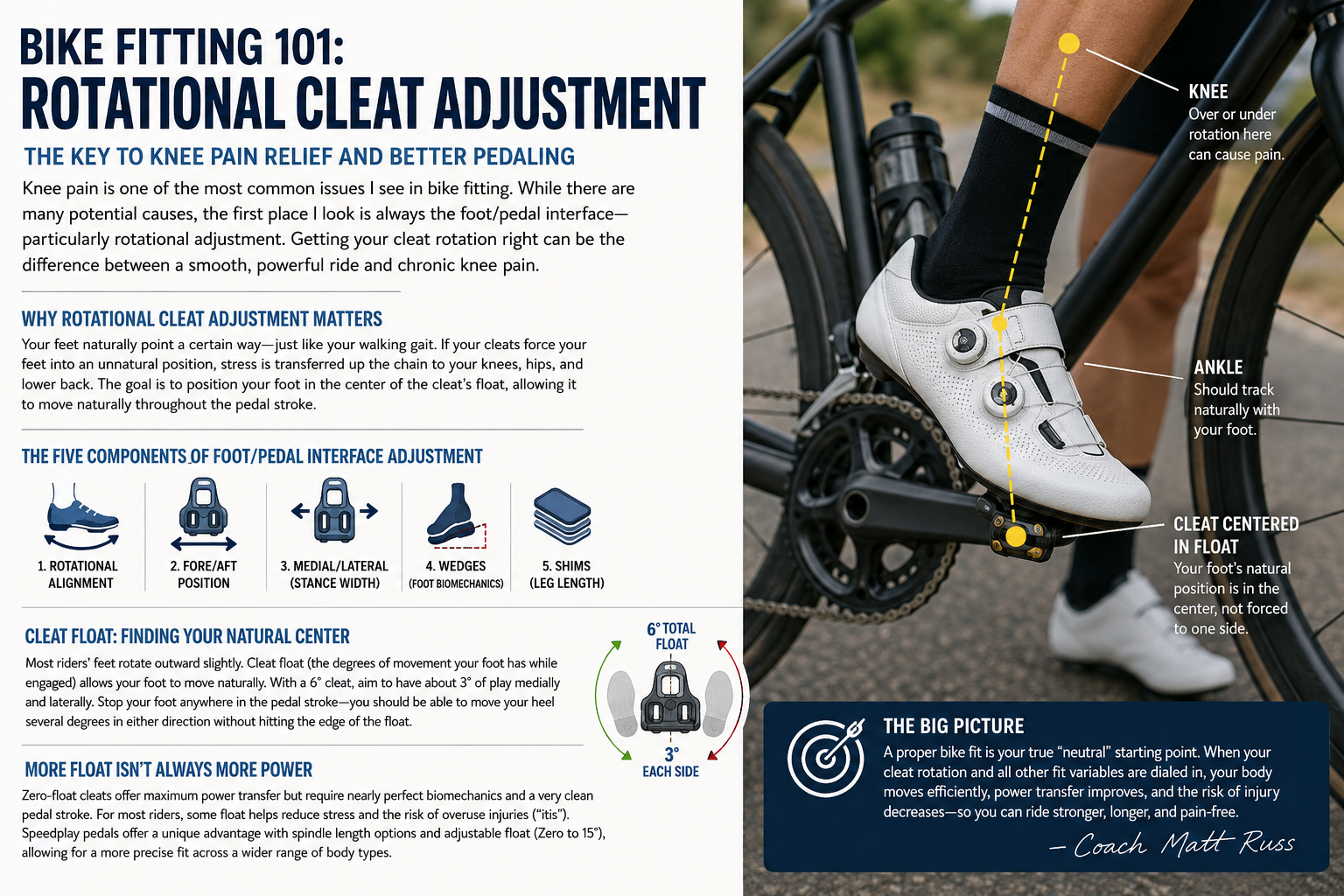
What Is Bicycle Cleat Float?
Cleat float is the amount of rotational movement your foot can make while it is clipped into the pedal.
For example, a cleat with approximately 6 degrees of total float provides roughly 3 degrees of movement in each direction from the center position.
Ideally, the rider's natural foot position should fall near the center of that available float.
In other words, if your foot naturally wants to rotate slightly outward, the cleat should be positioned so that your foot can settle naturally into that position without immediately reaching the end of its available movement.
This can be difficult to measure precisely.
One technique I use is to stop the rider's foot at different points during the pedal stroke and observe how freely the heel can move in either direction. If the rider can move several degrees in either direction without immediately reaching the limit of the cleat's float, we have a good indication that the foot is not being forced into position.
I also ask the rider a simple question:
“Does your foot feel like it is being forced or held in this position?”
It should feel natural.
Zero-Float Cleats: More Power Isn't Always Better
Most cycling cleats are available with two or three different levels of float, ranging from relatively free movement to zero float, or a fixed position.
Zero-float cleats are the most demanding because the cleat rotation needs to match the rider's biomechanics extremely well.
There is no room for the foot to make small adjustments during the pedal stroke.
For that reason, I generally don't recommend zero-float cleats for most riders. The human body isn't static while pedaling. There is considerable movement occurring throughout the ankle, knee, hip, and foot during every pedal revolution.
For example, the tibia undergoes subtle rotational movement during the pedal stroke. Restricting natural movement can potentially transfer additional stress to other structures, including the knee.
Cyclists with highly variable biomechanics or a less consistent pedal stroke may benefit from having more float available.
Some pedal systems take a different approach. Speedplay's X-series pedals historically allowed virtually unlimited float, while the Zero series provides adjustable float, allowing riders and fitters to fine-tune the amount of movement.
A fixed cleat position may provide a very direct connection between the rider and pedal, and some riders believe it improves power transfer. However, more restriction is not automatically better. The potential benefits have to be weighed against the rider's biomechanics and tolerance for restricted movement.
Don't Ignore the Other Bike-Fit Adjustments
Rotational cleat adjustment is only one piece of the puzzle.
I find that a rider's foot will naturally try to move toward the position it prefers. My job isn't to fight that movement. Instead, I want to determine why the foot is moving and address the underlying problem.
Properly addressing:
- Varus and valgus alignment
- Leg-length discrepancies
- Stance width
- Fore/aft cleat position
- Saddle height
- Saddle fore/aft position
- Foot support
can eliminate much of the unwanted movement or “slop” in the pedal stroke.
Once those variables are properly addressed, we can begin working on pedaling technique and form.
Your Pedal Stroke Can Reveal a Poor Bike Fit
The body will often compensate for an improperly fitted bicycle.
For example, a saddle that is too low can cause the knees to flare outward during the pedal stroke. Over time, the rider may develop a characteristic “knees-out” pedaling style.
A bike fit can correct the position that contributed to the problem, but changing a movement pattern that has been developed over thousands of pedal strokes may take additional time.
Another common issue is excessive ankle movement, sometimes referred to as “ankling.” Excessive extension and flexion at the ankle can be associated with an improperly fitted bicycle, including an overly high saddle position.
The goal isn't simply to make the rider look symmetrical. The goal is to create a position where the body can produce power efficiently without constantly compensating for the equipment.
A Proper Bike Fit Is Your True Neutral Position
I often think of a professional bike fit as establishing the rider's true neutral position.
Once the saddle, cleats, stance width, foot support, and other fit variables are properly aligned, the rider has a much better foundation for developing an efficient pedal stroke.
The benefits can include:
- Better knee alignment
- Improved pedaling efficiency
- More effective power transfer
- Less unnecessary movement
- Greater comfort
- Reduced biomechanical stress
- A more consistent pedal stroke
But a bike fit isn't necessarily the end of the process.
It is the starting point.
Once you have ridden several hundred miles in a new position, your body may reveal additional adjustments that are worth making. Small refinements can then be made based on how you actually ride rather than how you look on a stationary bike.
The best bike fit is not about forcing every cyclist into the same “perfect” position. It's about creating a position that works with the individual rider's anatomy and natural biomechanics.
When it comes to cleat rotation, the same principle applies: don't force your feet to fit the pedals. Adjust the pedals and bicycle to work with your body.
Matt Russ enjoyed a professional coaching career spanning over two decades of working with professional endurance athletes. His athletes have achieved numerous regional, national, international and championship titles under his direction. Matt achieved the highest level of licensing by both USA Triathlon and USA Cycling, and was a licensed USA Track and Field Coach. His accomplishments include being named "Team USA" Coach for the 2011 Beijing World Championship. Head Coach and founder of The Sport Factory, a USA Triathlon Certified Performance Center, he has authored many articles on a wide variety of endurance related topics.