

XDR Fit Checks for Mechanics: 1.85 mm Spacer Rule
Posted by Matt Russ on 8th Sep 2026
XDR Fit Checks for Mechanics: 1.85 mm Spacer Rule
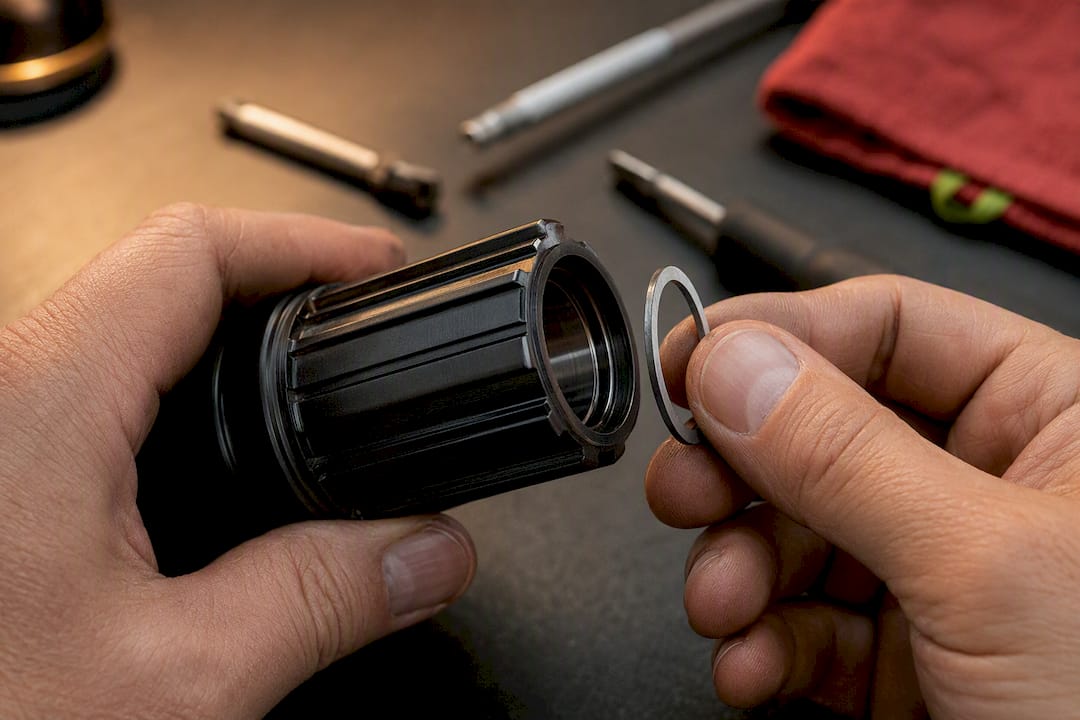
XDR is SRAM’s road driver body standard, built to accept road cassettes with a 10-tooth low-end cog. The compatibility verdict is simple: XDR cassettes only fit XDR driver bodies, while XD cassettes fit XDR too, as long as you add a 1.85 mm spacer. Before you tighten anything down, confirm spline engagement sits between 7 and 8 mm using the correct lockring tool.
TL;DR:
- XDR compatibility requires confirming the driver body has a 1.85 mm longer interface than XD and that a spacer is used when fitting XD cassettes onto XDR bodies.
- Proper spline engagement between 7 and 8 mm is crucial to prevent stripping and ensure reliable installation of XDR and XD cassettes.
- Verifying driver body type involves checking manufacturer specifications, stamped markings, or measuring the offset with a caliper, especially on older wheels.
- Using the wrong lockring tool or neglecting to install the spacer can cause fitment issues, creaking, or damage to the driver body.
- XDR suits modern SRAM road and gravel cassettes, but driver bodies are not interchangeable across different standards like XD Slim or Shimano, which require specific parts.
Table of Contents
- What Is XDR and How Does It Differ From XD and XD Slim?
- Which Cassettes Fit Which Driver Bodies?
- How Do You Confirm an XDR Driver Body Before You Buy?
- Installation Checklist: Tools, Spline Depth, and Torque
- Should You Replace the Driver Body, the Wheelset, or the Cassette?
- Do XDR Driver Bodies Work Across Different Frames and Hubs?
- Best Practices for Installing and Maintaining an XDR Driver Body
- What Causes Most XDR Fitment Problems?
- How Does XDR Compare to Other Driver Body Standards?
- An Honest Read on Where XDR Confusion Actually Comes From
- Get the Right Driver Body, Spacer, or Cassette Without the Guesswork
- Where to Verify Exact XDR Specifications
- Sources
What Is XDR and How Does It Differ From XD and XD Slim?
XDR measures exactly 1.85 mm longer than XD at the driver interface. SRAM built that extra length specifically for road cassettes that needed room for an 11-speed or 12-speed cog range starting at a 10-tooth small cog, without changing hub spacing or axle standards already common on road wheelsets. The SRAM technical documentation frames the split as a road versus mountain distinction: XD launched first for mountain bike cassettes, XDR came later once road groupsets adopted the same 10-tooth-start philosophy.
The practical benefits show up on the bench, not in a spec sheet. A properly seated XDR interface resists the fretting and cassette creep that plagued splined freehubs before the 10-tooth cog era, and the driver body itself tends to hold up better under repeated cassette swaps because the spline engagement is deeper. Weight differences between XD and XDR bodies are minor, a few grams at most, so nobody should chase one standard over the other for that reason alone.
The naming causes real confusion at the shop counter. XD, XDR, and XD Slim sound like variations on a theme, but they are three distinct interfaces with different lengths and, in the case of XD Slim, a different intended use case for smaller-diameter mountain hubs. Compatibility comes down to matching the cassette’s actual driver requirement to the hub’s actual driver body, never assuming a shared prefix means a shared fit.
Which Cassettes Fit Which Driver Bodies?
The rules governing SRAM’s road cassette lineup are consistent enough to memorize, and doing so saves a return trip to the parts bin mid build. According to SRAM’s cassette compatibility guidance, the fitment logic breaks down cleanly:
- XD cassette on an XD driver body: direct fit, no spacer needed.
- XD cassette on an XDR driver body: fits with a 1.85 mm spacer installed between the cassette and the driver body shoulder.
- XDR cassette on an XDR driver body: direct fit, no spacer, and no workaround exists to fit an XDR cassette onto a plain XD body.
- XD Slim cassette: requires an XD Slim compatible driver body specifically; it is not interchangeable with standard XD or XDR parts.
Model codes are the fastest way to confirm which category a cassette falls into, since box labeling and the code stamped on the cassette itself will indicate the driver standard. A code like CS-XS-797S signals an XD Slim part, and SRAM’s road compatibility map lists model-by-model driver assignments for current road cassettes, including notes on where the spacer applies. That map is worth bookmarking rather than memorizing, since SRAM updates it as new cassette ranges ship.
How Do You Confirm an XDR Driver Body Before You Buy?
A wheelset in front of you rarely comes with a label that says “XDR” in plain sight, so confirming the driver body takes a short bench check rather than a guess. Work through these steps before you order a cassette:
- Check the hub or wheel manufacturer’s spec sheet for the driver body designation. Most publish it under freehub or driver body compatibility.
- Look for stamped markings on the driver body itself. SRAM driver bodies sometimes carry a small “XD” or “XDR” imprint near the base, though wear can obscure it on older hubs.
- Measure the offset if markings are missing or unreadable. A 1.85 mm difference is small but measurable with a caliper against a known XD or XDR reference part.
- Cross-check the cassette’s model code against SRAM’s compatibility map to see whether that specific cassette is XDR-only or spacer-compatible.
- Contact the hub manufacturer directly when documentation is thin, particularly on older or lower-volume wheelsets where the driver body standard was never clearly marked at the point of sale.
Skipping this check is how riders end up with a cassette that looks seated but sits 1.85 mm proud of where it should, which throws off shifting before the first ride even starts.
Installation Checklist: Tools, Spline Depth, and Torque
Installing an XD or XDR cassette does not require exotic tools, but it does require the right ones. You will need a lockring tool rated for XD/XDR interfaces (not a standard Shimano-style splined tool), a torque wrench, the 1.85 mm spacer if you are fitting an XD cassette to an XDR body, and any hub-specific driver tool the wheel manufacturer calls for.
Spline engagement is the detail that separates a clean install from a stripped lockring. SRAM specifies engagement between 7 and 8 mm for the lockring or locktube to fully seat, and that number is not a suggestion. A tool that engages shallower than 7 mm can slip under torque, rounding out the splines on both the tool and the cassette.
Work through the install in this order:
- Slide the spacer on first if fitting XD to XDR, seating it flush against the driver body shoulder.
- Set the cassette cogs onto the splines and confirm they drop into place without forcing.
- Thread the lockring by hand until it stops turning freely.
- Measure spline engagement before applying torque, not after.
- Torque to the manufacturer’s spec in one smooth pull rather than pulsing the wrench.
Pro Tip: Keep a dedicated XD/XDR lockring tool in your kit separate from your standard cassette tools. Grabbing the wrong tool under time pressure at a race feed zone is exactly how splines get stripped.
Should You Replace the Driver Body, the Wheelset, or the Cassette?
Replacing just the driver body makes sense when the hub itself is otherwise sound and the manufacturer sells that driver body as a serviceable part. Many hub designs, especially from brands with a broad service ecosystem, let you swap from XD to XDR or replace a worn driver body without touching the rest of the wheel. That keeps cost down and avoids re-lacing or re-truing a wheel that still spins true.
Wheelset replacement becomes the right call when the hub is not serviceable, when the axle standard or spacing does not match your frame regardless of driver body, or when the hub shell itself shows wear beyond the driver interface. At that point, buying a driver body for a hub you are about to retire is money spent solving the wrong problem.
Swapping the cassette is the cheapest fix, and it is often the right one. If your existing driver body is XDR and you simply want a different gear range, check the model code against the compatibility map before assuming you need new hardware at all. When in doubt on cost tradeoffs, a wheel manufacturer’s support line or a shop mechanic can usually settle it in a five-minute conversation.
Do XDR Driver Bodies Work Across Different Frames and Hubs?
The driver body standard itself is frame-agnostic. XDR describes the interface between hub and cassette, not the interface between hub and frame, so a hub with an XDR driver body works on any frame that accepts its axle standard and spacing, whether that is a rim brake road frame with quick release dropouts or a disc brake frame built around 12x142 mm thru axles.
Where things get more complicated is the hub side of that equation. Not every hub shell is designed to accept an XDR driver body even from the same manufacturer, since some older or budget hub designs were built around freehub bodies that predate the 10-tooth cog standard entirely. A broad licensed ecosystem of hub manufacturers now produces XDR compatible driver bodies, which means most modern road and gravel hubs can accept one, but “most” is not “all.”
Gravel and cyclocross frames add another layer, since some use the same 12x142 mm rear spacing as road disc frames while others still run 12x148 mm Boost spacing borrowed from mountain bikes. The driver body standard does not care which spacing your frame uses, but your hub does, and mismatching axle spacing has nothing to do with XDR compatibility even though the two issues often get confused at the same time. Confirm axle spacing and driver body standard as two separate checks, not one.
Best Practices for Installing and Maintaining an XDR Driver Body
A driver body lasts longer when it gets cleaned and greased on a schedule rather than only when something feels wrong. Pull the cassette at least once or twice a season, more often if you ride in wet or gritty conditions, and check the splines for the fine metal shavings that signal early wear.
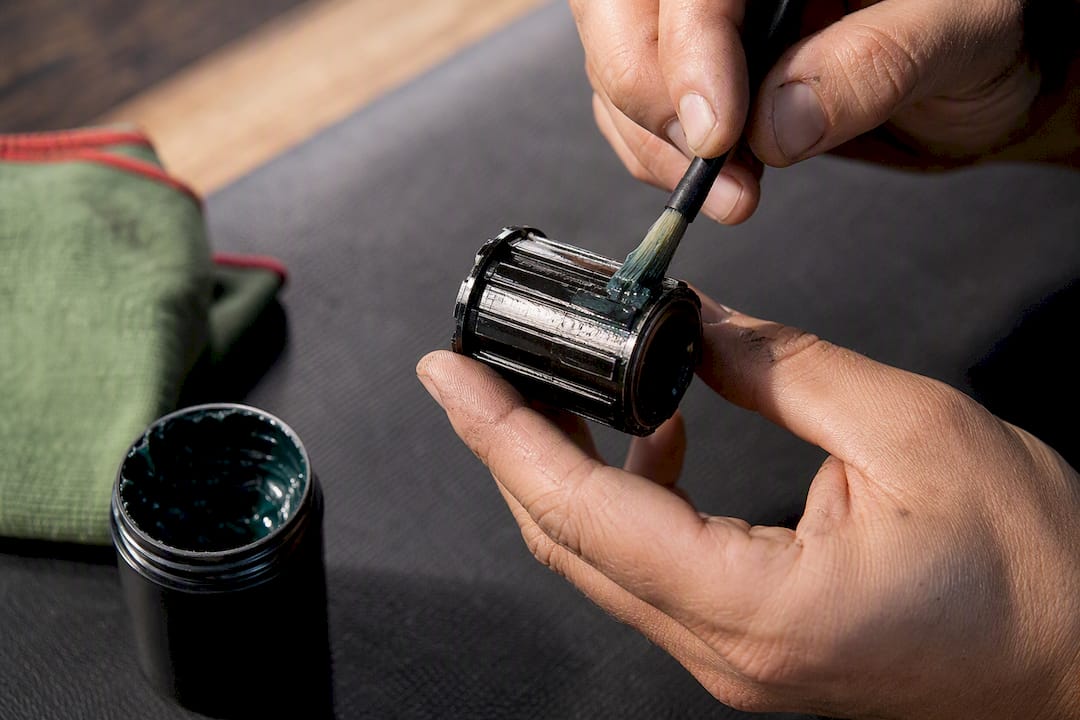
A light coat of grease on the driver body splines before reinstalling the cassette reduces fretting corrosion, which is the slow buildup of oxidation between two metal surfaces under repeated small movements. Aluminum XD/XDR driver bodies are more prone to this than steel ones, since the cassette cogs are typically steel and the driver body is often a softer alloy. That hardness mismatch is normal and expected; SRAM designed the driver body to be the wear item, not the cassette.
Reinstall the cassette with the same attention to spline engagement and torque sequence described earlier every time, not just on the first build. A cassette that gets pulled for cleaning and reinstalled loosely, without rechecking that 7 to 8 mm engagement, is a common source of the creaking and slight play that riders often mistake for a bottom bracket or headset issue. Store spacers somewhere you will not lose them between services. A missing 1.85 mm spacer at the wrong moment turns a five-minute cassette swap into a delayed race morning.
What Causes Most XDR Fitment Problems?
Most reported problems trace back to one of three mistakes, and none of them are exotic. The first is skipping the spacer when mounting an XD cassette on an XDR body, which leaves the cassette sitting slightly proud and throws off derailleur indexing even though the cassette appears seated correctly.
The second is using the wrong lockring tool, one designed for a different spline pattern, and forcing it to engage anyway. This is the fastest way to strip a driver body, and stripped splines usually mean a full driver body replacement rather than a simple fix.
The third is shallow spline engagement from a worn or incorrect tool, which lets the lockring slip under torque even when everything else was done correctly. Measuring spline engagement before applying torque catches this before it becomes a problem, and it takes fifteen seconds with the tool already in hand.
If a cassette that was shifting fine suddenly develops a clicking or grinding noise under load, check for driver body play before assuming it’s a derailleur adjustment issue. Freehub bodies with worn splines allow a small amount of rotational play between the cassette and the hub, which shows up as an inconsistent, hard-to-diagnose noise that mimics a dozen other drivetrain problems.
How Does XDR Compare to Other Driver Body Standards?
XDR sits alongside a handful of other splined driver body standards, each with tradeoffs worth understanding before you commit a wheelset to one ecosystem.
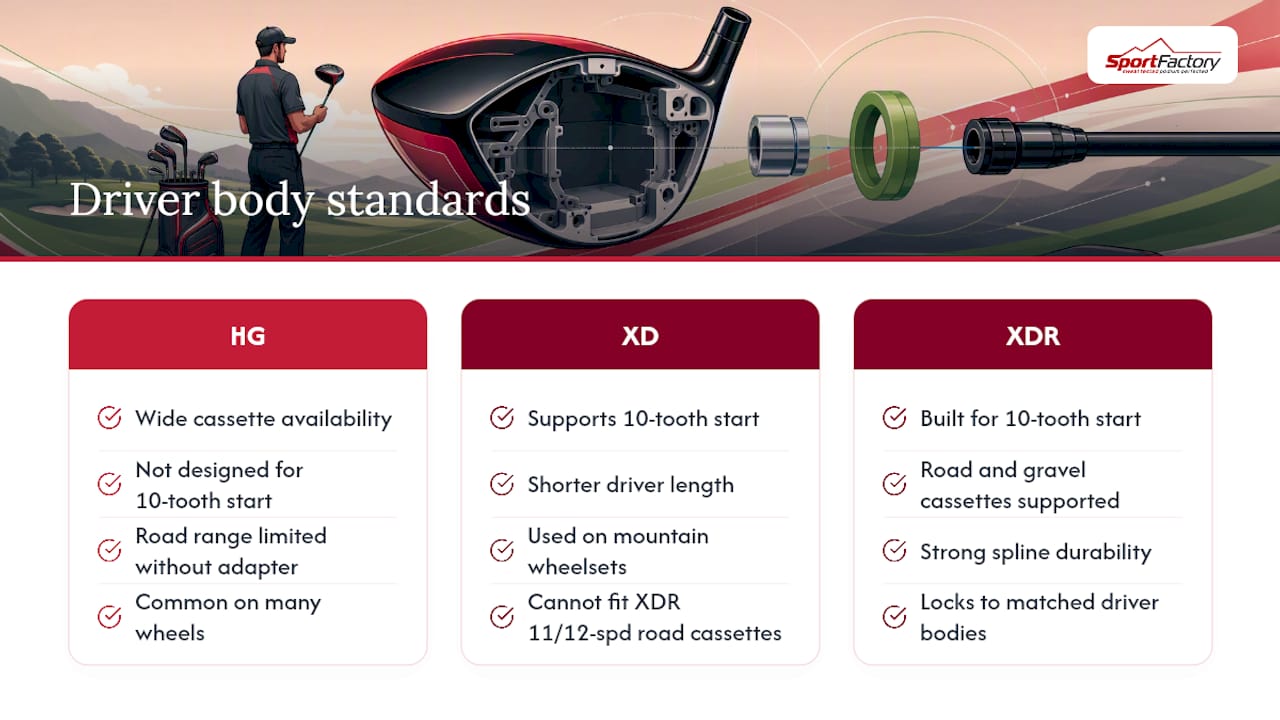
Standard Shimano HG splined freehubs remain common on many wheels and offer wide cassette availability, but they were not designed around a 10-tooth starting cog, which limits how low a gear range they can accept without a specific micro spline adaptation. XD, the predecessor to XDR, still shows up on mountain bike wheelsets and shares the 10-tooth cog philosophy, but its shorter length means it cannot accept the road-specific 11 and 12-speed cassettes built for XDR bodies.
XD Slim narrows the field further, built for smaller-diameter hubs where space is tight, and it demands its own dedicated driver body rather than accepting standard XD or XDR parts. The tradeoff across all of these standards is the same one riders face with any proprietary interface: XDR gives you access to SRAM’s current road and gravel cassette range with strong durability at the spline interface, but it locks you into sourcing driver bodies matched to that specific standard rather than pulling any cassette off a shop shelf. For most competitive road setups running SRAM drivetrains, that tradeoff favors XDR, since the cassette range it unlocks is exactly what modern road groupsets are built around.
An Honest Read on Where XDR Confusion Actually Comes From
The industry treats XDR compatibility like it’s complicated, and it mostly isn’t. The confusion comes from naming, not engineering. XD, XDR, and XD Slim sound like a family of interchangeable parts because they share a prefix, and that naming convention does more damage at the shop counter than any actual mechanical complexity in the standard itself.
Here’s what conventional advice gets wrong: it treats the spacer rule as a footnote when it’s actually the single most useful fact in this entire topic. Once you internalize that XD fits XDR with a 1.85 mm spacer and XDR never fits backward onto XD, ninety percent of the confusion disappears. The remaining ten percent is spline engagement, and that’s a measurement problem, not a knowledge problem. A caliper and a tool built for the right interface solve it in under a minute.
If you take one thing from this guide, let it be this: check the model code before you check anything else. It tells you more than a visual inspection ever will, and it saves you from the return shipping label.
— Matt
Get the Right Driver Body, Spacer, or Cassette Without the Guesswork
Sourcing the correct XDR driver body, spacer, or cassette gets a lot faster when you’re buying from a shop that curates for compatibility instead of just listing parts. A shop that specializes in cycling parts stocks driver body components and cassette-compatible hardware suitable for competitive road and gravel setups, so you’re not cross-referencing spec sheets across multiple manufacturer sites to confirm a fit.

If you’re mid-build and unsure whether your hub takes an XD, XDR, or XD Slim driver body, check the part number stamped on your current cassette or driver body before ordering, then match it against the model your wheel manufacturer lists. A team’s support can help confirm fitment when you provide your wheel and cassette model information, whether you need a 1.85 mm spacer, a replacement driver body, or the correct lockring tool for the job. Head to the Sport Factory Pro Shop storefront to browse compatible parts or reach out with your specific wheel and cassette details before you place an order.
Where to Verify Exact XDR Specifications
For model-level accuracy, consult SRAM’s XD and XDR driver body explainer and the road compatibility map directly, since SRAM updates both as new cassette ranges launch. Your wheelset manufacturer’s own spec page is the final word on whether your specific hub’s driver body is user-serviceable. For a broader look at cassette and wheelset compatibility across setups, The Beam’s gravel rider protection guide covers related fitment basics worth a look.