

Tire Rolling Resistance: Physics, Fuel, and What It Costs You
Tire Rolling Resistance: Physics, Fuel, and What It Costs You
Tire rolling resistance is the energy a vehicle must continuously supply just to keep its tires rolling on a surface. Every rotation deforms the tire slightly, and that deformation dissipates energy as heat rather than returning it as forward motion. The technical measure is the rolling resistance coefficient, or Crr, defined by a straightforward formula: rolling resistance force (in Newtons) equals Crr multiplied by the normal force pressing the tire onto the road. For a 3,000-lb car, even a small Crr difference compounds across thousands of miles into real fuel costs.
According to Consumer Reports, rolling resistance accounts for roughly 4–11% of fuel consumption in passenger vehicles, and a 10% reduction in rolling resistance translates to approximately a 1% improvement in fuel economy. For EV owners, lower Crr directly extends range, which is why most automakers equip hybrids and electric vehicles with low rolling resistance tires from the factory.
Typical Crr ranges to orient your reading:
- Passenger car tires (low-RR / summer performance): roughly 0.007–0.010
- Passenger car tires (all-season): roughly 0.010–0.014
- Winter / snow tires: 0.012–0.016+
- Road bicycle tires: approximately 0.0025–0.005
These ranges are confirmed by industry-standard SAE lab tests (J1269/J2452) and independent sources including Consumer Reports and technical references.
These numbers come from standardized laboratory testing, and understanding what drives them is the first step toward making smarter tire choices.
Table of Contents
- What actually causes tire rolling resistance?
- How rolling resistance is measured and what the numbers mean
- What factors change rolling resistance, and which ones can you control?
- What do you give up when you choose a lower rolling resistance tire?
- How to find and choose lower rolling resistance tires
- How rolling resistance works differently for bicycle tires
- Key Takeaways
- Why rolling resistance matters more than most riders realize
- Sportfactoryproshop carries the tires that make this physics work for you
- Authoritative sources and further reading
What actually causes tire rolling resistance?
The dominant mechanism is hysteresis: the rubber in a tire’s tread and sidewall deforms as it enters the contact patch with the road, then rebounds as it exits. Rubber does not rebound perfectly. A portion of the energy stored during compression is released as heat rather than recovered as elastic energy. That lost heat is rolling resistance. The stiffer and more elastic the compound, the less energy it wastes per deformation cycle.
Hysteresis is not the only contributor, though. Several other mechanisms add to the total:
- Micro-sliding: — At the contact patch edges, tiny lateral slip between rubber and road surface dissipates energy, particularly in tires with aggressive tread patterns.
The practical takeaway is that most of the loss is baked into the tire’s compound and construction. Silica-rich tread compounds, which became widespread after the 1990s, reduce hysteresis at low frequencies compared with older carbon-black formulations, lowering rolling resistance without sacrificing wet-grip performance as severely as earlier low-RR designs did.
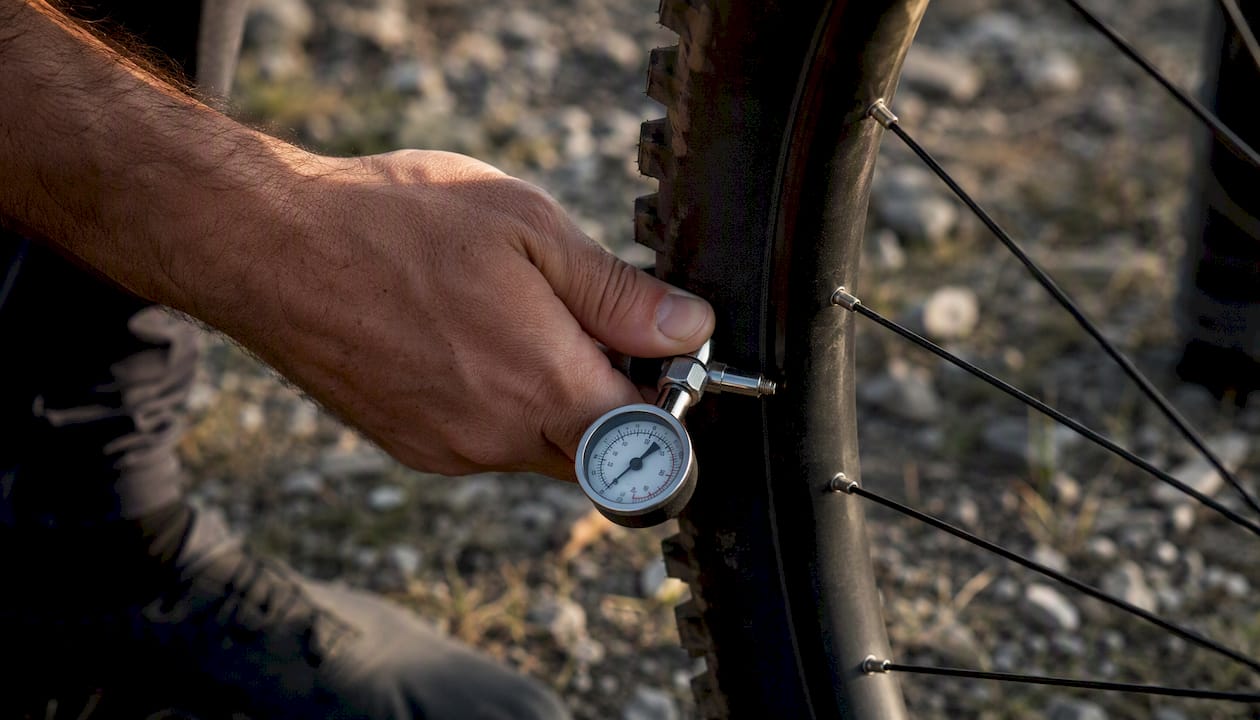
Pro Tip: You cannot change a tire’s compound after purchase, but you can control inflation pressure and alignment — two variables that directly affect how much the contact patch deforms. Both are free to maintain and together account for a meaningful share of avoidable rolling resistance.
How rolling resistance is measured and what the numbers mean
The rolling resistance coefficient (Crr) is dimensionless: it equals the rolling resistance force divided by the normal force on the tire. A Crr of 0.010 means the tire exerts 10 N of drag for every 1,000 N of vertical load.
Laboratory test methods
Two SAE standards dominate industry measurement. SAE J1269 measures energy consumption per unit distance on a rotating drum at a fixed speed, load, and inflation pressure. SAE J2452 extends the model across a matrix of varying loads, pressures, and speeds, producing a more complete picture of how Crr behaves across operating conditions. Both tests are typically run on new tires, which matters when you are comparing lab numbers to what you experience on a worn tire after 20,000 miles.
Coast-down testing offers a real-world complement: a vehicle is accelerated to a set speed, then allowed to decelerate freely on a flat surface. The deceleration rate reflects the combined drag of rolling resistance and aerodynamic forces, which can be separated mathematically.
Test conditions shift results significantly. Lower inflation pressure raises Crr. Higher load raises it. Cold temperatures stiffen rubber and increase hysteresis losses. A tire tested at 72°F on a smooth steel drum will post a lower Crr than the same tire on cold, rough asphalt in January.
Typical Crr ranges by tire type
| Tire type | Typical Crr range | Notes |
|---|---|---|
| Passenger car, low-RR | 0.007–0.010 | Often OEM-spec on EVs and hybrids |
| Passenger car, all-season | 0.010–0.014 | Broad category; wide variation within |
| Winter / snow tire | 0.012–0.016+ | Softer compound for cold-weather grip |
| Road bicycle tire | 0.0025–0.005 | Highly sensitive to casing TPI and pressure |
| Gravel / MTB bicycle tire | 0.005–0.012 | Tread volume and knob height drive the range |
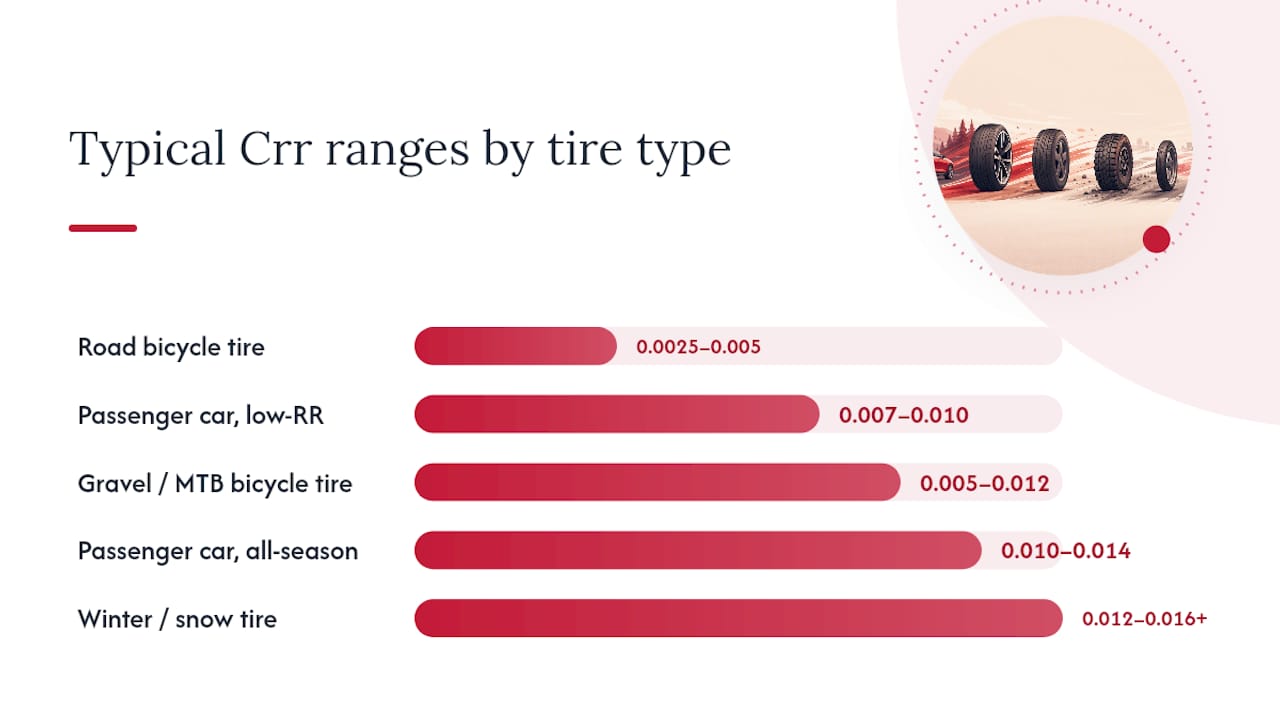
These ranges are aligned with SAE tests and the values provided in industry reports.
The EU tyre label assigns rolling resistance classes (A through E) to passenger and commercial tires based on measured Crr thresholds in N/kN. The United States has no equivalent mandatory consumer label, so U.S. buyers must rely on manufacturer specifications, SAE test reports, and independent testing organizations like Consumer Reports to compare tires.
A 34% difference in rolling resistance between the best and worst all-season tires in Consumer Reports testing translated to approximately 14 gallons of fuel over 12,000 miles — a gap that adds up to real money at the pump over the life of a tire set.
What factors change rolling resistance, and which ones can you control?
Rolling resistance is not a fixed property. It shifts with the tire’s design, how it is maintained, and the conditions it operates in.
Factors built into the tire (harder to change after purchase)
- Casing construction and TPI: — A higher thread-per-inch (high TPI) casing flexes more uniformly and with less energy loss than a stiff, low-TPI casing. This is especially pronounced in bicycle tires.
Factors you can control
- Wheel alignment: — Toe misalignment forces tires to scrub sideways as they roll forward, adding slip-based energy loss on every mile.
Practical maintenance checklist:
What do you give up when you choose a lower rolling resistance tire?
The physics of rubber create a genuine tension. The same hysteresis that wastes energy during rolling also generates the friction that stops your car in wet conditions. A compound engineered to minimize energy loss tends to have less grip at low temperatures and on wet surfaces than a softer, higher-hysteresis compound.
That said, the trade-off is not as stark as it once was. Modern silica-based compounds have narrowed the gap considerably, and Consumer Reports notes that many tires with low rolling resistance still rank in the upper half of their test pool for wet braking and handling. The key is to evaluate tires on both dimensions separately rather than assuming a low-RR label means compromised safety.
| Tire category | Rolling resistance | Wet grip | Tread life |
|---|---|---|---|
| Low-RR / summer performance | Low | Moderate to high | Moderate |
| Standard all-season | Moderate | Moderate | High |
| Winter / snow | High | High (on cold/wet surfaces) | Moderate to low |
The table reflects general tendencies, not universal rules. Individual tire models vary significantly within each category, which is exactly why independent test data matters more than category labels.
Pro Tip: When reading tire test reports, look at the wet-braking distance score as a standalone number, not just the overall score. A tire that ranks third overall but first in wet braking may be a better choice for a rainy-climate driver than one that leads on rolling resistance alone.
How to find and choose lower rolling resistance tires
Shopping for low-RR tires in the U.S. requires more legwork than in Europe, where the EU tyre label provides a standardized A–E rolling resistance class on every new tire sold. American consumers have no equivalent mandatory label, so the process relies on a combination of manufacturer data and independent testing.
What to look for in specs and test reports:
- Manufacturer-published Crr values (not always available, but worth requesting from dealers).
- SAE J1269 or J2452 test references in product documentation, which confirm the figure comes from a standardized method.
- Independent dynamometer or coast-down test results from organizations like Consumer Reports.
- Whether the test was conducted on a new tire or a worn one — new-tire Crr values can differ from real-world performance after significant mileage.
Questions to ask before buying:
- What test method was used to generate the published Crr figure?
- Was the tire tested at the inflation pressure listed on my vehicle’s door placard?
- What is the wet-braking distance score from independent testing?
- How does rolling resistance change as the tire wears?
Where U.S. consumers can find reliable data:
- Consumer Reports tire ratings (subscription required, but among the most rigorous independent U.S. sources).
- SAE technical papers for OEM and fleet buyers who need detailed test data.
- Manufacturer technical sheets, which sometimes include Crr ranges for fleet or commercial buyers.
Maintenance actions that preserve rolling resistance:
- Inflate to the door placard specification monthly. Cold weather drops pressure roughly 1 PSI for every 10°F drop in temperature.
- Get a wheel alignment check annually or after any hard impact.
- Rotate tires every 5,000–7,500 miles to maintain even wear across all four positions.
- Replace tires when tread depth reaches 2/32 inch or when sidewall cracking appears, since both degrade the contact geometry the tire was designed around.
How rolling resistance works differently for bicycle tires
Bicycle tires operate at much lower Crr values than car tires, and the variables that matter most shift accordingly. Road bike tires typically fall in the 0.0025–0.005 Crr range, with the best supple clinchers and tubeless setups approaching the lower end of that band. Gravel and mountain bike tires run higher, often 0.005–0.012, depending on tread volume and knob height.
For cyclists, the factors that move the needle most are:
- Inflation pressure: — Bicycle tires are extremely sensitive to pressure. Running a road tire 10 PSI below optimal can raise Crr enough to cost several watts at 20 mph.
Independent cycling test methods typically measure power required to maintain a set speed on a calibrated drum or roller, then compare tires directly. BestBikeSplit and similar platforms use these power-at-speed figures to model how tire choice affects race time over a given course. The gains are real: switching from a 60-TPI training tire to a 120-TPI race tire can save several watts, which at sustained effort translates to meaningful time savings over a long ride or triathlon.
Pro Tip: For cyclists, prioritize Crr gains only after confirming that the faster tire meets your puncture protection and wet-grip requirements for the terrain. A tire that saves 3 watts but flats twice per season costs far more time than it saves.
Sportfactoryproshop curates tubeless-ready tires and gravel options specifically selected for the balance between low rolling resistance and real-world durability, so you are not trading speed for reliability.
Key Takeaways
Lower rolling resistance reduces fuel consumption and extends EV range, and the biggest gains come from choosing the right tire compound and maintaining correct inflation pressure.
| Point | Details |
|---|---|
| Crr formula and scale | Rolling resistance force = Crr × normal force; passenger car tires range from 0.007–0.014, bicycle tires from 0.0025–0.005. |
| Biggest controllable factor | Inflation pressure is the most impactful variable you can change; check monthly and before long trips. |
| Fuel and range impact | Rolling resistance accounts for 4–11% of passenger vehicle fuel use; a 10% Crr reduction yields roughly 1% better fuel economy. |
| Safety trade-off | Low-RR tires do not automatically mean poor wet grip; evaluate wet-braking scores independently before buying. |
| Sportfactoryproshop | Curates tubeless-ready and gravel tires selected for low rolling resistance balanced with durability and grip for competitive cyclists. |
Why rolling resistance matters more than most riders realize
There is a common assumption in cycling and driving circles that premium, low-rolling-resistance tires are a marginal upgrade — something that matters only at the elite level. The evidence does not support that view. A 34% spread in rolling resistance between the best and worst all-season tires in Consumer Reports testing is not a marginal difference. It is the kind of gap that shows up in your fuel bill and, for cyclists, in your average speed on every ride.
What tends to get underestimated is the compounding effect of small Crr differences over distance. A cyclist who rides 5,000 miles per year on a tire that is 0.001 Crr worse than the alternative is not losing a few seconds. They are losing watts on every mile, which accumulates into real fatigue and real time. The same logic applies to EV owners who dismiss tire choice as a minor variable when their range anxiety is partly a tire problem.
The other underappreciated point is that the safety trade-off argument, while real, has been largely resolved by modern silica compounds. Buyers who avoid low-RR tires because they assume compromised wet braking are often working from assumptions formed around 1990s tire technology. The right approach is to read the wet-braking score in the same test report, not to assume the worst.
Where the conventional wisdom does hold up: rolling resistance matters far less at highway speeds than most people think, because aerodynamic drag grows with the square of speed and dominates above 50 mph. If you drive mostly highway miles, a roof rack removal will outperform any tire upgrade on fuel economy. But for city drivers, EV owners, and cyclists, Crr is a lever worth pulling.
Sportfactoryproshop carries the tires that make this physics work for you
Knowing your Crr target is one thing. Finding a tire that hits it without sacrificing grip or durability is where most cyclists and drivers get stuck. Sportfactoryproshop takes that work off your plate by curating a selection of high-performance cycling tires, tubeless setups, and maintenance tools specifically chosen for riders who care about both speed and reliability.
The shop stocks electronic repair inflators and precision pressure gauges alongside its tire selection, so you can maintain the inflation accuracy that keeps rolling resistance where it belongs. Every product in the lineup is selected for engineering quality and real-world performance, not just marketing claims. Whether you are building a race-ready road setup or a fast gravel kit, the team at Sportfactoryproshop can point you to options that balance low rolling resistance with the wet-grip and puncture protection your riding demands.
Browse the full selection and find your next tire upgrade at Sportfactoryproshop.
Authoritative sources and further reading
These sources are worth bookmarking if you want to go deeper on rolling resistance measurement, labeling, or cycling-specific data: