

Presta vs Schrader: Which Valve Is Right for Your Bike?
Presta vs Schrader: Which Valve Is Right for Your Bike?
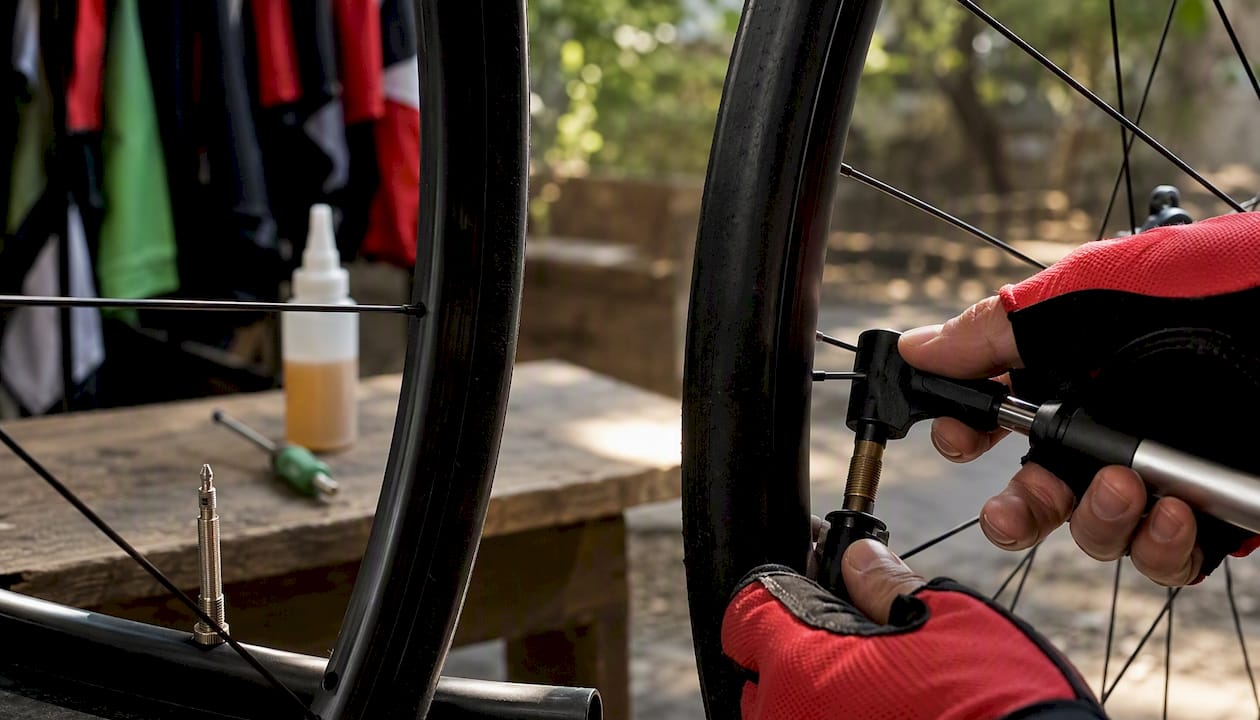
For road, gravel, and tubeless setups, Presta is the right choice. For commuter bikes, kids’ bikes, and any wheel where pump access matters most, Schrader keeps things simple. The decision comes down to two practical facts: Presta valves use a narrower stem that preserves rim strength and suits high-pressure tubeless systems, while Schrader’s wider body works with gas station compressors and most basic floor pumps right out of the box.
Before you go further, check these two things:
- Rim hole size: Measure or look up your rim’s valve hole. A ~6 mm hole means Presta only; a ~8 mm hole accepts Schrader (and Presta with a grommet).
- Pump compatibility: Does your pump have a Presta chuck, a Schrader chuck, or a dual-head? That single detail shapes your daily inflation routine more than anything else.
Key Takeaways
For most road, gravel, and tubeless riders, Presta is the correct valve; Schrader suits commuters, kids’ bikes, and anyone who prioritizes pump compatibility over performance.
| Point | Details |
|---|---|
| Presta for performance builds | Narrower ~6 mm stem suits high-pressure, tubeless, and carbon-rim setups. |
| Schrader for everyday simplicity | Works with gas station compressors and most basic pumps without adapters. |
| Stem length matters | Choose a Presta stem longer than your rim depth for pump access. |
| Don’t modify the rim | Enlarging a Presta hole to Schrader size weakens lightweight and carbon rims. |
| Sportfactoryproshop for the right tools | Dual-head pumps, core tools, extenders, and tubeless valves are stocked for every setup. |
Table of Contents
- What is a Presta valve and how does it work?
- What is a Schrader valve and how does it work?
- How do Presta and Schrader valves compare side by side?
- How to inflate and maintain Presta and Schrader valves
- Which valve should you choose for your bike?
- How to convert or replace valves safely
- Common valve problems and how to fix them fast
- Sportfactoryproshop workshop tips from real-world use
- The valve choice that actually matters most
- Gear that solves valve problems, stocked at Sportfactoryproshop
- Sources
What is a Presta valve and how does it work?
The Presta valve, also called a French valve or Sclaverand valve, is the slender-threaded stem you’ll find on most road bikes, gravel bikes, and tubeless-ready wheels. Its defining feature is a small brass nut at the top of the stem that you unscrew before inflating and tighten back down to seal the valve after.
According to Wikipedia, Presta valves have a diameter noticeably narrower than a Schrader valve. That smaller diameter means the rim hole can be drilled smaller, which is a real structural advantage on narrow aluminum rims and especially on carbon rims where every millimeter of material matters. Stems come in lengths ranging from around 32 mm for shallow rims up to 80 mm or longer for deep aero sections. The general rule: choose a stem at least 10 mm longer than your rim depth so the pump chuck has enough stem to grip.
Key insight: The Presta valve seals through air pressure alone, not a spring. Once inflated, the internal pressure holds the valve closed, and the small top nut acts as a secondary lock. This design handles the high pressures common in road and tubeless setups without leaking.
Many Presta valves, particularly those designed for tubeless use, have removable cores. You unscrew the core with a small valve core tool, inject sealant directly into the tire, then reinstall the core. That feature alone is why tubeless-ready rims almost universally use Presta. On the maintenance side, the thin stem is the valve’s main vulnerability: a sideways knock from a pump chuck or a heavy bag pressing against the stem can bend it, sometimes enough to cause a slow leak or make the valve impossible to open. Handle with care, especially when attaching push-on pump chucks.
What is a Schrader valve and how does it work?
The Schrader valve is the same standard used on car and motorcycle tires, which tells you most of what you need to know about its strengths. It’s wider, spring-loaded, and built for durability over precision.
Inside the Schrader body sits a spring-loaded pin. Pressing that pin depresses the core and releases air; a pump chuck does the same thing automatically when you attach it. No unscrewing, no small nut to lose. That simplicity is genuinely useful for casual riders, parents pumping up kids’ bikes, or anyone who wants to stop at a gas station and use the air compressor on the way to a trail.
Worth knowing: Because Schrader valves are the automotive standard, they are immediately compatible with most service-station compressors and a wide range of floor pumps, as Zéfal’s valve comparison guide confirms. That universal compatibility is the valve’s biggest practical advantage for everyday riders.
The tradeoffs are real, though:
- Larger rim hole: The ~8 mm hole required for a Schrader weakens the rim slightly compared to the smaller Presta hole, which is why premium rims avoid it.
- Spring-loaded core: The spring mechanism is robust but less field-serviceable. If the core fails, replacing the tube is usually the practical fix rather than swapping just the core.
- Heavier and shorter: Schrader stems are typically heavier and shorter than Presta stems, which matters for deep-rim compatibility and weight-conscious builds.
BikeRadar’s valve guide notes that Schrader valves are more common on older and lower-cost bikes, while premium rims favor Presta specifically because of the larger hole requirement.
How do Presta and Schrader valves compare side by side?
The table below covers the dimensions and practical factors that actually affect your choice.
| Feature | Presta | Schrader |
|---|---|---|
| Valve diameter | narrower | wider |
| Rim hole size | smaller (preserves rim strength) | larger (can weaken lightweight rims) |
| Pump / chuck type | Presta-specific or dual-head | Schrader or dual-head; gas station compressors |
| Removable core | Yes, on most models | Rarely; usually replace tube |
| Stem length range | 32 mm to 80 mm+ (matches rim depth) | Generally shorter; limited depth options |
| Tubeless suitability | excellent (removable core for sealant) | limited; fewer tubeless-specific options |
| High-pressure suitability | excellent (seals via air pressure) | adequate for moderate pressures |
| Ease of use | Requires unscrewing nut first | Simpler; attach pump and go |
| Durability / damage risk | Thin stem bends under lateral force | Robust body; spring can wear over time |
| Typical bike types | Road, gravel, cyclocross, tubeless MTB | Commuter, hybrid, kids, budget bikes |
A few practical takeaways from those numbers: the smaller Presta hole is a genuine structural benefit on thin carbon rims, not just a weight-saving detail. Michelin’s valve guide specifically flags that enlarging a Presta rim hole to accept a Schrader weakens lightweight rims and is not recommended. On the pump side, Schrader’s compatibility with compressors is a real convenience win for mixed-fleet riders who don’t always carry a dedicated pump.
One modification to avoid: drilling out a Presta rim hole to Schrader size. On aluminum rims it’s marginal; on carbon, it’s a structural risk that no performance gain justifies.
How to inflate and maintain Presta and Schrader valves
Inflating a Presta valve
- Remove the dust cap and set it somewhere you won’t lose it.
- Unscrew the small brass nut at the top of the stem counterclockwise until it stops (don’t remove it).
- Press the nut down briefly to release a small burst of trapped air. This unseats the valve and confirms it’s working.
- Attach your pump chuck firmly. For a push-on chuck, press straight down the stem axis, not at an angle.
- Inflate to your target pressure, watching the gauge.
- Remove the pump chuck with a straight pull to avoid bending the stem.
- Tighten the brass nut clockwise and replace the dust cap.
Inflating a Schrader valve
- Remove the dust cap.
- Attach your pump chuck. The chuck’s internal pin depresses the valve core automatically.
- Inflate to target pressure.
- Remove the chuck and replace the dust cap.
Tools to carry
A well-prepared rider or shop bench should have: a floor pump with a pressure gauge and a dual-head chuck (handles both valve types), a mini pump or CO₂ inflator for the road, a valve core removal tool, spare Presta cores, a Presta-to-Schrader adapter for emergencies, valve extenders for deep-section rims, and dust caps.
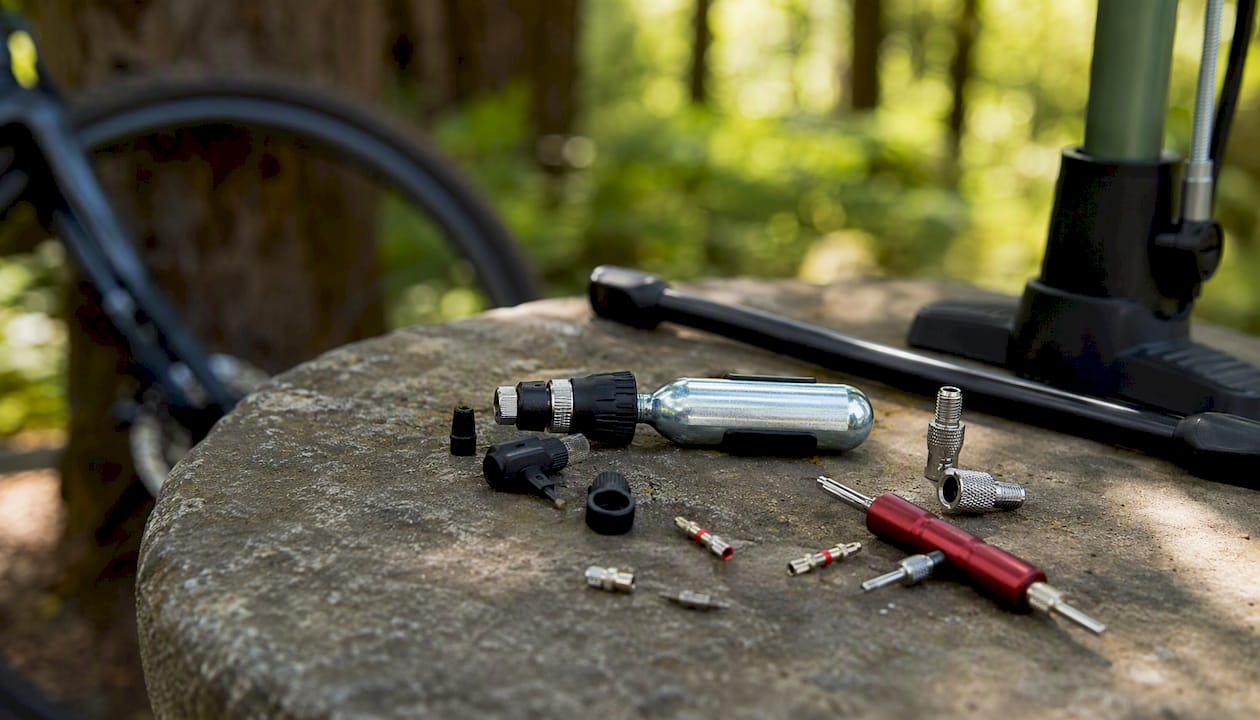
Pro Tip: When attaching a push-on Presta chuck, align it perfectly with the stem axis before pressing down. Any sideways angle puts lateral stress on the thin stem. On deep rims where the stem barely clears the rim bed, use a valve extender rather than forcing the chuck at an awkward angle.
For routine maintenance, check core tightness every few months by hand. On tubeless setups, Canyon’s valve guide recommends removing the Presta core before adding sealant so the liquid flows freely into the tire and the core stays clean. Keep a spare core in your kit; a damaged core is a five-second fix if you have the part.
Which valve should you choose for your bike?
Quick decision checklist
Before settling on a valve type, run through these:
- What size is your rim’s valve hole? (~6 mm = Presta only; ~8 mm = Schrader or Presta with grommet)
- How deep is your rim? Deep rims need longer Presta stems.
- What pressure does your tire run? High PSI road setups favor Presta’s air-pressure seal.
- Are you running tubeless or planning to? Presta with a removable core is the practical standard.
- Who pumps the tires? A casual rider or child benefits from Schrader’s simplicity.
- What pumps are available locally? Schrader works at gas stations; Presta needs a dedicated pump or adapter.
Recommendations by bike type
Road and gravel bikes: Presta, without question. The narrower stem suits the rim profiles, the removable core supports tubeless, and the high-pressure seal is reliable at 80–120 PSI. Canyon’s comparison confirms Presta is the standard on higher-end bikes for exactly these reasons.
Tubeless mountain bike setups: Presta with a removable core. Adding sealant is far cleaner with a core tool than trying to inject through a Schrader body.
Hybrid and commuter bikes: Either works, but Schrader is the lower-friction choice. You can top up at a gas station, the valve is harder to damage, and the slightly heavier weight is irrelevant on a city bike.
Kids’ bikes and budget bikes: Schrader. Simplicity wins here. Parents can use any pump, and the robust body handles rough handling.
Deep-section aero wheels: Presta with a long stem (matched to rim depth plus 10 mm). A valve extender is the alternative if you already have a shorter-stem tube.
Pro Tip: If your current rim and tube already work well, the best valve is the one already on your bike. Switching valve types means replacing the tube or the tubeless valve, and possibly buying a new pump chuck. Only convert when there’s a clear functional reason.
How to convert or replace valves safely
Using a Presta-to-Schrader adapter
A small threaded adapter screws onto the Presta stem and lets you use a Schrader pump or compressor. Installation takes about ten seconds:
- Unscrew the Presta nut fully and remove it.
- Thread the adapter onto the stem until snug.
- Inflate with your Schrader pump.
- Remove the adapter and reinstall the Presta nut.
Valve adapter guides note that adapters can leak slightly if not seated properly and are easy to lose. Treat them as a field convenience, not a permanent setup.
Fitting a valve extender for deep rims
- Use a valve core tool to remove the Presta core.
- Thread the extender onto the exposed valve body.
- Reinstall the core through the extender.
- Inflate normally through the extender’s tip.
Replacing a valve core
If a core leaks or strips, swap it in under a minute: deflate the tire, unscrew the core with a valve core tool, thread in a compatible replacement, and re-inflate. Match the core thread type to your valve body; not all cores are interchangeable across brands.
Safety warnings for rim modification
Do not enlarge a Presta rim hole to accept a Schrader valve on any carbon rim or lightweight aluminum rim. Michelin’s guidance is direct: the larger hole undermines structural integrity in rims where material is already minimal. If you genuinely need a different valve type long-term, the right method is replacing the inner tube or installing a tubeless valve body designed for that rim’s existing hole size. Rim modification is a last resort on steel or heavy aluminum rims only.
You can fit a Presta valve into a Schrader-drilled rim using a rubber grommet or reducer, as BikeRadar confirms. That direction of conversion is safe and common.
Common valve problems and how to fix them fast
Diagnosing a leaking valve
Work through this in order: check that the dust cap is off (a cap won’t cause a leak, but confirming it’s removed rules out confusion), then check core tightness by hand. A loose Presta core is one of the most common causes of slow leaks on tubeless setups. Next, look for visible stem damage: a bent Presta stem often leaks at the base where it meets the rim. Finally, check the valve’s seating at the rim bed. On tubeless wheels, a valve not fully seated against the rim tape can allow air to escape around the base.
Stat callout: Loose or damaged valve cores account for a significant share of slow leaks that riders initially misdiagnose as punctures. Checking the core before pulling the tire saves time in most cases.
Field fixes
Bent Presta stem: Straighten it carefully with your fingers, working slowly from the base. If it’s kinked rather than bent, the stem is compromised and the tube needs replacing.
Leaking core on the road: Carry a spare core and a valve core tool. Swap takes under two minutes with the tire deflated.
No Presta pump available: A Presta-to-Schrader adapter in your saddle bag solves this instantly. Alternatively, a CO₂ inflator with a Presta head gets you home.
Tubeless sealant blocking the core: Remove the core, clear the sealant from the valve body with a thin wire or a blast of air, and reinstall.
What to carry for the top three fixes
A compact field kit covers most situations: one spare Presta core, one valve core tool (many fit on a keychain), and one Presta-to-Schrader adapter.
Sportfactoryproshop workshop tips from real-world use
The shop sees the same failure patterns repeatedly, and most of them are preventable.
- Loose cores on tubeless setups: Cores back out over time from vibration, especially on gravel and mountain bikes. Check core tightness every few months with a valve core tool. Finger-tight is not tight enough; a quarter-turn with the tool makes the difference.
- Presta stems bending under cargo: Bikes stored with panniers or bags pressing against the valve area are a common source of bent stems. Route bags so nothing contacts the valve, or use a valve cap that extends slightly past the stem tip for protection.
- Sealant contaminating the core: When topping up tubeless sealant, always remove the core first. Injecting sealant through a seated core pushes liquid into the valve threads, where it dries and makes the core nearly impossible to remove later.
- Mismatched pump chucks causing leaks: A Schrader chuck pressed onto a Presta stem won’t seal. It’s an obvious mismatch, but it happens in a hurry. Confirm your chuck type before pumping.
Pro Tip: For gravel and rough-terrain riding, switch to a threaded Presta valve (one with a thread that locks against the rim with a small nut). The thread prevents the valve from rotating inside the rim hole during rough riding, which reduces wear on the rim tape and keeps the valve seated properly. It also makes core removal cleaner when you’re adding sealant in the field.
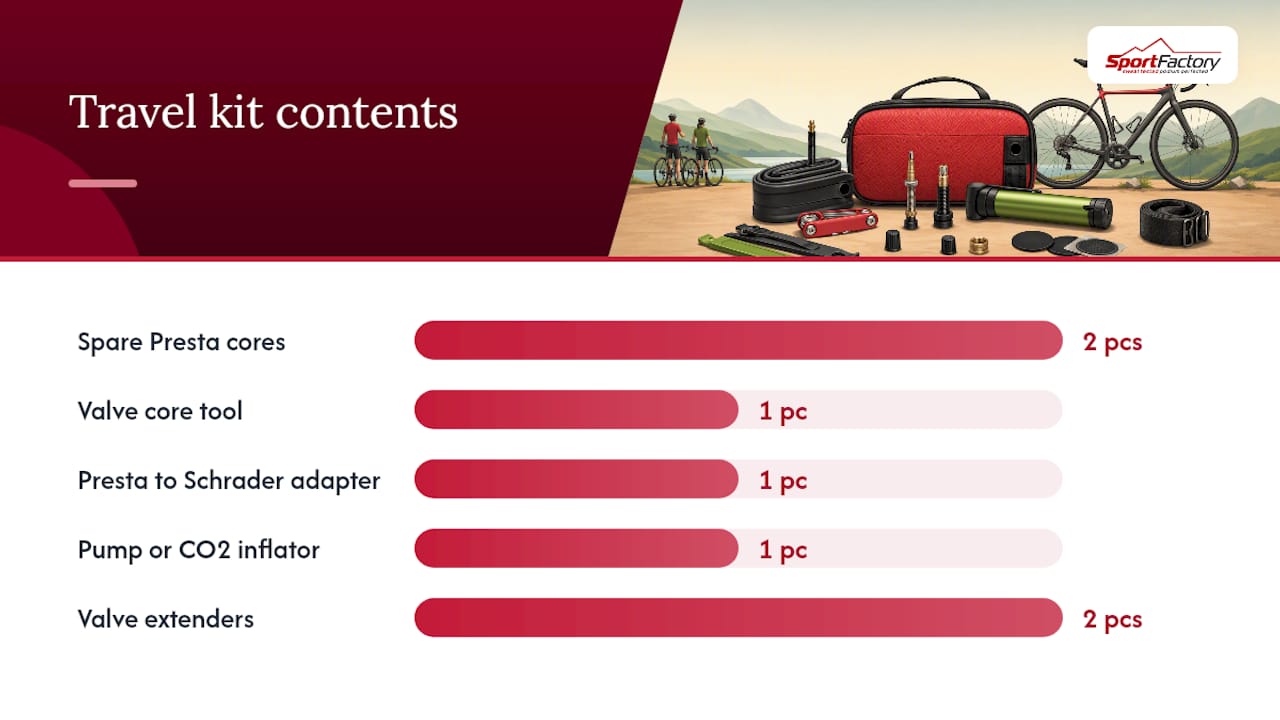
For a travel kit or race pit, the shop recommends stocking: two spare Presta cores, one valve core tool, one Presta-to-Schrader adapter, a compact dual-head pump or CO₂ inflator, and two valve extenders sized to your deepest rim. That kit fits in a jersey pocket and covers every common valve failure.
The valve choice that actually matters most
Most valve debates focus on the technical specs, and the specs are real. But the choice that matters most in practice is whether your pump matches your valve. A rider with a Presta valve and no Presta pump is stranded at a gas station, adapter-less, watching the compressor hose not fit. That scenario is avoidable and surprisingly common.
For competitive cyclists and anyone running tubeless, Presta is the clear standard. The removable core, the smaller rim hole, and the high-pressure seal are not marginal advantages. They’re the reason every serious road and gravel rim is drilled for Presta. The thin stem is a real fragility, but it’s manageable with the right pump technique and a spare core in your kit.
For casual riders, commuters, and anyone who values simplicity over performance, Schrader’s compatibility with everyday compressors is genuinely useful. The valve is harder to damage, easier to inflate without special tools, and perfectly adequate for the pressures a commuter or hybrid tire runs.
The one thing worth resisting is the impulse to modify a rim to switch valve types. Replace the tube or the tubeless valve instead. The rim is the expensive part.
Gear that solves valve problems, stocked at Sportfactoryproshop
Choosing the right valve is only half the equation. Having the right tools to inflate, maintain, and service that valve is what keeps you riding.
Sportfactoryproshop carries the cycling gear that makes valve maintenance straightforward: floor pumps with dual-head chucks that handle both Presta and Schrader without adapters, Presta valve core tools, valve extenders for deep-section rims, tubeless valve kits with removable cores, and Presta-to-Schrader adapters for mixed-fleet riders. Every product is selected for reliability and performance, not just price. Whether you’re setting up a tubeless gravel build or just want a pump that works every time, browse the full range at Sportfactoryproshop and find the right kit for your setup.
Sources
The following sources were used to build this guide. Each covers a specific aspect of valve selection, maintenance, or compatibility.
Primary references used in this guide:
- Presta valve — Wikipedia: Technical specifications including diameter (~6 mm), stem length guidance, and pump chuck types.
- What are the different types of bike tyre valves? | Michelin: Rim hole implications, tubeless suitability, and the structural risks of enlarging a Presta hole.
- What is the difference between a Presta and a Schrader valve? | Zéfal: Schrader’s automotive compatibility and compressor use.
- Presta vs Schrader Valve: Key Differences and Which to Choose | Canyon: Valve use by bike type, removable core benefits for tubeless, and maintenance recommendations.
- Presta vs Schrader: what’s the difference between inner tube valves? | BikeRadar: Market distribution by bike category and rim hole conversion guidance.