


Choosing The Right Helmet: 3 Test Backed Rules for Aero vs Cooling
Posted by Matt Russ on 16th Sep 2026
Choosing The Right Helmet: 3 Test Backed Rules for Aero vs Cooling Helmets
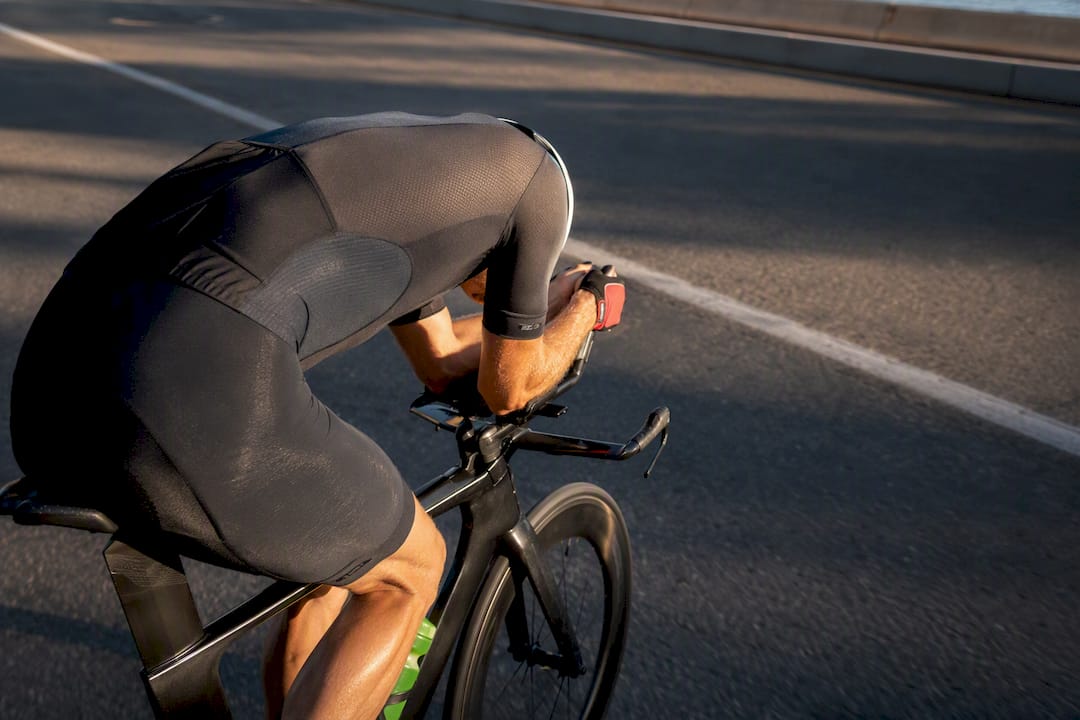
Choose an aerodynamic helmet when your event and speed make drag the dominant limiter, such as in flat time trials or solo breakaways at higher racing speeds. Choose a ventilated helmet when heat threatens your comfort, your pacing, or your run split in a triathlon. Fit and personal heat tolerance can shift this call either way, so the “right” helmet is really the one that matches your event, your climate, and your own sweat rate.
TL;DR:
- Aero helmets provide the greatest benefit at speeds above 25 mph, especially during solo time trials or breakaways where drag significantly impacts performance.
- Ventilated helmets are preferable in hot conditions, long events, or when thermal load surpasses aerodynamic considerations, especially in races lasting over 90 minutes.
- Modern aerodynamic helmets can often match traditional vents in cooling performance through smarter internal channels, reducing the typical tradeoff between speed and heat dissipation.
- Short-term efforts in extreme heat show negligible effects of head temperature on power output, but longer races in heat increase the risk of overheating and thermal discomfort.
- Proper helmet fit, test riding in race conditions, and matching helmet type to event and climate are crucial for optimal performance and comfort.
Table of Contents
- Helmet Aerodynamics vs Cooling: A Quick Decision Framework
- What Wind-Tunnel and Athlete Studies Actually Show
- Translating Drag Percentages Into Real Watts and Seconds
- How Vents, Channels, and Shell Shape Actually Control Both
- How to Choose and Test Your Helmet Before Race Day
- Why Triathlon Changes the Aero-vs-Cooling Calculation
- Three Simple Rules for Choosing Between Aero and Cooling
- Reconciling Lab Numbers With How a Helmet Actually Feels
- Get Fitted for the Right Helmet at Sport Factory Pro Shop
- Where to Read the Original Research
- Sources
- FAQ
Helmet Aerodynamics vs Cooling: A Quick Decision Framework
The core tradeoff comes down to speed and duration. At higher racing speeds, aerodynamic drag becomes the dominant power limiter, and every watt saved by a smoother shell can improve your split. Below that speed, or in events lasting several hours in the heat, thermal load starts to matter more than drag coefficient. This is the real question behind helmet aerodynamics vs cooling: which variable is actually limiting you today?
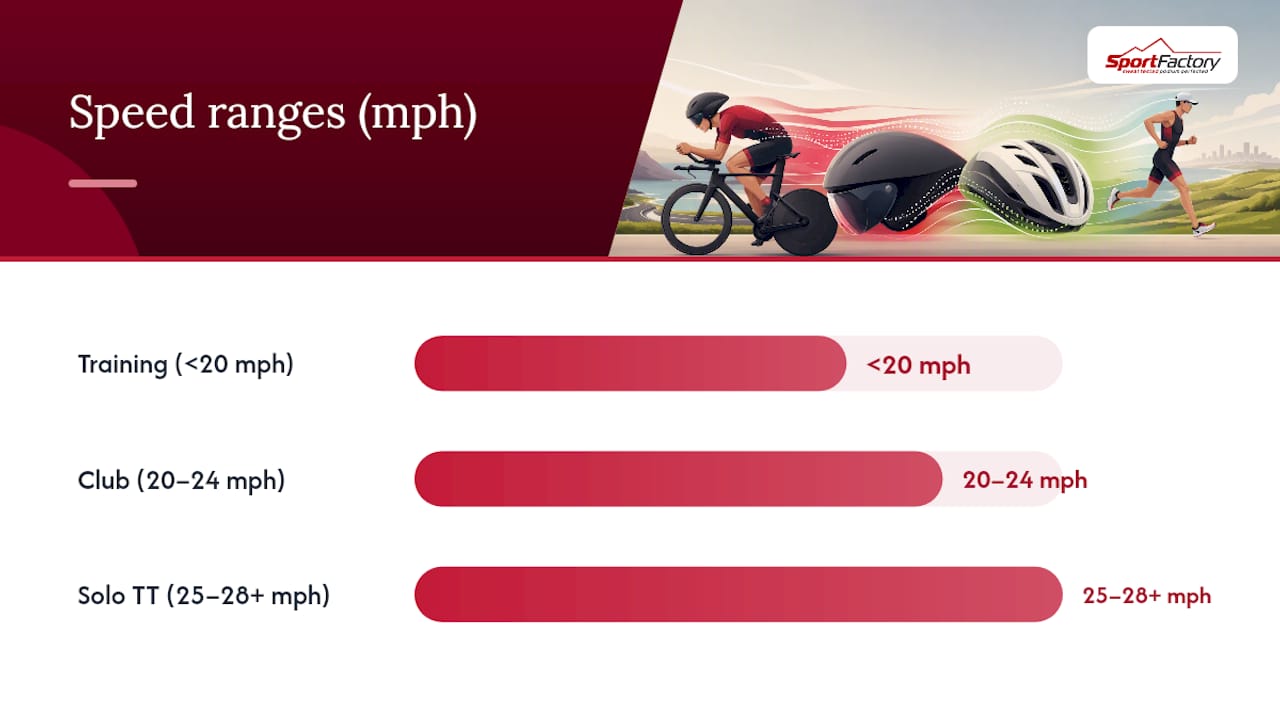
Here’s how speed and event type map onto the decision:
- Training rides under 20 mph: Drag is a minor factor. Cooling and comfort should drive your choice every time.
- Club rides and group efforts, 20 to 24 mph: Drafting reduces the aero penalty of a vented helmet substantially, so comfort still wins for most riders.
- Solo time trials and triathlon bike legs, 25 to 28+ mph: Drag dominates. This is where aero helmets built for airflow efficiency pay off in real seconds.
- Criteriums in heat, long climbs, and hot ultra-distance rides: Even at race pace, sustained heat stress can cost you more than the drag savings recover.
- Draft-legal triathlon and road racing in a pack: Aerodynamics matter less than in solo efforts since the group blocks wind for long stretches.
Event type matters as much as raw speed. A flat 40-kilometer time trial with no drafting is the textbook case for an aero helmet: constant effort, constant airflow, no tactical surges that generate extra heat. Solo breakaways in road racing fall into the same bucket. On the other side, a criterium run in 90-degree heat, a mountain stage with sustained 8% climbs, or an Ironman bike leg followed by a marathon all put heat management ahead of drag reduction.
The practical outcome splits into two risk profiles. Pick aero, and you’re trading a few degrees of extra scalp temperature for measurable watt savings; pick cooling, and you’re trading a small aerodynamic penalty for a lower chance of overheating, cramping, or blowing up your run. Neither choice is “wrong” in isolation. It only becomes the wrong choice when it doesn’t match your event.
Pro Tip: If you race the same course type all season, buy the helmet built for that course, not the one that looks fastest in photos. A time trial specialist doesn’t need the same helmet as a criterium racer who attacks in 95-degree heat.
What Wind-Tunnel and Athlete Studies Actually Show
The data on helmet aerodynamics vs cooling is more nuanced than most marketing copy suggests, and it comes primarily from three types of testing: heated-manikin wind-tunnel work, controlled athlete trials, and vent-geometry experiments using thermal headforms.
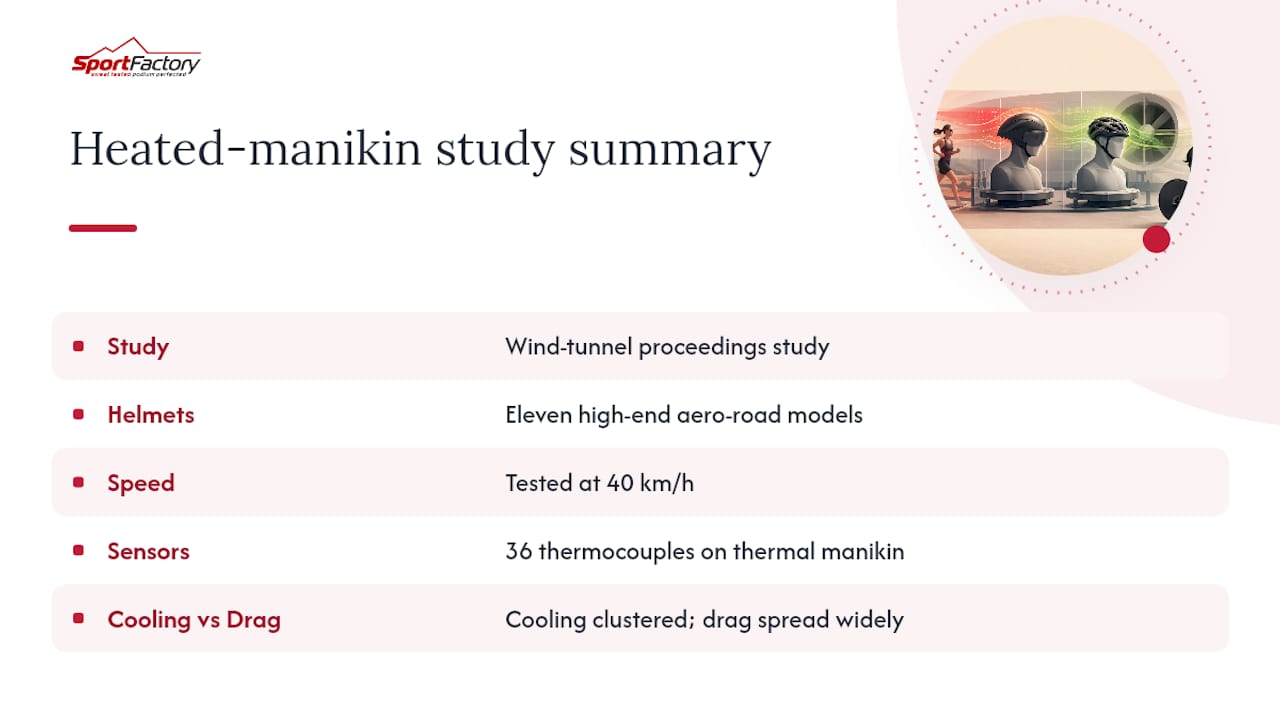
The Key Finding: Wind-tunnel and heated-manikin testing of eleven high-end aero-road helmets found that many modern aero-road models are approximately as cool as each other, even though their aerodynamic drag varies significantly between designs.
That result comes from a proceedings study that mounted eleven high-end helmets on a thermal manikin fitted with 36 thermocouples, then measured them at wind-tunnel speeds including 40 km/h. Researchers built thermal contour plots and plotted mean surface temperature difference against Wind Averaged Drag. The pattern that emerged: helmets clustered fairly tightly on cooling performance, but spread widely on drag. In other words, you can often find a helmet that’s meaningfully faster than its competitors without paying much of a thermal penalty. This finding directly reshapes the aerodynamic helmets benefits conversation. It’s not always a straight tradeoff. Some modern aero-road helmets increasingly close the gap between low drag and effective cooling through smarter internal channeling rather than sheer vent count.
The athlete-trial evidence tells a slightly different story, and it matters for anyone racing in genuinely hot conditions. A 2013 study measuring head temperature, core temperature, and cycling power compared an aerodynamic helmet against a traditional vented helmet during cycling in 39°C heat, including a 12-kilometer time trial. Head-skin temperature ran measurably higher with the aero helmet at several points during the trial. But here’s the part that surprises most racers: heart rate and core (gastrointestinal) temperature did not differ meaningfully between the two helmets, and there was no difference in finish time or power output during the high-intensity time trial. This same trial is documented in a PubMed entry with consistent results.
That’s a genuinely useful piece of impact of design on helmet cooling research, because it tells you something specific: for a short, all-out effort, a hotter scalp doesn’t automatically translate into a slower finish. Your body seems to tolerate localized head heat reasonably well over 20 to 30 minutes of hard racing, even at extreme ambient temperatures.
Vent geometry research adds another layer. Testing on a streamlined cycling helmet across multiple head angles and vent hole configurations found that front inlets paired with rear outlets and internal channels produced the best cooling outcomes, better than many small vents scattered across the shell. Interestingly, head angle (how you position your head while riding) often changed aerodynamic drag more than the vent layout itself did. That’s a detail most buyers never consider: your riding position can matter more to your drag numbers than which helmet you’re wearing.
A related test series on commuter and road helmet mock-ups reinforces the geometry point. Air channel construction and design element testing done in a wind tunnel at both walking-pace and riding-pace airflow found that the best-performing designs used larger rear openings combined with smaller front openings, creating a suction effect that pulled air through the helmet rather than just letting it in. This is exactly the mechanism behind ventilation in motorcycle helmets and high-end cycling lids alike: it’s not about how many holes you drill, it’s about how the air moves once it gets inside.
Every one of these studies has limits worth knowing before you overweight the results. The 39°C athlete trial used a small group of cyclists over a short duration, which is common in exercise physiology research but means it may not fully predict how you’ll respond over four hours in the saddle. Heated-manikin testing captures airflow and surface temperature accurately, but a manikin doesn’t sweat the way a human scalp does, so real-world evaporative cooling could shift results in either direction. None of this invalidates the findings. It just means you should treat them as strong directional evidence, not universal guarantees for your specific head shape, hair, and sweat rate.
Translating Drag Percentages Into Real Watts and Seconds
Aerodynamic drag doesn’t scale in a straight line with speed. It scales with the cube of velocity, meaning power required to overcome air resistance is proportional to velocity to the third power. Small increases in speed demand disproportionately more wattage, which is exactly why aero gains matter so much more at race pace than during an easy Sunday ride.
Here’s what that looks like in practice. At 40 km/h, the same percentage reductions translate into larger absolute watt savings because you’re fighting more total drag to begin with.
These are representative estimates based on the physics of drag scaling, not a guarantee for any specific helmet model. Actual savings depend on your body position, yaw angle, and the specific comparison helmet.
For a 40-kilometer time trial, the difference between a fast aero helmet and a mediocre one can plausibly be 20 to 40 seconds, enough to move you several places up a results sheet in a competitive field. That’s the case for helmet airflow efficiency taking a back seat when the course and conditions allow it.
The physiological side of the equation is where things get more interesting for longer events. The athlete trial data shows that higher head-skin temperature didn’t cost power output over a short 12-km time trial in extreme heat. But that same study didn’t test a four-hour Ironman bike leg followed by a marathon. Perceived exertion, thermal discomfort, and cumulative heat strain tend to compound over duration in ways a 30-minute trial can’t capture. A helmet that costs you nothing in a short criterium might genuinely cost you minutes in an event that pushes past the two-hour mark, especially if you’re heading straight into a run.
Pro Tip: If your race includes a run leg or lasts longer than 90 minutes in hot weather, weight the cooling side of this decision more heavily than the raw drag numbers suggest. The physics of watts saved doesn’t change, but your ability to hold pace when your core temperature climbs absolutely does.
How Vents, Channels, and Shell Shape Actually Control Both
Helmet design for better airflow isn’t primarily about vent count. It’s about vent placement and what happens to air after it enters the shell.
- Front inlets plus rear outlets with internal channels consistently outperform designs with many scattered small vents because the geometry creates a pull effect that moves air across the scalp rather than letting it stagnate.
- Central and top vents are often thermally inefficient because they sit in a low-pressure zone at speed, and many aero-focused designs remove them entirely to cut drag without losing meaningful cooling.
- Surface smoothness and tail shaping affect yaw-angle drag independently of vent layout, meaning two helmets with identical vent counts can perform very differently in crosswinds based purely on shell contour.
- Head contact area and channel depth influence how much airflow actually reaches the scalp, not just how many holes exist on the outer shell.
The suction-effect research on air channel construction backs this up directly: helmets with larger openings toward the back and smaller openings up front outperformed designs relying on more numerous, evenly distributed vents. Air needs somewhere to exit efficiently, or intake vents just create turbulence without meaningful cooling in techniques for improving helmet cooling. This is a core piece of any explanation of aerodynamics and thermal comfort in helmet engineering: intake without a clear exit path is close to wasted design.
Ergonomics research on headgear reinforces a related point: reduced head contact and proper channeling improve ventilation, but every design decision here runs into impact protection constraints. A manufacturer can’t simply carve out massive vents to chase cooling numbers, because the foam structure underneath still has to absorb impact energy according to safety standards. This is why the best aero-road helmets on the market today tend to be evolutionary rather than radical. Engineers are threading a narrow needle between drag, cooling, and crash protection simultaneously.
Worth knowing: some emerging cooling technology, including thermoelectric and phase-change cooling concepts, exists in patent filings and prototype research. None of it is standard consumer equipment yet, so don’t expect actively cooled helmets on shelves anytime soon. For now, geometry and channeling remain the practical levers that matter.
How to Choose and Test Your Helmet Before Race Day
A helmet that shows good specs can feel different in real use. It is important to test in realistic conditions before race day.
Start with the basics: what’s your event type, your expected average speed, the ambient temperature and humidity you’ll be racing in, and whether you’re running off the bike afterward? Those four answers narrow your options faster than any spec comparison.
- Match helmet type to event profile. A flat, non-drafting time trial or triathlon bike leg above 25 mph favors aero. A hot criterium, long climb, or run-heavy triathlon favors ventilation.
- Check adjustability and weight before aerodynamics. A helmet that shifts or presses on pressure points during a hard effort will cost you more focus than any drag coefficient will save you.
- Run a 20 to 40 minute test ride at race intensity. Pay attention to how your scalp feels at the 15 minute mark and again near the end. Discomfort that builds late is a signal the helmet won’t hold up over a longer race.
- Do a one-day heat test if your target race runs hot. Wear the helmet for a full ride in conditions close to expected race-day heat and humidity, not just a mild morning spin.
- Check head angle and stability last. Since head position can influence drag as much as vent configuration, a helmet that sits slightly off your natural riding angle may underperform its lab numbers on your actual body.
Pro Tip: Test in the same kit you’ll race in, including any aero sunglasses or visor. Helmet and eyewear interaction changes both airflow and drag more than most riders expect.
If a helmet passes the checklist but causes even mild discomfort during your test ride, don’t override that signal for a marginal aero claim. A few watts of theoretical savings mean nothing if discomfort forces you to sit up, adjust, or lose focus during the race that actually counts.
Why Triathlon Changes the Aero-vs-Cooling Calculation
Triathlon adds a variable that pure cycling races don’t have: you still have to run afterward, often in the same heat that’s been cooking your scalp for the last two to five hours.
- Long-distance and hot-weather triathlons generally favor ventilated helmets, because excess heat accumulated on the bike carries directly into your run split, and overheating on the bike is one of the fastest ways to blow up a marathon leg.
- Short-course and non-drafting flat bike legs still favor aero helmets, particularly in sprint and Olympic-distance racing where the bike leg is short enough that heat accumulation matters less than raw speed.
- Draft-legal triathlon reduces the aero advantage significantly, similar to road racing in a pack, since drafting cuts your individual wind exposure.
- Wetsuit heat load compounds the problem in wetsuit-legal swims, since athletes often start the bike leg already running warm before helmet choice even enters the equation.
Practical transition tips help bridge the gap regardless of which helmet you choose. Pouring water over your head and helmet at aid stations, using a light-colored or reflective helmet shell to reduce solar heat gain, and starting the bike leg slightly conservative on effort in extreme heat all reduce thermal load independent of vent design. None of these replace a genuinely well-ventilated helmet, but they buy you margin on race days that run hotter than forecast.
Three Simple Rules for Choosing Between Aero and Cooling
After sorting through wind-tunnel data, athlete trials, and vent-geometry studies, the decision really boils down to three rules.
Rule one: speed-first. If your event is a flat, non-drafting time trial or a solo breakaway above 25 mph, buy the aero helmet. The watt savings are real and they compound over distance.
Rule two: heat-first. If your event runs long in high heat and humidity, especially with a run leg attached, buy the ventilated helmet. Comfort and thermal management protect your pacing better than a few seconds of drag reduction.
Rule three: mixed-event compromise. If you race a variety of course types across a season, look for a helmet using the modern hybrid approach: large front inlets, deep internal channels, and rear outlets that preserve cooling without excessive vent count. This is exactly the design trend that recent testing shows closing the historical gap between the two categories.
The helmet lineup is curated around this framework rather than chasing every new release, offering fit guidance based on event type and climate, a selection built around engineering data rather than marketing claims, and straightforward returns if a helmet doesn’t perform as expected on first hot-weather use. One honest note on transparency: the lab studies referenced throughout this guide come from independent wind-tunnel and university research, not from any single helmet manufacturer’s internal marketing. That’s intentional. Numbers you can trust matter more than numbers designed to sell you something.
Reconciling Lab Numbers With How a Helmet Actually Feels
The lab data is convincing, but it doesn’t fully capture how a helmet feels after three hours in the saddle. Wind-tunnel and manikin studies measure surface temperature and drag with precision most riders will never need. What they can’t measure is how your specific hair thickness, sweat rate, or tolerance for a warm scalp interacts with a given design on race day.
That gap between measured and felt is worth respecting. A helmet cover, a change in hairstyle, or even a different chin strap tension can shift how “hot” a helmet feels without changing its actual thermal output at all. Rider preference isn’t noise in this data; it’s a legitimate input that lab tests were never designed to capture. The physics tells you what’s possible. Your own testing tells you what’s practical.
My honest recommendation: trust the speed-first and heat-first rules as your starting point, then actually test before locking in a race-day helmet. Ride it hard, ride it hot, and pay attention to how you feel at minute 90, not just minute 10. If you land on something that works, it’s worth sharing with other racers chasing the same tradeoff.
— Matt
Get Fitted for the Right Helmet at Sport Factory Pro Shop
The helmet lineup is built around the tradeoff covered in this guide: speed when speed matters, cooling when heat is the real opponent, providing a curated set of helmets chosen for engineering performance backed by testing.
The shop’s approach centers on a few concrete advantages for racers and triathletes shopping for their next helmet:
- A curated selection that skips the noise of every helmet on the market and focuses on models proven through wind-tunnel data and rider feedback.
- Fit guidance to help you match head shape, riding position, and event type to the right shell and vent geometry.
- Straightforward returns if a helmet doesn’t perform as expected once you’ve tested it under real race conditions.
If your season mixes flat time trials with hot, long-course triathlons, browse the current helmet lineup at Sportfactoryproshop and reach out for fit help before you commit. Getting the shell right before race day beats discovering a mismatch at mile 30.
Where to Read the Original Research
Readers who want the primary data behind these recommendations can go straight to the source material rather than relying on secondhand summaries.
- The wind-tunnel and heated-manikin study tested eleven high-end aero-road helmets, measuring drag alongside surface temperature using thermocouples and thermal contour plots.
- The 2013 athlete trial measured head-skin temperature, core temperature, and cycling power in cyclists riding in 39°C heat, including a 12-kilometer time trial.
- The vent-configuration study tested a streamlined helmet across multiple head angles and hole layouts on a thermal headform, isolating how geometry affects both drag and cooling.
- The air channel construction research from Lund University examined how inlet and outlet placement changes evaporative resistance and heat transfer in commuter and road helmet mock-ups.
Sources
- Bicycle Helmets—Are Low Drag and Efficient Cooling Mutually Exclusive?
- Effect of an Aerodynamic Helmet on Head Temperature, Core Temperature, and Cycling Power Compared With a Traditional Helmet
- Thermal comfort and drag of a streamlined cycling helmet as a function of ventilation hole placement
- Effect of an Aerodynamic Helmet on Head Temperature, Core Temperature, and Cycling Power Compared With a Traditional Helmet (PubMed entry)
FAQ
What Is the 2 2 2 Rule for Bike Helmets?
The “2 2 2 rule” isn’t a standardized safety or performance framework in the cycling research reviewed here. If you’ve seen it referenced, treat it as informal advice rather than an established engineering standard, and rely instead on fit checks and vent geometry principles covered in this guide.
How Much Faster Do Aero Helmets Make You?
At race speeds around 30 to 40 km/h, a helmet with a 4 to 7% drag advantage can save roughly 8 to 30 watts depending on speed, which translates to an estimated 15 to 40 seconds over a 40-kilometer time trial. Actual gains vary by rider position, yaw angle, and the specific helmets compared.
Which Helmet Has the Best Airflow?
No single model wins universally, but testing consistently shows that helmets combining large front inlets, deep internal channels, and rear outlets outperform designs relying on many small scattered vents. The helmet lineup is selected with this geometry principle in mind.
Why Do Motorcycle Helmets Look So Cool?
Motorcycle helmet shapes are driven primarily by full-face impact protection and high-speed stability rather than the cycling-specific tradeoff between drag and scalp cooling covered in this guide. Ventilation in motorcycle helmets still relies on similar inlet-and-outlet principles, just scaled for different speeds and crash forces.
Does a Hotter Head Actually Slow You Down?
Not necessarily during short, high-intensity efforts. A controlled athlete trial found aero helmets raised head-skin temperature in 39°C heat but produced no difference in finish time or power output during a 12-kilometer time trial, though longer events or run legs may behave differently.