

45mm Default: Gravel Tire Clearance Test Fit Checklist for Riders
Posted by Matt Russ on 31st Aug 2026
45mm Default: Gravel Tire Clearance Test Fit Checklist for Riders
Aim for at least 45mm of tire clearance as your smart default, and go to 50mm or more if your riding calendar includes mud, technical terrain, or bikepacking loads. Anything under 42mm locks you into narrow, fast-rolling tires only. The right number depends on your mounted tire width, not the marketing spec, and a shop like Sport Factory Pro Shop can help you confirm the real fit before you commit to a frame or wheelset.
TL;DR:
- Most riders should aim for at least 45mm of tire clearance, with 50mm or more recommended for muddy, technical, or bikepacking terrain.
- Real-world clearance varies significantly based on rim internal width, tire casing, and load, so test-fitting and measuring is essential before committing.
- Clearance standards suggest a minimum of 4mm of free space per side and 6mm for mud clearance, with manufacturer specs often being conservative.
- Upgrading rim width can improve clearance more cost-effectively than wheel replacement, especially when dealing with marginal space.
- Buying for future terrain and seasonal variations ensures better performance and prevents wheel jams in wet, muddy, or loaded conditions.
Table of Contents
- What Does Gravel Tire Clearance Actually Mean?
- Why Manufacturer Specs Don’t Match Real-World Mud Clearance
- How to Measure and Test-Fit Your Tires
- What Tire Width Should You Run for Your Terrain?
- How Wheel Size and Tubeless Pressure Change Your Clearance
- Shop-Tested Checks From Sport Factory Pro Shop
- Should You Buy for Today’s Tires or Tomorrow’s Terrain?
- Get Your Gravel Setup Fitted Right
- Sources
What Does Gravel Tire Clearance Actually Mean?
Tire clearance is the physical gap between your mounted tire and the closest point on your frame or fork, measured at the tightest spot in the chainstay, seatstay, or fork leg. It’s not a marketing ceiling printed on a spec sheet. It’s the real, usable space your tire needs to spin freely without touching anything.
Too little clearance and you get rubbing under load, chainstay damage from flexing tires, or a wheel that locks solid the moment mud packs into the gap. That last scenario is the one racers fear most: a tire that fit fine dry on a test ride, then jams against the frame after ten miles of wet gravel.
This is why clearance deserves race-calendar thinking. If your season includes a muddy spring classic or a bikepacking trip with loaded panniers, you need room for swelling, debris, and flex, not just your current tire mounted in dry conditions. Frame clearance for gravel bikes should match the worst day you’ll actually ride, not the best one.
Why Manufacturer Specs Don’t Match Real-World Mud Clearance
A frame listed at “50mm clearance” doesn’t always mean you can mount a 50mm tire and call it done. That number usually assumes a specific rim and a dry tire, and both variables shift the real answer.
Rim internal width changes mounted tire width more than most riders expect. A tire labeled 40mm might measure 38mm on a narrow 19mm internal rim, then balloon to 42mm or more on a 25mm internal rim. Rim width alters mounted tire width significantly, which means two riders running the “same” tire can end up with different clearance margins depending on their wheel choice.
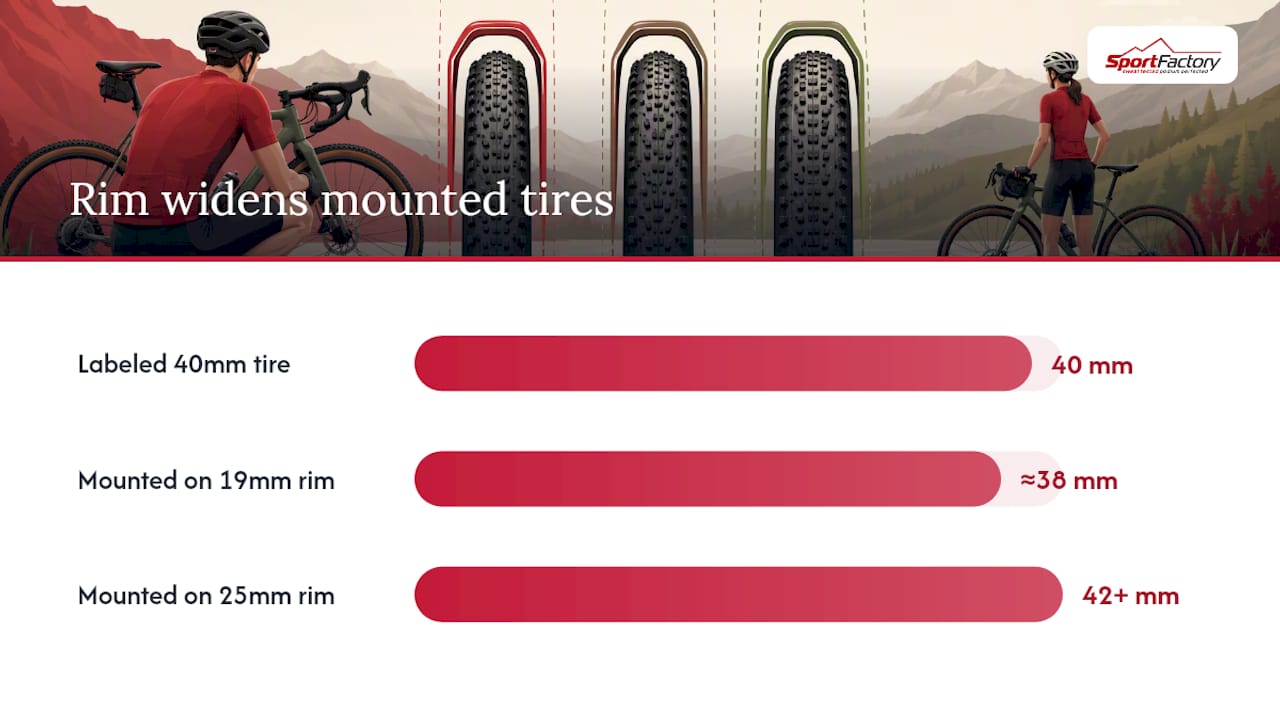
Manufacturer clearance figures are also often conservative or measured under ideal conditions, so real-world fit depends heavily on your specific rim and tire combination. That’s why test-fitting matters more than trusting the spec sheet alone.
The industry-standard safety margin is well established:
- 4mm minimum free space per side between tire and frame
- 4 to 5mm optimal for flex, debris, and casing variance
- 6mm total mud gap at critical pinch points for reliable wet-race performance
Working clearance standard: Cannondale’s guidance calls for 4 to 5mm of free space per side to account for tire flex and debris buildup, the same margin most frame builders design around.
How to Measure and Test-Fit Your Tires
Confirming real clearance takes fifteen minutes and a few basic tools. Here’s the checklist we walk customers through at Sport Factory Pro Shop before they finalize a tire or rim upgrade.
What you’ll need:
- A shock pump or standard pump
- A caliper or ruler
- A 4 to 6mm hex key
- A clean rag (mud and grit skew your measurements)
Step-by-step test-fit:
- Mount the tire tubeless or with a tube, and inflate to your actual intended riding pressure, not shop-floor pressure.
- Let it sit for ten minutes so the bead seats fully and the casing settles.
- Measure the mounted width at the widest point of the tire, not the sidewall label.
- Spin the wheel slowly in the frame or fork and watch for contact at the chainstay, seatstay, and fork crown.
- Load the bike (sit on it, or add a bikepacking bag) and recheck, since load compresses the tire and reduces clearance.
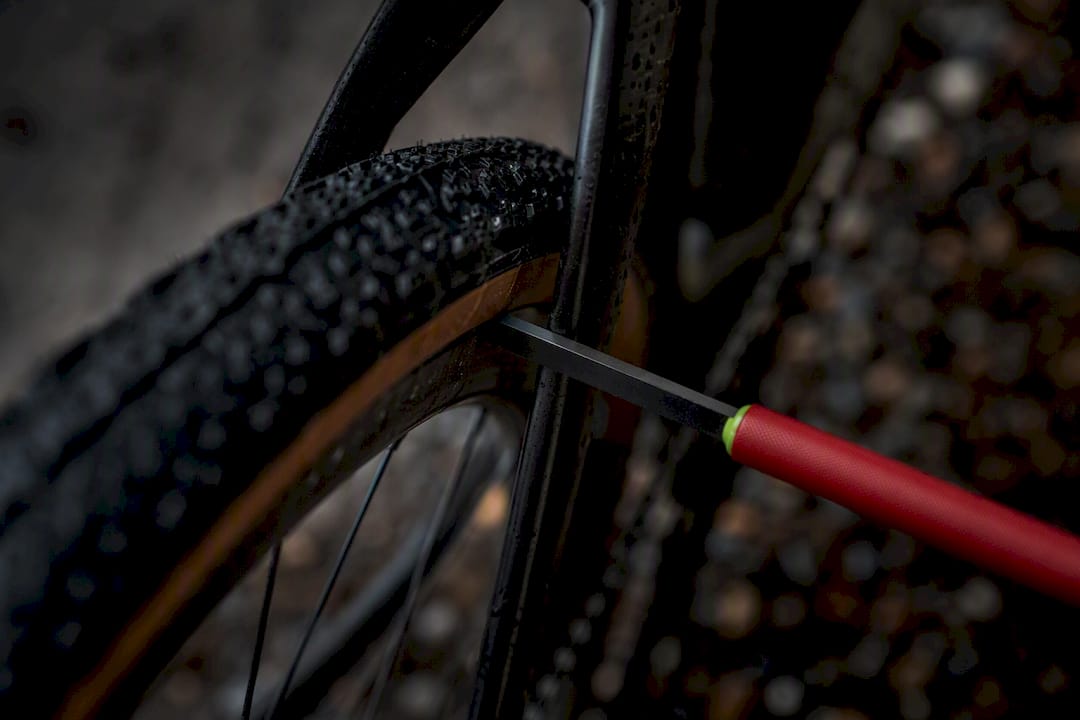
- Slide a 4 to 6mm hex key into the tightest gap on each side. If it slides through freely, you’re within the recommended range.
- Check both wheels independently. Rear triangles are almost always tighter than forks.
- Write down the mounted width, pressure, and clearance measurement for each wheel and tire combo you test.
Pro Tip: Run a slightly wider tire up front than in back if your rear triangle is tight. Forks almost always have more room to spare, so this trick lets you gain volume and traction where it matters most without touching your rear clearance limit.
What Tire Width Should You Run for Your Terrain?
The right target width depends entirely on what you’re riding, not just what your frame allows. Here’s how the bands break down in practice.
- Under 42mm: Fast, tarmac-heavy mixed routes where rolling speed matters more than cushioning.
- 42 to 45mm: Most gravel race calendars, balancing speed with enough volume for loose surfaces.
- 45mm (smart default): The width that covers the widest range of gravel conditions without major compromise.
- 50mm and up: Technical terrain, wet or muddy courses, and bikepacking trips where load and traction outweigh raw speed.
| Use Case | Target Width | What to Check |
|---|---|---|
| Fast mixed gravel/road | Under 42mm | Rolling efficiency, tarmac sections |
| General gravel racing | 42 to 45mm | Mounted width at race pressure |
| All-around gravel riding | 45mm | Mud buffer, rim internal width |
| Technical, wet, or loaded riding | 50mm+ | 650b compatibility, frame mud gap |
Published tire size guides map these bands directly to real riding conditions, noting that 45mm covers most gravel race fields while 50mm and above opens the door to 650b wheels and bikepacking setups. Mudguards and frame bags eat into usable clearance too, so if you run either, bias toward the wider end of whatever band you land in.
How Wheel Size and Tubeless Pressure Change Your Clearance
Your wheel and rim choice affects usable clearance just as much as the frame itself. Switching to 650b wheels lets you run higher-volume tires in the same frame, since the smaller wheel diameter often opens up several extra millimeters of room compared to 700c.
Rim internal width plays a similar role. A 40mm tire on a 21mm internal rim measures differently than that same tire on a 25mm rim, sometimes by 2 to 3mm.
Tubeless setups add another layer. Lower tubeless pressures, often 3 to 5 psi below tubed setups, improve rolling resistance and reduce pinch flat risk, but they also change how the sidewall bulges under load, which shifts your effective clearance.
- Test mounted width at your actual tubeless pressure, not a placeholder number
- Recheck clearance after a few rides once the tire has stretched into its final shape
- Keep a second wheelset if you regularly swap between 700c and 650b setups
Shop-Tested Checks From Sport Factory Pro Shop
We test-fit tires on multiple rim widths before recommending a combination to customers, because a tire that measures tight on one wheelset can measure comfortably clear on another. Casing construction varies between models too. Some tires run noticeably wider than their labeled size, which matters when you’re working with a marginal frame.
Checks we run before recommending a setup:
- Mount the same tire on two or three rim widths to compare measured width
- Confirm clearance at race pressure, not shop pressure
- Flag frames under 42mm clearance as limited to narrower, race-oriented tires only
Pro Tip: If you’re deciding between beefier casing and a tire insert for rough terrain, our guide to sidewall protection breaks down when casing alone is enough and when an insert earns its weight.
When a customer’s clearance is marginal, we’ll usually suggest a rim width change before a full wheel swap. It’s often the cheaper fix.
Should You Buy for Today’s Tires or Tomorrow’s Terrain?
Most riders buy clearance for the tire they’re running right now, and that’s the mistake. Your race calendar changes. Your terrain preferences change. A frame that only clears 40mm today locks you out of the muddy spring event you might sign up for next year.
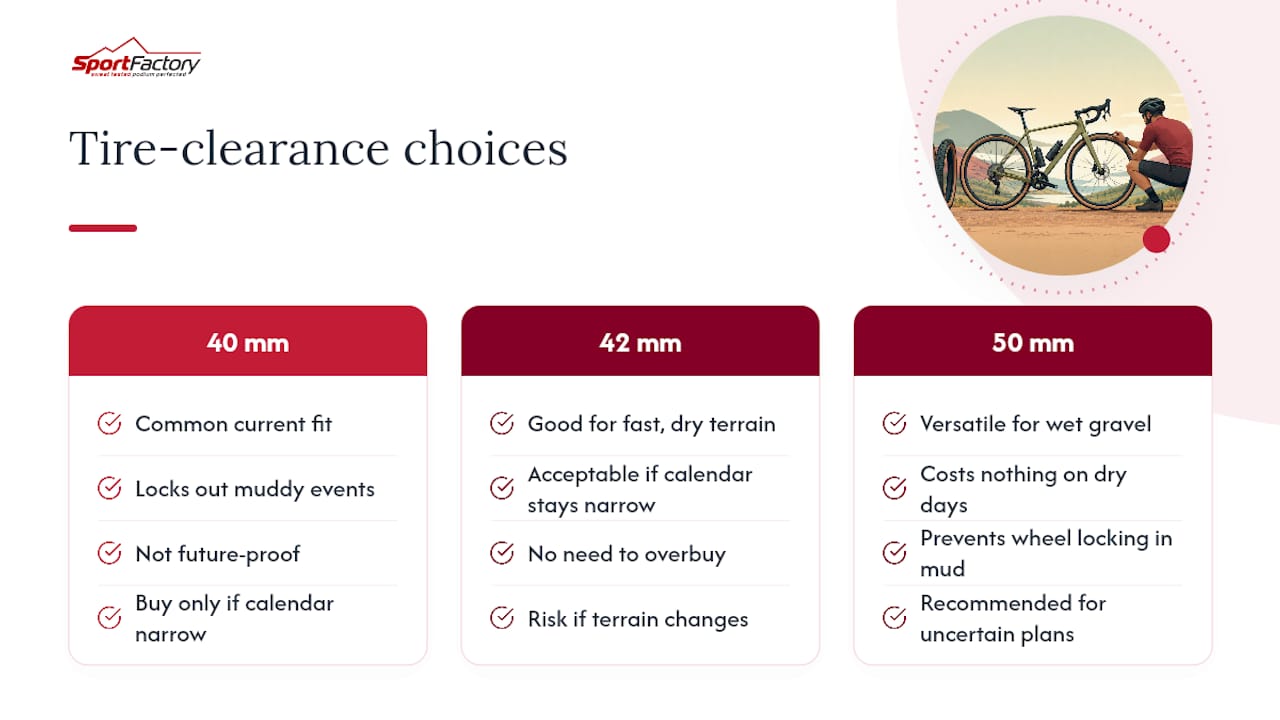
Buy the option, not just the fit. If your riding stays firmly on fast, dry mixed terrain, 42mm clearance is genuinely fine and there’s no reason to overbuy. But if there’s any chance you’ll chase a wet gravel race or load up for an overnight trip, 50mm clearance costs you nothing on dry days and saves you a locked wheel on wet ones.
Narrower clearance is acceptable only when your calendar is narrow too. For everyone else, a shop test-fit and a possible rim upgrade beat guessing.
— Matt
Get Your Gravel Setup Fitted Right
Guessing at tire width costs you either speed on dry days or a jammed wheel on wet ones. Sport Factory Pro Shop stocks tubeless gravel tires across the 40 to 50mm range, along with wider rim options built specifically to maximize your mounted width without forcing a frame swap.
Our tubeless kits handle the conversion cleanly, and if you’re weighing casing thickness against tire inserts for rougher terrain, our sidewall protection breakdown covers that decision in detail. Whether you need a wider rim to unlock more mounted width or a full tubeless setup for your next event, browse the current lineup at Sport Factory Pro Shop and get your bike dialed in before race season, not during it.
Sources
For deeper background on the numbers behind this guide, the BikeRadar case for 50mm clearance, Cannondale’s clearance explainer, and the IceBike tire size guide are worth bookmarking before your next tire purchase.