

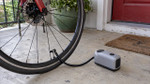
Electric Inflator Noise: How Loud Is Too Loud for Bike Tires?
Posted by Matt Russ on 18th Oct 2026
Electric Inflator Noise: How Loud Is Too Loud for Bike Tires?

Electric bike inflators are loud. Independent tests put compact units between roughly 74 and 90 dB, and none of the tested pumps was described as silent. The real question is whether a given pump is loud for a few seconds at the trailhead or loud enough that you dread using it in a hotel room. This guide covers what the decibel numbers mean, why these pumps also get hot, and how to choose and use one so noise stays a minor annoyance.
TL;DR
- Expect a hairdryer, coffee grinder or small blender sound. Compact electric inflators are never silent, and the quietest measured examples sit around 74 to 80 dB at one meter.
- A decibel figure only means something when the measuring distance is stated. Compare independent one-meter tests, not marketing words like “quiet.”
- Heat matters as much as noise. Use an extension hose on plastic-valved tubes, and respect the duty cycle in the manual.
- A faster pump can be the better choice if it cuts the total time you listen to it.
- Keep the pump away from your ear and use hearing protection with louder units used for long stretches.
Table of Contents
- How loud are electric bike inflators?
- Why a spec-sheet number can mislead you
- Noise and heat come as a pair
- Hearing: how careful do you need to be?
- How to choose a quieter electric inflator
- How to use an electric inflator with less noise and heat
- Our view on noise
- Build a roadside kit that fits your tires
- Quick fixes if your inflator is too loud
- FAQ
- Sources
How loud are electric bike inflators?
A small motor drives a piston at high speed to reach road-bike pressures from a tiny battery-powered body. That design makes noise. Test results across the past year agree on the range, even if the exact numbers differ by method.
Here is what independent testers measured:
| Test | Result | What it tells you |
|---|---|---|
| off-road.cc review of a compact mini inflator | 74 dB at one meter | Near the low end of the electric class |
| off-road.cc review of a second mini inflator | 78 dB at one meter | The same reviewer notes all pumps tested so far fell between 74 and 78 dB |
| Singletracks mountain bike test | 77 to 90 dB across five pumps on a 29x2.5-inch tire | Testers called all five clearly audible |
| BikeRadar 2026 buyer’s guide | One unit at 86.8 dBA, with other examples running up to 96.6 dB | That reading is described as similar to a coffee grinder or small blender |
The spread looks wide, and part of it is real. Part is method. Distance from the microphone, tire size, pressure, and whether the number is a peak or an average all change the reading. Treat the figures as a ranking within each test, not as numbers you can mix across tests.
What the numbers sound like
A 10 dB increase is perceived as roughly twice as loud. So a 74 dB pump and a 90 dB pump are not neighbors. The first is a noticeable whir. The second is an unpleasant buzz you will want to finish quickly. The Singletracks table is a good reminder that the loudest pump in that test also sat at the top of its range for noise, while the quietest of the five measured 77 dB.

Why a spec-sheet number can mislead you
Three things make a printed noise rating less trustworthy than it looks.
The distance is missing. A figure taken at 30 centimeters will read far higher than the same pump at one meter. If a listing gives a number with no distance, you cannot compare it with an independent test.
Lab conditions differ from real use. One cordless inflator manual shows this clearly. Makita’s MP001G manual declares 71 dB(A) under a standard method, then separately says the noise while working may exceed 80 dB(A). The tool is a general-purpose inflator, not a bike mini pump, but the lesson carries over: pressure, valve connection, surface and runtime all change what you actually hear.
“Quiet” is a relative word. BikeRadar’s testers make the point that a lower reading can still sound sharp because the pump sits close to you. Their guidance is to compare measured noise, heat, accuracy, speed and battery life together.

Noise and heat come as a pair
The same motor-and-piston design that makes noise also makes heat. Bicycling tested 11 mini inflators for speed, heat, noise and accuracy, and the reason is simple: compressing air into a high-pressure tire warms both the pump and the hose.
That is why searches about overheating show up next to searches about noise. If your pump gets hot, the trouble usually is not a defect. It is a duty cycle problem or a connection problem.
Protect the valve
Heat at the valve is the issue riders miss most. A tester at Bicycling found that an inflator that sounded tolerable could still damage a plastic valve when used without an extension hose. The CYCPLUS AS2 Pro MAX manual says the same thing for TPU tubes with resin valves: use an extension hose, because overheating can melt the valve.
That manual also shows how built-in protection works on one model. The unit stops automatically after three minutes of continuous inflation under abnormal conditions and displays “HOT” when its internal temperature exceeds the limit. Other pumps behave differently, so read yours.
Respect the duty cycle
Makita’s manual specifies 10 minutes on and 5 minutes off. Bike mini inflators have their own limits, usually printed in the manual. If you are topping up several tires in a row, such as a team car at a race or a family ride, rotate pumps or let the unit cool between tires.
Hearing: how careful do you need to be?
For a 20-second top-up, noise is mostly an annoyance. For longer or repeated use, take it seriously. The HOTO manual lists operating noise of 75 to 80 dB, and Makita’s manual warns users to wear ear protection with its louder unit. Practical habits:
- Do not hold a small inflator next to your ear or head while it runs.
- Set the target pressure, start the pump, and step back if the hose allows.
- Use earplugs or earmuffs if you inflate many tires in a session, as in a workshop or at an event.
- Be extra careful in enclosed spaces. A garage or hotel bathroom bounces sound back at you, so the same pump feels louder than it did outdoors.
If you have hearing concerns, a doctor or audiologist can advise on safe exposure for your situation.
How to choose a quieter electric inflator
No compact unit is silent, but you can choose well.
- Look for independent, one-meter measurements. Results near the low end of the tested range, around 74 to 80 dB, were measurably quieter than the 87 to 90 dB units in the same coverage.
- Weigh speed against loudness. In the Singletracks table, time to 20 psi ran from 59 seconds to 1 minute 32 seconds. A slightly louder pump that finishes in a minute can expose you to less total noise than a quieter one that takes a minute and a half.
- Check the build. A stable, rubber-footed body vibrates less against the ground, and a pump that rattles on a rock or tailgate adds noise you will notice.
- Confirm the valve connection. Verify whether the pump supports Presta directly or needs an adapter, and look at the maximum pressure, hose type, battery capacity and duty cycle. A loose connection leaks air and makes the pump run longer, which means more noise and more heat.
- Plan for a complete roadside system. The lowest decibel figure matters less than a pump, hose and tubes that work together.
Choose by where you will use it
| Situation | What matters most |
|---|---|
| Roadside flat on a road ride | Speed and weight. Noise lasts seconds, so it rarely decides the purchase |
| Trail repair on a mountain bike | High volume for large tires, battery capacity and a hose that protects the valve |
| Race day or event pit area | Duty cycle, quick recovery between tires, hearing protection if you do many |
| Apartment, hotel or shared garage | The lowest measured noise you can find, or a manual pump |
The independent reviews are clear that compact pumps work well for a short roadside top-up but can be unpleasant in a hotel room or enclosed garage. If that second scenario is your main one, a floor pump is quieter than any electric unit.
How to use an electric inflator with less noise and heat
- Seat the hose or head fully on the valve. Air leaking at the connection makes the pump run longer.
- Use an extension hose if the tube has a plastic or resin valve, as with many TPU tubes.
- Select the target pressure before you start, not after.
- Start the pump and let it stop at the preset. If you are using manual control, stop at your target.
- Let the pump rest before the next tire if it feels hot, or if it displays a temperature warning.
- Check final pressure with a separate gauge when accuracy matters, for example on low-pressure tubeless setups.
If you want a deeper look at how many fills a battery gives, our guide on portable pump battery life for racers covers it, and choosing an eflator compares a 108 g pocket backup with a 426 g workshop unit.
Our view on noise
We curate gear for riders who care about performance, and we look at user reviews and performance insights before something earns a place in the shop. For electric inflators, that means we do not ask “is it quiet?” The honest answer is always “quiet for what it is.” We ask a better set of questions.
How long will it run to reach your pressure? Does it have a hose that keeps heat away from the valve? Will the battery cover the flats and top-ups you actually face? A pump that does all this in a minute is a better companion on a ride than a slightly quieter one that takes twice as long and runs hot.
We also think riders should keep a manual backup. An electric inflator is a convenience, and a convenient tool still needs a plan B when a battery is flat or a hotel desk asks you to keep the noise down. A compact frame or mini pump weighs little and makes no electric racket at all.
Finally, choose the pump together with the tire and tube. Big-volume mountain bike tires take longer to fill, which means more runtime, more heat and more noise. Tubes with plastic valves need that extension hose. Treat the setup as one system and the noise becomes something you barely think about.
— Coach Matt
Build a roadside kit that fits your tires
If you are putting together a kit, start with the pump and match it to your tires. Our pumps and inflation systems category covers mini pumps, frame pumps, floor pumps and shock pumps, so you can keep a quiet manual backup next to an electric unit. Mountain bikers can also browse MTB tires and TPU tubes with Presta valves, then pick a pump setup that handles that volume. The rest of our cycling range is on the Sport Factory home page.
Quick fixes if your inflator is too loud
Not ready to replace the pump? Try these:
- Move the pump to a soft surface. A towel or mat under the body cuts vibration noise. Do not block air vents or cover the pump.
- Use the right fitting. Seat the hose fully so the pump does not labor against leaks.
- Shorten the job. Start from a few psi rather than a fully flat tire when you only need a top-up, and fill in short bursts.
- Step away. Use a longer hose where available so the motor is not beside your head.
- Go outdoors. Sound reflects off walls in small rooms.
What these tips will not do is change the motor itself. If the pump is rattling, grinding or smelling hot, stop using it and check the manual or contact the seller.
FAQ
How loud is an electric bike inflator?
Independent tests mostly land between 74 and 90 dB, depending on the pump, the tire and the measuring method. One-meter tests at off-road.cc recorded 74 and 78 dB. Others measured 86.8 dBA and higher, similar to a coffee grinder or small blender.
Why does my electric inflator get so hot?
The motor and piston compress air quickly, and that heats the pump and hose, especially at high pressure. Long runs make it worse. Use an extension hose on plastic valves, keep the connection tight so the pump does not run longer than it must, and give it a rest when it warns of high temperature.
Is there a silent electric inflator?
No tested compact unit was described as silent. Quieter models exist, but they still produce a clear whirring sound. If silence is your priority, a floor pump or mini pump is the better choice.
Can an electric inflator damage my hearing?
A brief top-up is unlikely to be a problem. Some manuals, such as Makita’s, recommend ear protection with loud units, and repeated or extended use close to your ears adds up. Keep the pump away from your head, and see a doctor or audiologist if you have hearing concerns.
Should I buy the quietest one?
Not automatically. Noise should be judged alongside speed, heat, accuracy, battery life and weight. The quietest pump is not the best if it takes much longer to finish the job.
Sources
- off-road.cc: compact mini inflator review, 74 dB at one meter
- off-road.cc: mini inflator review, 78 dB at one meter
- Singletracks: electric bike pumps reviewed
- BikeRadar: the best electric bike pumps 2026
- Bicycling: 11 tiny electric pumps tested head-to-head
- CYCPLUS AS2 Pro MAX inflator manual
- Makita MP001G inflator manual