

Bike Tire Rotation Direction: What Cyclists Need to Know
Bike Tire Rotation Direction: What Cyclists Need to Know
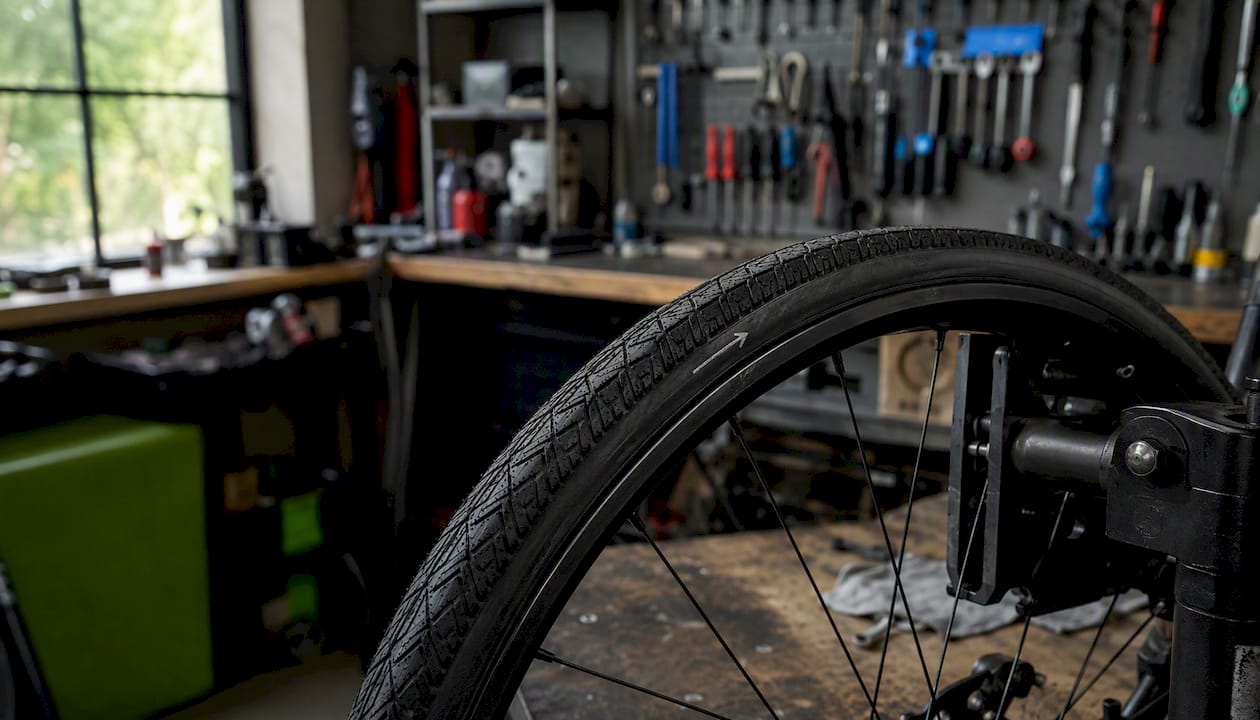
If a rotation arrow appears on your tire’s sidewall, mount it so that arrow points forward at the top of the wheel. That single rule covers the majority of situations. For replacements, the safety-first protocol is equally direct: install the new tire on the front and move the less-worn front tire to the rear. Never bring a worn rear tire to the front.
Here’s the quick-reference version:
- Arrow present: orient so the arrow points in the direction of forward travel when viewed at the top of the wheel.
- FRONT/REAR labels present: fit each tire to the wheel the label specifies, even if the arrows point in opposite directions.
- No arrow, no label: read the tread shape (V or chevron) and use the duty-based rule below.
- Replacing a tire: new tire goes to the front; the current front moves to the rear.
Pro Tip: Before mounting any tire, hold it up next to the wheel and trace the arrow with your finger in the direction the wheel will spin. It takes five seconds and eliminates the most common mounting mistake.
Key Takeaways
Correct bike tire rotation direction is a safety issue first and a performance issue second: always mount the new tire on the front, follow sidewall arrows without exception on treaded tires, and never bring a worn rear tire forward.
| Point | Details |
|---|---|
| Follow sidewall arrows | Mount so the rotation arrow points forward at the top of the wheel; obey FRONT/REAR labels as printed. |
| Off-road direction is critical | MTB and gravel tires lose braking traction and self-cleaning ability when mounted backward. |
| New tire always goes front | Move the less-worn front to the rear; never promote a worn rear tire to the front position. |
| No arrow? Read the tread | V-shapes pointing forward favor rolling efficiency; V-shapes pointing backward at contact favor grip and self-cleaning. |
| Sportfactoryproshop tire selection | Sportfactoryproshop carries directional MTB, gravel, and road tires from performance-focused brands with clear sidewall markings. |
Table of Contents
- How do you read the rotation markings on a bike tire sidewall?
- Why does tread direction affect braking, steering, and grip?
- Which tire types actually require a directional mount?
- How to figure out rotation when your tire has no arrow
- Should you rotate bike tires the way you rotate car tires?
- Mounting checklist and quick safety checks after fitting a tire
- Common myths about tire direction and rotation
- A pro-shop perspective on tire direction and safety
- Sportfactoryproshop has the tires your riding demands
- Sources
How do you read the rotation markings on a bike tire sidewall?
Schwalbe marks most of its tires with a “ROTATION” arrow on the sidewall, and many of its MTB tires carry both “FRONT” and “REAR” labels with separate recommended rolling directions. That approach is standard across most performance tire brands.
Where to look and what each marking means:
- ROTATION arrow: a single arrow printed on the sidewall, usually near the bead. It shows the direction the tire should roll. Point it forward at the top of the wheel.
- FRONT label: mount this tire on the front wheel only, in the direction its arrow indicates.
- REAR label: mount on the rear wheel only. The arrow may point the opposite direction from a FRONT-labeled tire of the same model.
- DRIVE marking: used on some rear-specific tires to indicate the traction-optimized side.
- Wear indicators: small embossed dots or grooves molded into the tread. When they disappear, the tire is at end-of-life regardless of direction.
Some tires print the word “OUTSIDE” or “INSIDE” rather than a rotation arrow. Those markings refer to the tire’s lateral orientation relative to the rim, not its rolling direction, so check both axes before seating the bead.
Why does tread direction affect braking, steering, and grip?
The front and rear wheels do fundamentally different jobs, and tire tread is engineered around those differences. Driving and braking forces act in opposing directions, which is why some tires are designed to be fitted in opposite rotation directions front-to-rear.
Front wheel duties: braking and steering. Front tread patterns prioritize predictable bite during deceleration and the ability to shed mud or debris laterally so the tire maintains contact with the surface. A front tire mounted backward can reduce braking traction precisely when you need it most.
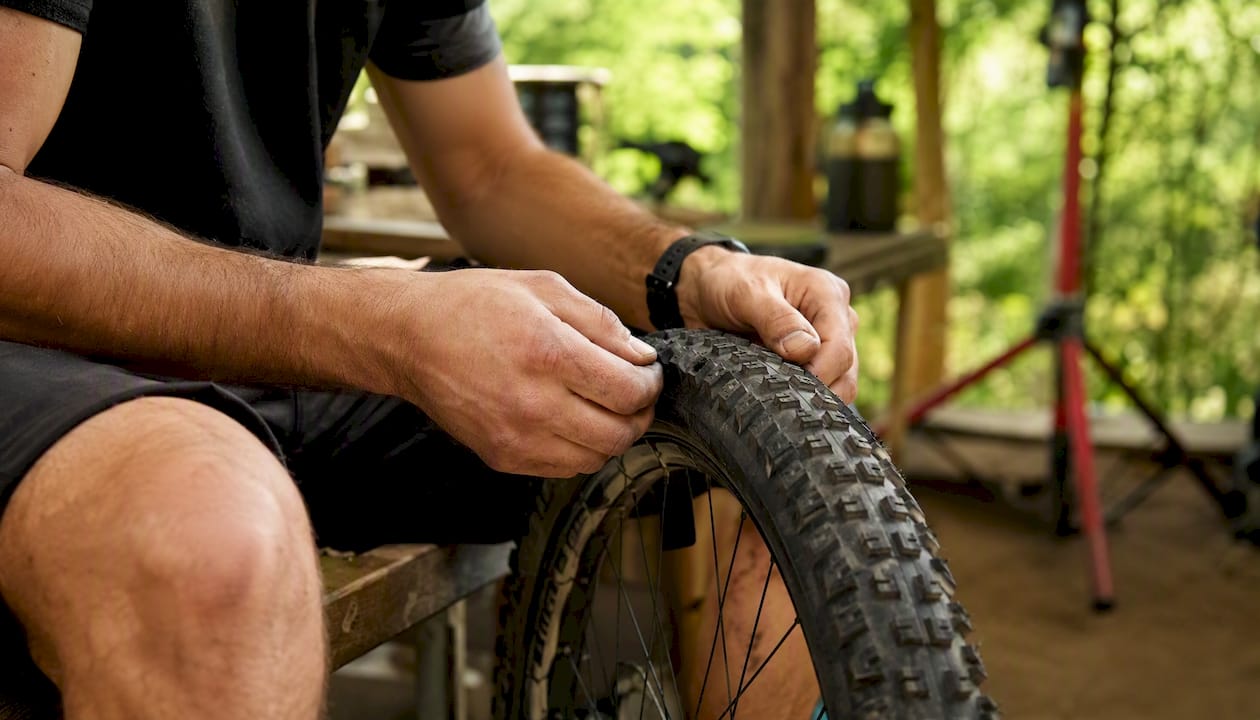
Rear wheel duties: drive and traction. Rear-specific treads often feature knob angles that dig in under pedaling load and resist spinning out. Mounting a rear-specific tire on the front can make the steering feel vague, particularly on loose or wet surfaces.
Pro Tip: On a dual-compound MTB tire, the softer compound is usually on the outer knobs for cornering grip. Mounting it backward puts the harder compound where you need the most bite, which defeats the design entirely.
Road slicks and minimally treaded tires tell a different story. Tread direction has limited practical effect on wet-road grip for smooth or near-smooth road tires, because there is no significant tread pattern to orient. Follow the arrow if one is printed, but don’t stress over it on a pure slick. Off-road is where correct bike tire rotation direction genuinely changes how a tire performs.
Which tire types actually require a directional mount?
Not every tire demands strict orientation. The table below outlines the priority level by category.
| Tire Category | Directional Priority | Key Reason |
|---|---|---|
| Road slick / near-slick | Low | Minimal tread means orientation rarely affects grip |
| Road directional (patterned) | Moderate | Follow arrow; some designs affect wet-road performance |
| Gravel / mixed-surface | Moderate–High | Center tread and shoulder knobs interact with varied terrain |
| MTB cross-country | High | Knob angle affects rolling resistance and cornering |
| MTB enduro / downhill | Very High | Front and rear tires often have opposing rotation directions by design |
| Tubeless (any category) | Matches category above | Sealant distribution is not affected by direction |
Many bicycle tires are directional, and the rule is most critical for treaded tires used off-road. Gravel riders often underestimate this: a gravel tire mounted backward can reduce the center tread’s rolling efficiency and cause shoulder knobs to fold under cornering load rather than grip.
How to figure out rotation when your tire has no arrow
No arrow doesn’t mean no answer. Tread geometry gives you the clues you need.
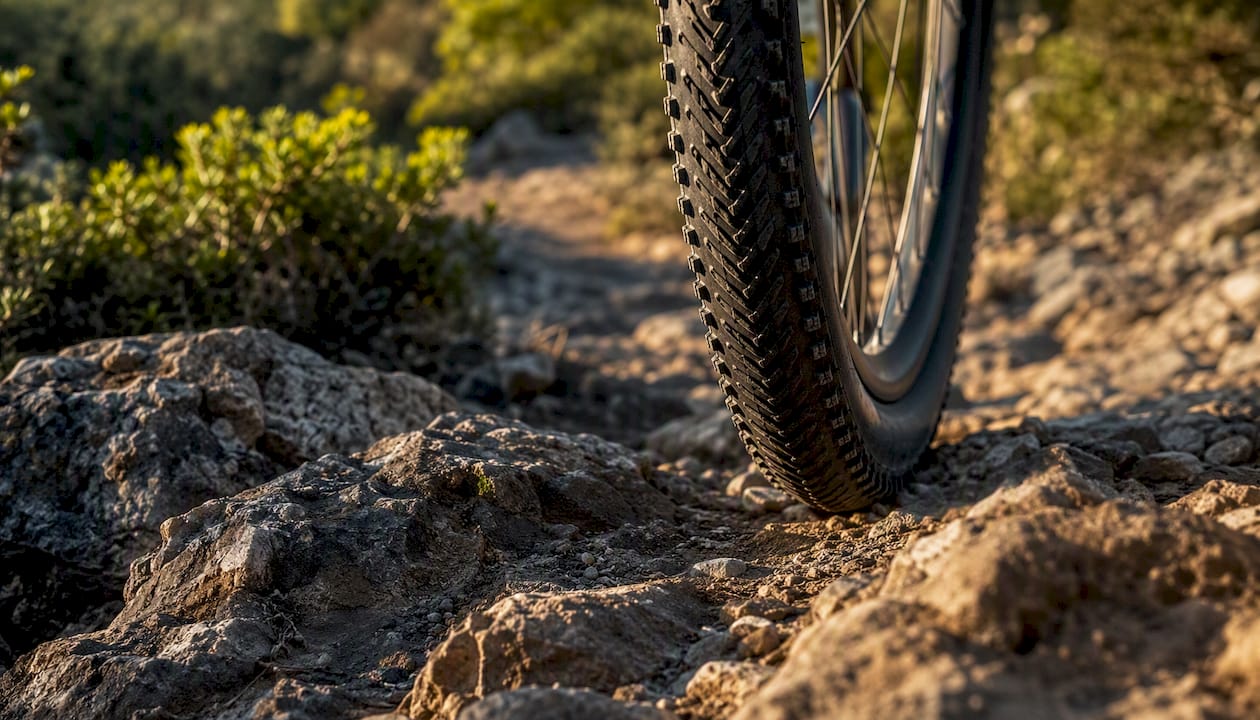
- V or chevron shapes: if the V points forward at the top of the wheel (opening toward the direction of travel), the tire favors rolling efficiency and water evacuation. If the V points backward as the tread contacts the ground, it favors mechanical bite and self-cleaning. Use the V-forward orientation for rear tires on hardpack; V-backward for front tires in mud or loose conditions.
- Knob lean: knobs that lean forward (in the direction of travel) tend to roll faster; knobs that lean backward dig in and brake harder. Set the front tire for braking traits and the rear for traction traits.
- Center ridge vs. shoulder knobs: a pronounced center ridge reduces rolling resistance. Orient it so the ridge runs cleanly in the direction of travel.
Pro Tip: Spin the wheel slowly after mounting and watch how the knobs move through the contact patch. If the leading edge of each knob hits the ground first, the tire is set up for braking. If the trailing edge hits first, it’s set for traction. Neither is wrong — it depends on which wheel you’re looking at.
Should you rotate bike tires the way you rotate car tires?
No. The car-style rotation model does not apply to bicycles, and following it can create a genuine safety hazard.
Car tires wear relatively evenly across all four positions, so rotating them extends overall tire life. Bike tires wear asymmetrically: the rear wears significantly faster than the front because it handles all the drive force and carries more of the rider’s weight during seated pedaling. Moving a worn rear tire to the front puts a degraded tire on the wheel responsible for braking and steering.
The mechanic-recommended protocol:
- When the rear tire is worn out, move the current front tire to the rear.
- Install the new tire on the front.
- Never move a worn rear tire to the front position.
This approach, strongly supported by expert mechanics and shop best practice, keeps the freshest rubber where it matters most for rider safety.
When swapping is acceptable: if both tires are the same model, both are in good condition, and you’re riding low-risk terrain (flat roads, casual trails), swapping front-to-rear is generally fine. Avoid it before high-speed descents, race events, or any ride where front-tire failure would be dangerous.
Pro Tip: Mark the rear tire’s sidewall with a small chalk line when it’s new. When that mark is barely visible from wear, it’s time to replace the rear and rotate the front back.
Mounting checklist and quick safety checks after fitting a tire
Getting the direction right is step one. Getting the tire seated safely is step two.
- Before mounting: confirm the rotation arrow points forward at the top of the wheel. Check FRONT/REAR labels. Verify the tire model matches the intended wheel position.
- Bead seating: use your palms to work the bead onto the rim and push the bead into the rim’s central channel to reduce the force needed at the last section. Never use a metal tire lever on the final bead if you can avoid it.
- Valve alignment: the valve stem should sit perpendicular to the rim. A cocked valve can cause uneven bead seating and slow leaks.
- Pressure check: read the recommended PSI range printed on the sidewall and inflate within that range. Tubeless setups need a burst of air to seat the bead; follow Park Tool’s installation steps to avoid pinching tubes or misseating beads.
- Post-mount ride: take a short, controlled spin at low speed. Any unusual handling, pulling to one side, or rapid pressure loss signals a mounting problem. Stop and recheck before riding at speed.
Pro Tip: After inflating, run your finger around the bead on both sides of the rim. You should feel a consistent, even ridge. Any dip or bulge means the bead isn’t fully seated.
Common myths about tire direction and rotation
A few persistent misconceptions keep circulating in group rides and online forums. Here’s where they go wrong.
- Myth: rotate tires regularly to equalize wear, like a car. Bike tire wear is asymmetric by design. The rear wears faster. Equalizing wear by moving a worn rear to the front puts degraded rubber on the safety-critical wheel. Don’t do it.
- Myth: directional arrows are just for aesthetics or marketing. For road slicks, the practical difference is small. For knobby, directional MTB or gravel tires, a backward mount can reduce braking traction, impair self-cleaning, and cause knobs to fold under load. The arrows reflect real engineering decisions.
- Myth: FRONT and REAR arrows always point the same direction. Sometimes they point in opposite directions by design. A tire with separate FRONT and REAR labels may have the front arrow pointing one way and the rear arrow pointing the other, because the tread is optimized for different forces at each wheel. Always read both labels independently.
A pro-shop perspective on tire direction and safety
The safety-first replacement rule is the one we push hardest at the shop level, and for good reason. Riders often focus on tread wear as a performance issue, but front-tire grip is a control issue. A front tire that loses traction under braking doesn’t give you a second chance to correct it. That’s why the protocol of moving the less-worn front to the rear and putting fresh rubber up front isn’t just a mechanic’s preference. It’s the approach that keeps riders upright.
On the question of directional tires specifically: if you’re riding road slicks on pavement, the direction matters less. If you’re on gravel, cross-country trails, or anything with variable surface conditions, it matters a lot. The knob geometry on a quality directional MTB or gravel tire is engineered for a specific contact sequence. Mounting it backward doesn’t just reduce performance; it can make the tire behave unpredictably in corners or under hard braking.
For riders choosing between front-specific and rear-specific tires, the investment is worth it. A front tire optimized for braking and steering, paired with a rear tire built for traction and drive, gives you a system that works as the engineers intended. That’s the setup we recommend for anyone riding technical terrain or racing.
Sportfactoryproshop has the tires your riding demands
Knowing the correct bike tire rotation direction is only half the equation. The other half is starting with a tire engineered to perform in the right direction.
Sportfactoryproshop stocks directional MTB, gravel, and road tires from performance-focused brands, each selected for clear sidewall markings, reliable tread geometry, and real-world durability. Whether you need a front-specific tire with aggressive braking knobs or a rear-optimized tire built for drive traction, the product pages include mounting orientation details so you’re never guessing at the shop floor. Competitive cyclists and serious enthusiasts can browse the full tire selection, check compatibility with their wheel setup, and get model-specific mounting guidance directly from the team. Visit Sportfactoryproshop to find the right tire for your discipline and get it mounted correctly the first time.
Sources
The most reliable references for tire direction and installation are manufacturer documentation and established shop resources.
- Tire Rotation
- Schwalbetires
- Do Bike Tires Have a Direction? How to Read Tread Arrows
- Which way do I orient my bike tires tread direction and why? - Bicycles Stack Exchange
For model-specific questions, the tire manufacturer’s product page is always the authoritative source. When in doubt, a qualified bike mechanic can confirm correct orientation in under a minute.