


Triathlon Pacing Strategy: How to Race Within Your Limits
Posted by Matt Russ on 1st Sep 2026
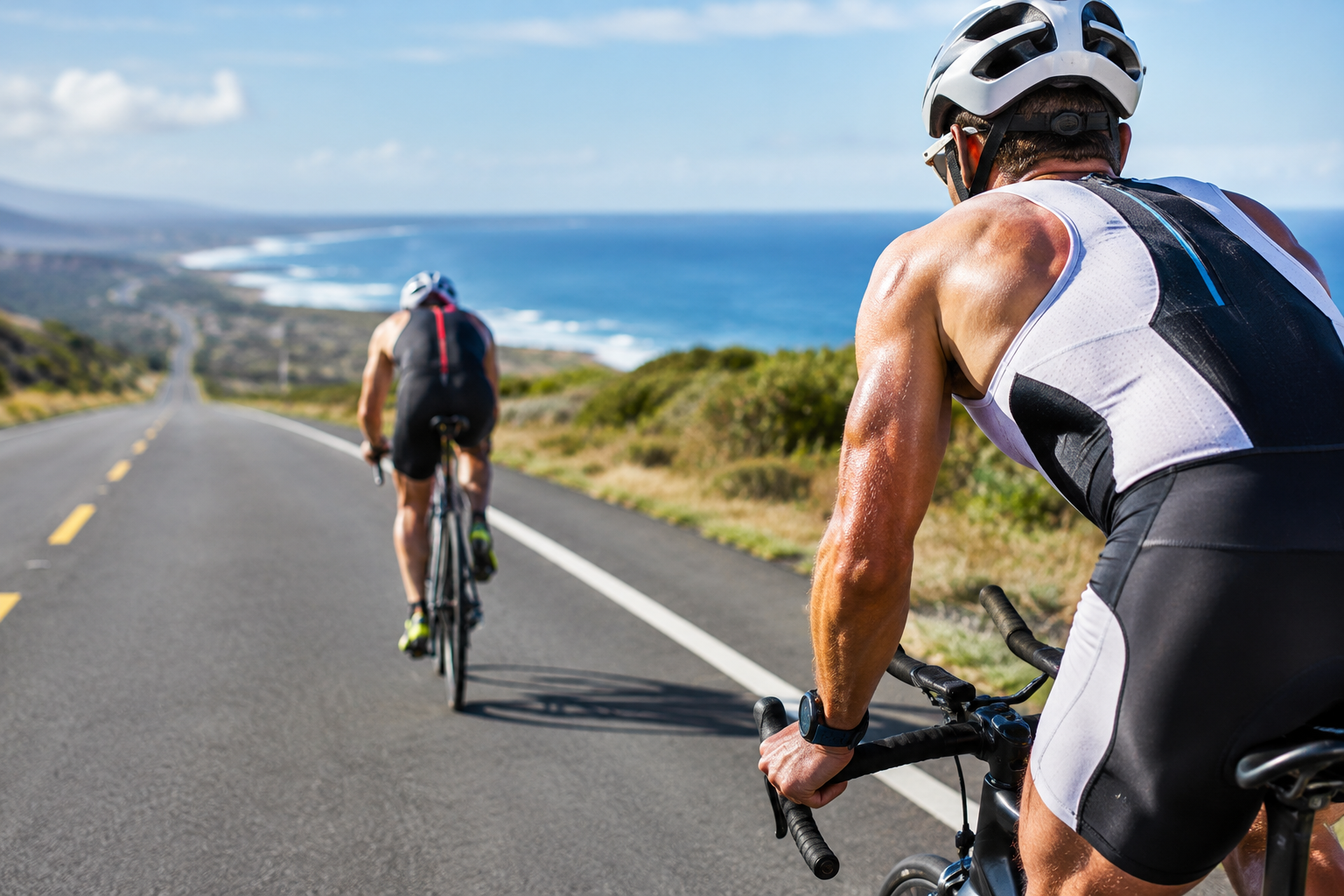
No athlete enjoys being passed in a race. When you sense yourself falling behind, the natural reaction is to speed up and try to keep pace with the athlete who just went by.
But there is a problem with that reaction: you have just abandoned your own race strategy and started racing someone else's.
You may have no idea what that athlete's pacing plan is, what their strengths and weaknesses are, or how much energy they have left. You could be chasing an athlete who has no relevance to your final race placement while expending valuable energy that you will need later.
This is one of the most common mistakes athletes make when it comes to triathlon pacing.
Race Your Own Race
Triathlon pacing is more complicated than pacing for many other endurance sports because you have to account for your individual strengths and weaknesses across three disciplines.
The swim affects the bike. The bike affects the run. And how aggressively you race early in the event can determine how much ability you have left when you reach the final miles.
In a non-drafting triathlon, the race is essentially a time trial. Your objective should be to produce the best overall performance you are capable of—not to constantly react to the athletes around you.
Race the clock, not the competition.
A sound pacing strategy is based on your own physiological limits, conditioning, race distance, course, and fitness. There is a very fine line between under-pacing and over-pacing, and finding that line is one of the most important skills an endurance athlete can develop.
The longer the race, the more important pacing becomes.
In an ultra-distance event, getting caught up in the excitement of the start and pushing beyond your sustainable pace can create problems that may not become apparent for hours. By the time you realize you have gone too hard, the damage may already be done.
The Cost of Going Too Hard
When you push into anaerobic intensities, your body relies more heavily on energy systems that cannot be sustained for long periods. These efforts are metabolically expensive and can create significant fatigue.
They also increase your reliance on limited glycogen stores rather than fat metabolism. If the intensity is high enough, you may eventually be forced to slow down simply to recover from the effort.
This is particularly important for athletes who are not specifically trained to tolerate and repeat high-intensity efforts.
The problem isn't that anaerobic efforts are inherently bad. They can be an important part of training and racing when used appropriately. The problem occurs when an athlete repeatedly exceeds the intensity their race strategy can support.
Your objective is to determine your individual performance envelope and race within it.
Establish Your Pacing Parameters
Field testing and clinical testing can provide useful reference points for establishing a pacing strategy.
Depending on the athlete and the testing protocol, this may include:
- Lactate threshold heart rate
- Aerobic and anaerobic thresholds
- VO2 max or peak VO2
- Functional threshold power
- Running pace at threshold
- Sport-specific heart-rate or power zones
These numbers provide reference points—a sort of physiological "redline"—that can help establish appropriate pacing guidelines.
However, the numbers themselves do not tell you exactly how fast you should race.
Where you should pace relative to your thresholds depends on your conditioning, race distance, course, and ability to sustain the effort.
A highly trained athlete racing a short-course event may be capable of spending considerable time near or even above lactate threshold. An athlete expecting to race for several hours must approach the same physiological markers very differently.
Short-course race simulations can be particularly useful for determining where your thresholds and practical abilities actually lie.
Longer and ultra-distance events are a different proposition. The emphasis shifts toward aerobic intensity, energy conservation, nutrition, and maintaining a sustainable effort for the duration of the race.
Your Pacing Strategy Requires Discipline
Once you establish your pacing parameters, the next challenge is actually staying within them.
That requires discipline.
Race day creates a different environment from training. Adrenaline, competition, spectators, weather, and the excitement of the start can all make a given pace feel easier than it actually is. Athletes frequently produce more power, run faster, or elevate their heart rate above planned levels simply because it is race day.
This is why race data can be extremely valuable.
Reviewing your heart rate, power, pace, and other performance data after an event allows you to determine whether your pacing strategy worked—and where it needs to be adjusted.
Technology makes this process considerably easier. Modern cycling computers, GPS watches, heart-rate monitors, and power meters can collect and display real-time data while also allowing athletes to review their performance afterward.
Use Real-Time Data to Pace Proactively
A basic method of pacing is checking mile splits or using speed on the bike. These metrics can be useful, but they have limitations.
Speed varies considerably with terrain, wind, hills, and course conditions. On a variable course, maintaining a specific speed can result in a constantly changing physiological workload.
Mile splits can create another problem: they encourage a reactive pacing strategy. You see that your last mile was too slow, so you speed up. Then the next mile is too fast, so you back off.
Instead of responding to what has already happened, effective pacing should be proactive.
Real-time metrics such as heart rate, power, and GPS-derived running pace can provide a much better picture of what your body is doing at that moment.
It should become a habit to regularly scan your device during a race and compare what you are seeing with your pacing plan.
The goal isn't to stare at your computer or watch for the entire race. It is simply to make sure you are still executing the strategy you established before the race began.
Don't Make Race Placement Your Goal
Predicting your race placement is a poor primary objective because you have absolutely no control over who shows up on race day.
You control your preparation.
You control your pacing.
You control your nutrition.
You control your execution.
You do not control the fitness or performance of the athletes standing next to you on the starting line.
An athlete can become frustrated or discouraged by a race result even though they actually performed better than ever. Perhaps they achieved a personal-best time but finished lower in their age group because an unusually strong field showed up.
The reverse can also happen.
Instead of making placement the primary objective, establish goals that are within your control. Set a course PR, improve your swim split, execute your bike pacing, run the final miles stronger, or simply execute the race plan you developed during training.
Then let the chips fall where they may.
Make Pacing Automatic
When a sound pacing strategy has been developed and practiced, racing becomes a much more controlled and almost automatic process.
You know what the numbers should look like.
You know what the effort should feel like.
You know when you can push and when you need to hold back.
Most importantly, you don't have to make an entirely new decision every time another athlete passes you.
That athlete may be having a great race—or they may be making a mistake. Either way, it shouldn't change your plan.
The most successful endurance athletes are not necessarily the ones who react the fastest. They are often the athletes who know exactly what they need to do and have the discipline to execute that strategy from start to finish.
Race your own race. Stay within your limits. Let your training determine your pace—not the athlete running or riding next to you.
See Also...
- How to Train Effectively for the Cycling Leg of Your Next Triathlon
This is probably the best internal link for the new article because it directly relates to triathlon-specific pacing, course demands, terrain, elevation, and race preparation.
Read the article
- How to Choose a Bicycle Power Meter: 5 Questions to Ask Before You Buy
Good link from the section discussing power meters and using watts for pacing.
Read the article - Single vs Dual-Sided Power Meters: Do Cyclists Really Need Left/Right Power Analysis?
Useful when discussing power data and how athletes can use performance metrics without becoming overly focused on data.
Read the article - Aerobic Base Training – How Going Slower Gets You Faster
This is particularly relevant to the portions of the article about aerobic pacing, energy conservation, lactate threshold, and long-distance endurance.
Read the article - Training Technology: Does More Data Actually Improve Athletic Performance?
This would fit nicely with the section about race computers, GPS, heart rate, power, and using data without becoming overly dependent on it.
Read the article - Racers: Choose a Power Meter That Won't Make You Buy Twice
Another current power-meter article that could support the discussion of power-based pacing and real-time performance data.
Coach Matt Russ enjoyed a professional coaching career spanning over two decades of working with professional endurance athletes. His athletes have achieved numerous regional, national, international and championship titles under his direction. Matt achieved the highest level of licensing by both USA Triathlon and USA Cycling, and was a licensed USA Track and Field Coach. His accomplishments include being named "Team USA" Coach for the 2011 Beijing World Championship. Head Coach and founder of The Sport Factory, a USA Triathlon Certified Performance Center, he has authored many articles on a wide variety of endurance related topics.