

Training Technology: A Blessing, a Curse, and Sometimes Enough to Drive You Nuts
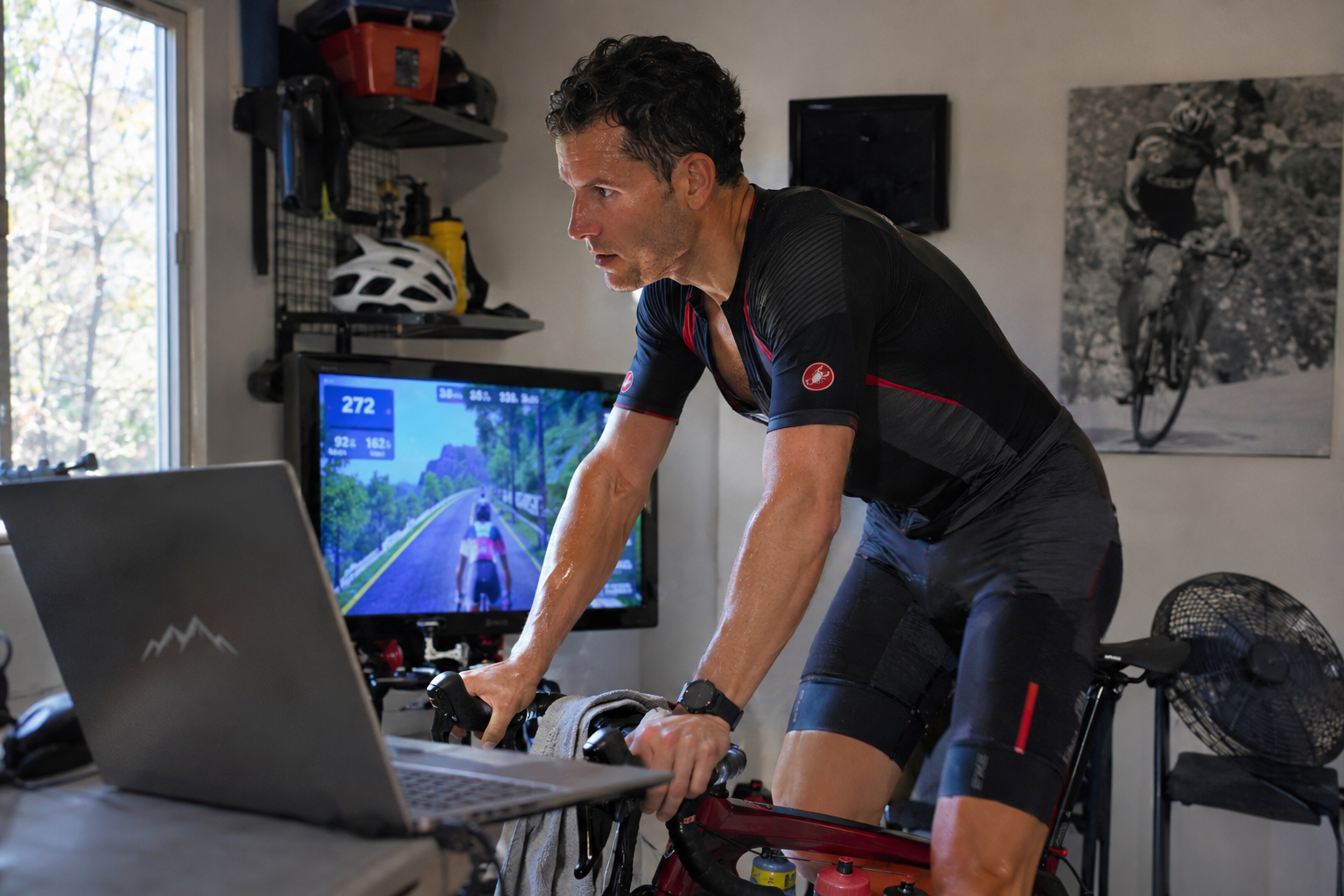
The landscape of endurance training technology has changed dramatically over the past two decades. Just as our phones, computers, and televisions have evolved, so have the devices we use to train and the software we rely on to analyze performance.
Years ago, if you had told me that a single wristwatch could track heart rate, running pace, cycling power, elevation, distance, and GPS position while automatically uploading every workout to an online training platform, I might have questioned your sanity. Today, these capabilities are commonplace.
Indoor cycling technology has progressed just as dramatically. Smart trainers can automatically adjust resistance to simulate hills, reproduce outdoor routes, and allow athletes around the world to compete against one another in virtual races. Training platforms can analyze years of performance data, identify trends, and help coaches adjust workouts without ever meeting their athletes in person.
What a wonderful time to be an endurance athlete!
That is, until your new device arrives, refuses to connect to your phone, requires three firmware updates, and insists that you create yet another account before it will record your first workout.
As a coach, I've come to view training technology as both a blessing and a curse. Which one it happens to be often depends on the day of the week.
Training Technology Is Only as Good as Your Ability to Use It
One of the greatest mistakes athletes make is assuming that purchasing a sophisticated training device will automatically improve their performance.
A power meter, GPS watch, or heart rate monitor doesn't make you faster. It provides information that may help you train more accurately, manage intensity, evaluate progress, and execute a better race strategy.
The value comes from understanding that information and applying it correctly.
I've worked with athletes who owned expensive cycling power meters but used them for little more than displaying speed and distance. Others purchased multisport watches with dozens of advanced features but never learned how to configure the basic training screens.
Before investing in new technology, ask yourself what problem you're trying to solve. Do you need more accurate cycling intensity measurements? Better pacing feedback during running workouts? A way to monitor training consistency? Or are you simply attracted to the latest gadget?
If you don't have a clear purpose for the device, there's a good chance you'll end up paying for features you never use.
And if you're still struggling to operate your toaster, a sophisticated power meter probably shouldn't be your next major investment.
Choosing the Right Training Device
Modern training devices offer an impressive variety of features, but not every feature is useful to every athlete.
A competitive cyclist may benefit substantially from a reliable power meter and cycling computer. A runner preparing for a marathon may need accurate pace, distance, and heart rate measurements. A triathlete may prefer a multisport watch that can record swimming, cycling, running, and transitions within a single activity.
The first consideration should be whether the device meets your actual training needs.
Next, examine compatibility. Many devices communicate through Bluetooth, ANT+, Wi-Fi, or combinations of these technologies. However, support for one wireless standard doesn't guarantee that every device will work with every application or feature.
Before purchasing, confirm that your equipment will communicate with the training platforms, sensors, and computers you already use. This is especially important when combining smart trainers, power meters, heart rate sensors, and third-party software.
Battery life, ease of operation, screen visibility, reliability, and manufacturer support also deserve consideration. A device with fewer features may be the better choice if it consistently performs the functions you need.
Remember that the newest product isn't necessarily the most dependable. Occasionally, allowing manufacturers time to resolve early software problems is a better strategy than being first in line for the latest release.
The Curse of Connectivity
One of the great promises of modern training technology is that everything will communicate automatically.
Your watch records a workout, uploads it to the manufacturer's platform, transfers it to your training calendar, and makes the information available to your coach. In theory, the process should be seamless.
In practice, you may occasionally discover that your workout has vanished somewhere between your watch, phone, and training software.
The problem could involve a Bluetooth connection, an expired account authorization, outdated firmware, a software update, a weak wireless signal, or a temporary problem with a cloud service.
When several manufacturers' products are involved, determining where the failure occurred can become frustrating.
The watch manufacturer may tell you the problem is with the training platform. The training platform may insist that the watch isn't transmitting the information correctly. Meanwhile, you're sitting at your computer wondering why a workout you completed three hours ago still doesn't exist.
As head coach, I've spent more time troubleshooting equipment and software than I ever expected. If there were any justice in the world, I'd receive a monthly check from every manufacturer whose products I've helped athletes configure.
Fortunately, modern synchronization is generally more convenient than the old days of cables, upload cradles, and manually transferring workout files. But greater convenience doesn't eliminate the possibility of technical problems.
Troubleshooting: Start With the Simplest Explanation
When a device stops working, I recommend beginning with the most obvious possibilities rather than immediately assuming something complicated has gone wrong.
This is a practical application of Occam's razor: when several explanations are possible, start by investigating the simplest reasonable ones.
Check whether the device is charged, the sensor battery needs replacing, or the wireless connection has been interrupted. Restarting the device or application often resolves temporary problems.
If the issue continues, confirm that the device and software are running supported firmware and application versions. Check manufacturer compatibility information before installing updates that may affect an important training setup.
Physical problems are another possibility. Sweat, rain, road grime, and repeated handling can damage charging contacts, cables, and sensor connections. Inspect equipment carefully and clean it according to the manufacturer's recommendations.
Avoid disabling antivirus protection or computer security settings simply to force a device to communicate. Modern software should generally function without compromising your computer's security.
If a workout fails to upload, check whether the original activity is still stored on the device. In many cases, the data can be synchronized again or exported manually.
Most importantly, familiarize yourself with your equipment before race day. An important competition is not the time to discover that your power meter won't pair or your watch is displaying the wrong information.
Too Much Data Can Become a Distraction
Modern training devices can measure an extraordinary number of variables. Depending on the equipment, athletes may have access to heart rate, power, pace, cadence, elevation, ground contact time, vertical oscillation, training load, recovery estimates, sleep scores, and numerous other metrics.
The challenge is determining which measurements actually matter.
I encourage athletes to concentrate on a relatively small number of useful indicators rather than attempting to interpret every available number.
For cyclists, power output, duration, intensity distribution, and subjective effort may provide valuable insight into training. Runners may benefit from pace, heart rate, workout structure, and perceived exertion.
Other measurements can be helpful in particular situations, but they shouldn't automatically dictate training decisions.
Wearable recovery estimates and readiness scores are especially easy to overinterpret. These measurements are based on algorithms and indirect physiological signals. They may help identify trends, but they aren't definitive assessments of recovery or proof that an athlete is ready for a demanding workout.
Likewise, a rising heart rate during an endurance session doesn't automatically indicate dehydration. Temperature, fatigue, exercise intensity, and other factors can influence the relationship between heart rate and pace or power.
Good coaching requires interpreting data in context rather than treating every number as an unquestionable fact.
Don't Become a Slave to Your Training Devices
Technology should support your training, not control it.
I've seen athletes become so fixated on maintaining an exact power output or pace that they lose awareness of their surroundings, ignore how they feel, or become frustrated when conditions prevent them from hitting a prescribed number.
There are times when objective measurements are extremely useful, particularly during structured intervals and race-specific workouts. However, athletes should also develop the ability to regulate effort through breathing, perceived exertion, and experience.
Your GPS may lose its signal in a tunnel. A heart rate strap may stop transmitting. A power meter may fail during a race.
When that happens, you still need to know how to train and compete effectively.
I believe every endurance athlete should occasionally complete workouts without constantly checking performance data. This helps develop internal pacing awareness and reduces dependence on technology.
The objective is to use your equipment as a guide rather than allowing it to become a distraction.
Why I Still Believe Training Technology Is Invaluable
After discussing all these potential frustrations, you might wonder why I continue to advocate using training technology.
The answer is simple: when properly applied, objective training data can dramatically improve the information available to both athlete and coach.
Years ago, coaches often relied primarily on written training logs, occasional performance tests, and conversations with athletes. We could prescribe workouts and ask how they went, but detailed information about what occurred during each session was limited.
Today, I can review a cycling workout and examine how an athlete's power output changed throughout the session. I can compare heart rate with power or pace, evaluate training consistency, and identify patterns of fatigue or improvement.
For runners, I can examine pacing across long workouts, evaluate interval execution, and compare performances under similar conditions.
For triathletes, I can review the swimming, cycling, and running components of a race and determine whether pacing or execution may have influenced the overall result.
Perhaps most importantly, I can track these measurements over months and years.
A single workout provides limited information. A long-term record can reveal meaningful trends in fitness, training response, consistency, and race performance.
This allows coaching decisions to be based on more than speculation.
Better Communication Between Coach and Athlete
One of the greatest benefits of modern training platforms is the ability to maintain an ongoing dialogue between coach and athlete.
I can review completed workouts, compare them with the intended training objectives, and adjust upcoming sessions when necessary. An athlete can provide feedback about fatigue, motivation, sleep, and perceived exertion alongside the objective data.
This combination is particularly valuable because the numbers don't always tell the complete story.
An athlete may successfully complete a demanding workout while feeling unusually fatigued. Another may miss a prescribed power target because of excessive heat, inadequate recovery, or an unusually stressful week.
Without communication, the coach might interpret these sessions incorrectly.
Technology makes it easier to identify potential problems, but the athlete's feedback helps determine what those problems actually mean.
I don't believe software will ever replace the relationship between a knowledgeable coach and an engaged athlete. It simply gives both parties better information with which to make decisions.
Technology Doesn't Replace Good Coaching
One of the dangers of increasingly sophisticated training software is the assumption that algorithms can make every decision for an athlete.
Automated training recommendations can be useful, particularly for organizing workouts and identifying patterns. However, training responses vary substantially between individuals.
A computer doesn't necessarily understand the full effect of an athlete's work schedule, family responsibilities, injury history, motivation, or competitive goals.
Even when software incorporates some of this information, its recommendations still require interpretation.
A good coach uses technology to support professional judgment rather than substitute for it.
The same principle applies to athletes who coach themselves. Data can help you understand how your body responds to training, but you must be willing to evaluate that information critically and adjust your approach when necessary.
The most sophisticated training system in the world is of little value if it consistently leads you toward the wrong decisions.
Keep It Simple and Make the Technology Work for You
My advice is to build your training technology around a few essential needs.
Choose reliable equipment, learn its basic functions thoroughly, and confirm compatibility before adding more devices or software. Configure your screens to display the information you actually use, and establish a straightforward process for recording and reviewing workouts.
When problems occur, troubleshoot systematically rather than immediately replacing equipment or introducing additional applications.
Above all, remember that the purpose of collecting data is to improve training and racing decisions.
You don't need every available metric to become a better athlete. You need accurate information, a sound training plan, and the ability to apply what you learn.
The Bottom Line: Training Technology Is a Tool, Not a Shortcut
There is no question that technology has transformed endurance training. Athletes and coaches now have access to information and analytical capabilities that would have seemed extraordinary only a generation ago.
These advances can improve training precision, communication, race execution, and long-term performance analysis. But they also introduce complexity, occasional frustration, and the temptation to become overly dependent on numbers.
The solution isn't to reject technology. It's to use it intelligently.
Learn your equipment, focus on meaningful measurements, and remember that even the most advanced device cannot replace consistent training, recovery, experience, and good judgment.
Training technology can be a blessing or a curse. The difference is whether you're using the technology—or allowing the technology to use you.
By Coach Matt Russ
Coach Matt Russ enjoyed a professional coaching career spanning over two decades of working with professional endurance athletes. His athletes have achieved numerous regional, national, international and championship titles under his direction. Matt achieved the highest level of licensing by both USA Triathlon and USA Cycling, and was a licensed USA Track and Field Coach as well as a SICI Certified Bike Fitter. His accomplishments include being named "Team USA" Coach for the Beijing World Championship. Head Coach and founder of The Sport Factory, a USA Triathlon Certified Performance Center, he has authored many articles on a wide variety of endurance related topics.