

Stationary Bike Workouts for Cyclists: How to Maintain Cycling Fitness While Traveling
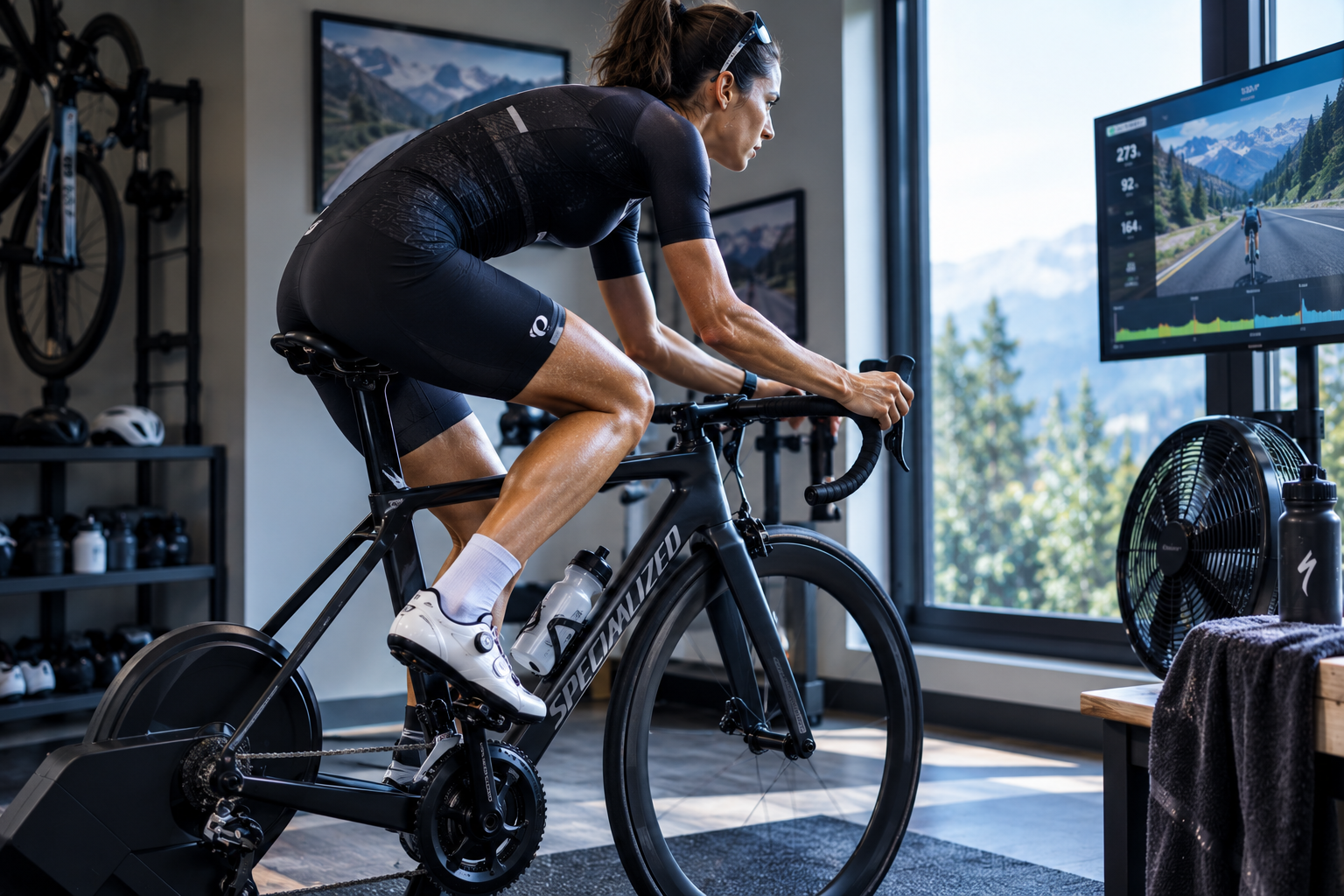
By Coach Matt Russ
For many endurance athletes, maintaining a consistent training schedule while traveling is one of the biggest challenges of the season. Running and swimming can often be accommodated with relatively little planning, but cycling presents a different problem.
Perhaps you've experienced this yourself. You haven't ridden your road bike since the previous weekend, an important race is approaching, and you're beginning to worry about losing fitness. You head to the hotel gym, only to discover an aging stationary bike with limited features and questionable maintenance.
Can you still get a productive cycling workout? And will training on a stationary bike transfer to riding outdoors?
The answer to both questions is yes—with a few important qualifications.
A stationary bike cannot completely replace time on the road. Outdoor cycling develops bike-handling skills, balance, road awareness, and the ability to respond to changing terrain and conditions. However, indoor cycling can help maintain aerobic fitness, develop muscular endurance, and improve pedaling coordination when your regular bike isn't available.
In some cases, a controlled indoor environment is actually advantageous because you can concentrate on a specific training objective without traffic, hills, weather, or interruptions.
The key is choosing the right workout for the equipment available.
Planning Cycling Workouts Around Travel
The first step is planning ahead.
When I design training schedules for athletes who travel regularly, I try to place longer, more general cycling sessions on weekends when they are more likely to have access to their own bikes. Shorter, more targeted workouts can often be scheduled during the week, when travel and work commitments are more likely to interfere.
If you know you'll be away from home, investigate the available exercise facilities before making your hotel reservation.
Some hotels have well-equipped fitness rooms, while others provide only basic equipment. Don't assume that a hotel gym automatically includes a functioning stationary bike.
Whenever possible, ask the hotel directly about its cycling equipment. Find out whether the bike is operational, whether resistance can be adjusted, and whether the display provides cadence or other useful measurements.
Some hotels also have arrangements with nearby fitness centers, which may offer better equipment than the hotel itself.
A few minutes of planning can prevent the frustration of arriving prepared for a workout that you cannot perform.
Adapt the Workout to the Bike You Have
Not every stationary bike offers the same capabilities.
Some models provide adjustable resistance and cadence readings. Others have limited resistance ranges, inaccurate displays, or no reliable way to measure workload.
Before beginning your session, determine what the equipment can do.
-
Resistance adjustment: Can you create both light and heavy workloads?
-
Cadence display: Can you monitor revolutions per minute (RPM)?
-
Workout duration: Can you comfortably sustain the required effort?
-
Bike fit: Can the seat and handlebars be adjusted to a reasonably comfortable position?
-
Equipment condition: Does the bike operate smoothly without excessive movement or unusual noise?
If the bike has no reliable power measurement, use perceived exertion, breathing, and cadence to guide the workout. Heart rate can also help, although it responds more slowly to short intervals and is affected by heat, hydration, fatigue, and other factors.
You may need to modify the workout to accommodate the equipment. That's perfectly acceptable. The goal is to preserve useful training adaptations, not to reproduce your normal cycling session at all costs.
1. Cycling Strength Workouts on a Stationary Bike
Cycling performance depends partly on your ability to produce force through the pedals and sustain that force over time.
Traditional resistance training can help develop strength, but cycling-specific work can also train muscular endurance and the ability to apply force while pedaling.
A stationary bike provides a convenient way to work on these qualities without needing a long road or a sustained climb.
Force Repetitions
Force repetitions emphasize controlled, relatively high-force pedaling.
Workout:
-
Warm up for 10–15 minutes, gradually increasing resistance.
-
Select a heavy resistance that allows smooth, controlled pedaling at a low cadence.
-
Perform 20–30 pedal strokes with an emphasis on applying force smoothly through the pedal cycle.
-
Recover easily for approximately five minutes.
-
Repeat for four to eight repetitions, adjusting the workload to your experience and fitness.
Avoid grinding against a resistance so heavy that you have to strain, rock your hips, or lose control of the pedal stroke.
These efforts are intended to develop force production, not to test how much resistance you can overcome.
Because heavy, low-cadence cycling can place substantial stress on the knees, athletes with knee pain or a history of relevant injuries should choose a more conservative workload or an alternative session.
Leg Tension Intervals
Leg tension intervals target muscular endurance by combining sustained resistance with a relatively low cadence.
Imagine climbing a long, steep hill while maintaining a steady effort.
Workout:
-
Warm up for 10–15 minutes.
-
Increase resistance until the workload feels challenging but sustainable.
-
Maintain a cadence of approximately 50–60 RPM.
-
Ride for five to 20 minutes, depending on your training level.
-
Recover easily for five to 10 minutes between efforts.
-
Complete one to three intervals as appropriate.
Keep your upper body relaxed and your pedal stroke controlled. The effort should be challenging without requiring excessive strain.
If the resistance causes you to grind through the pedals or experience joint discomfort, reduce it.
Aerobic Tension Intervals
Aerobic tension intervals combine sustained aerobic work with moderate resistance.
The objective is to maintain a steady workload for an extended period, similar to riding a long, gradual climb.
Workout:
-
Warm up for 10–15 minutes.
-
Select a moderate-to-heavy resistance.
-
Maintain approximately 65–75 RPM.
-
Ride for 20–60 minutes at a controlled aerobic effort.
-
Cool down for five to 10 minutes.
This workout can be surprisingly demanding because the combination of sustained effort and lower cadence increases muscular loading.
Beginners should start with shorter intervals and moderate resistance. More experienced athletes can gradually extend the duration as their fitness and recovery allow.
2. Cycling Power Workouts on a Stationary Bike
Power training combines force production with the ability to produce that force rapidly.
These workouts can be useful for experienced cyclists who already have an adequate strength and aerobic foundation. However, high-intensity intervals create substantial fatigue and should be introduced according to the athlete's training phase and recovery capacity.
A hotel stationary bike may not provide enough resistance, sufficiently rapid adjustments, or reliable workload measurements to perform every type of power workout effectively.
If the equipment is limited, prioritize a controlled aerobic or cadence session instead.
Power Bursts
Short power bursts develop the ability to produce a brief, forceful effort.
Workout:
-
Warm up for 15 minutes, including several short increases in cadence.
-
Perform a 10-second hard effort against a resistance that allows you to pedal smoothly and quickly.
-
Recover easily for several minutes.
-
Repeat four to six times, adding repetitions only if your technique remains consistent.
The original version of this workout uses recoveries of up to 10 minutes. That may be appropriate for very demanding efforts, but recovery should be based on the purpose of the session and the athlete's readiness to repeat the effort.
Avoid all-out sprints on a poorly maintained stationary bike or one that feels unstable.
Power Intervals
Longer power intervals combine a high workload with a sustained effort.
Workout:
-
Warm up for 15 minutes.
-
Perform three to five intervals of one to three minutes at a hard, controlled effort.
-
Recover easily for approximately the same duration between intervals.
-
Cool down for 10 minutes.
Use a resistance that allows you to maintain a smooth pedal stroke throughout each interval.
If cadence falls dramatically or your form deteriorates, reduce the resistance or shorten the effort.
These intervals are demanding and generally belong in an appropriately planned training block rather than every travel workout.
Short Speed-Endurance Intervals
Short intervals can help develop the ability to repeat hard efforts with incomplete recovery.
Workout:
-
Warm up for 15 minutes.
-
Ride hard for 30 seconds.
-
Recover easily for 30–60 seconds.
-
Repeat six to 10 times, adjusting the number of repetitions to your fitness and the quality of your efforts.
-
Cool down for 10 minutes.
The original workout calls for as many as 20 repetitions. That volume may be excessive for some athletes, particularly when training on unfamiliar equipment.
Start conservatively and increase the workload only when you can maintain consistent effort and recover adequately.
3. Cycling Speed and Cadence Workouts
Speed training on a stationary bike focuses on the ability to pedal quickly and smoothly without relying on heavy resistance.
These workouts are particularly useful on days when you want to work on coordination and leg speed without adding the muscular fatigue associated with heavy tension intervals.
The emphasis is on a relaxed upper body, a stable pelvis, and a smooth pedal stroke.
Progressive Fast Legs
This workout gradually increases cadence until you approach the fastest rate you can sustain without bouncing in the saddle.
Workout:
-
Warm up for 10–15 minutes.
-
Begin at approximately 90 RPM.
-
Increase cadence by five RPM every 30 seconds.
-
Stop increasing when you can no longer maintain smooth, controlled form.
-
Hold that cadence briefly, then recover easily for two to three minutes.
-
Repeat four to six times.
Use light resistance. If your hips begin bouncing or your pedal stroke becomes erratic, reduce cadence.
The objective is to improve coordination at higher pedal speeds, not to achieve an arbitrary RPM number.
Endurance Spinning
Endurance spinning develops the ability to maintain a relatively high cadence comfortably over time.
Workout:
-
Warm up for 10 minutes.
-
Select a light-to-moderate resistance.
-
Maintain a cadence approximately five RPM below the highest cadence you can sustain comfortably with good form.
-
Continue for 10–30 minutes initially, extending toward 60 minutes as appropriate.
-
Cool down for five minutes.
For less experienced cyclists, a shorter session is sufficient. The goal is relaxed, consistent pedaling rather than maintaining a cadence that creates unnecessary tension.
Spin-Ups
Spin-ups are short cadence accelerations performed against relatively light resistance.
Workout:
-
Warm up for 10 minutes.
-
Gradually accelerate your cadence toward your fastest sustainable rate.
-
Maintain the higher cadence briefly without bouncing.
-
Reduce cadence by approximately 20 RPM and recover.
-
Repeat eight to 12 times.
Keep each acceleration controlled. There is no need to sprint or reach an extreme cadence.
4. Which Stationary Bike Workout Should You Choose?
The best workout depends on your training phase, fitness level, available equipment, and the type of session you missed.
| Training objective | Suggested workout | Primary focus |
|---|---|---|
| Muscular endurance | Leg tension intervals | Sustained force at lower cadence |
| Aerobic conditioning | Aerobic tension intervals | Endurance and steady workload |
| Short, hard efforts | Power bursts | Brief forceful efforts |
| Repeated hard efforts | Short intervals | Ability to repeat demanding efforts |
| Pedaling coordination | Progressive fast legs | Smoothness and cadence |
| Leg speed | Spin-ups | Controlled cadence acceleration |
You do not need to complete all these workouts during a single trip. Select one session that fits your existing training plan, and use easy aerobic cycling or rest on the other days as appropriate.
A missed road ride does not automatically require a harder replacement workout.
Sometimes the best choice is simply to maintain a comfortable aerobic effort until you can return to your normal training routine.
5. How Much Does Stationary Bike Training Transfer to Road Cycling?
Stationary cycling can maintain many important components of cycling fitness, including aerobic conditioning, muscular endurance, and pedaling coordination.
However, it does not reproduce every demand of riding outdoors.
Road cycling requires balance, bike handling, cornering, responding to wind, changing gears, navigating traffic, and adapting to variable terrain. These skills require practice on an actual bicycle.
Stationary bikes also differ in their geometry, resistance characteristics, and pedal mechanics. Training on an unfamiliar bike may feel different from riding your own road bike.
The best approach is to use indoor cycling to maintain general fitness while preserving outdoor riding for the skills and adaptations that require it.
When you return home, resume outdoor training according to your schedule and recovery status rather than trying to make up every missed mile.
6. When Should You Use These Workouts?
Most of the muscular-endurance and cadence workouts described here can be adapted for the base and general preparation phases of an annual training plan.
More demanding power intervals should be included when they complement the athlete's overall training program and there is adequate time for recovery.
As your goal race approaches, outdoor riding becomes increasingly important because it allows you to practice race-specific pacing, handling, terrain management, and equipment setup.
For triathletes, indoor cycling can also help preserve consistency during business travel, but it should be integrated with the demands of swimming, running, and recovery.
The key is not to make every hotel workout intense. It is to maintain continuity without creating unnecessary fatigue.
Final Thoughts: Make the Most of the Equipment Available
Travel does not have to derail your cycling training.
A basic stationary bike may lack the features of your home trainer or the freedom of an outdoor ride, but it can still provide a useful workout when approached intelligently.
You can maintain aerobic conditioning, work on muscular endurance, practice high-cadence pedaling, and perform selected intervals without access to your road bike.
Plan ahead, assess the equipment, choose a workout that fits your training objectives, and adjust the effort to your current condition.
The goal of training while traveling is to maintain momentum—not to turn every limited opportunity into a maximal workout.
Use the stationary bike as one more tool in your training toolbox, then return to the road when the opportunity presents itself.
Originally published in Inside Triathlon Magazine.
Coach Matt Russ enjoyed a professional coaching career spanning over two decades of working with professional endurance athletes. His athletes have achieved numerous regional, national, international and championship titles under his direction. Matt achieved the highest level of licensing by both USA Triathlon and USA Cycling, and was a licensed USA Track and Field Coach. His accomplishments include being named "Team USA" Coach for the Beijing World Championship. Head Coach and founder of The Sport Factory, a USA Triathlon Certified Performance Center, he has authored many articles on a wide variety of endurance related topics.