


How to Choose a Bicycle Saddle for Comfort and Fit
Posted by Matt Russ on 1st Sep 2026
Choosing the right bicycle saddle can make a significant difference in your comfort, riding efficiency, and overall cycling experience. With hundreds of saddle designs, widths, shapes, and padding options available, finding the right one can feel like an endless process of trial and error. However, understanding how saddle design, riding position, and proper adjustment work together can help narrow your options and prevent unnecessary discomfort.
The best bicycle saddle isn't necessarily the most expensive, the most padded, or the most popular. It's the one that supports your anatomy and accommodates the type of riding you do.
Choose a Saddle Designed for Your Type of Cycling
The first step in choosing a bicycle saddle is to consider how you ride. Road cyclists, mountain bikers, recreational riders, and triathletes distribute their weight differently and use different riding positions. A saddle that works well for one cyclist may be uncomfortable or impractical for another.
Recreational cyclists typically ride in a more upright position, placing a greater proportion of their weight on the saddle. A saddle with an appropriate width and supportive shape can help distribute that pressure comfortably.
Road cyclists generally ride with a more forward-leaning torso, placing additional weight on their hands and feet. Their pedaling cadence and frequent changes in effort often make a narrower saddle with a shape that permits unrestricted leg movement a good starting point.
Triathletes and time trialists spend extended periods in an aerodynamic position with the torso lowered and the pelvis rotated forward. This changes the areas of the saddle that bear the most pressure, making a saddle specifically suited to aerodynamic riding worth considering.
Mountain bikers frequently shift their weight forward, backward, and sometimes behind the saddle on steep descents. They benefit from a design that allows easy movement without creating unnecessary friction or interfering with bike handling.
Don't assume the saddle supplied with your bicycle is automatically the right one for you. Manufacturers must balance many factors when building a complete bike, and the original saddle may not match your anatomy or preferred riding position.
Saddle Width: Start With Your Sit Bones
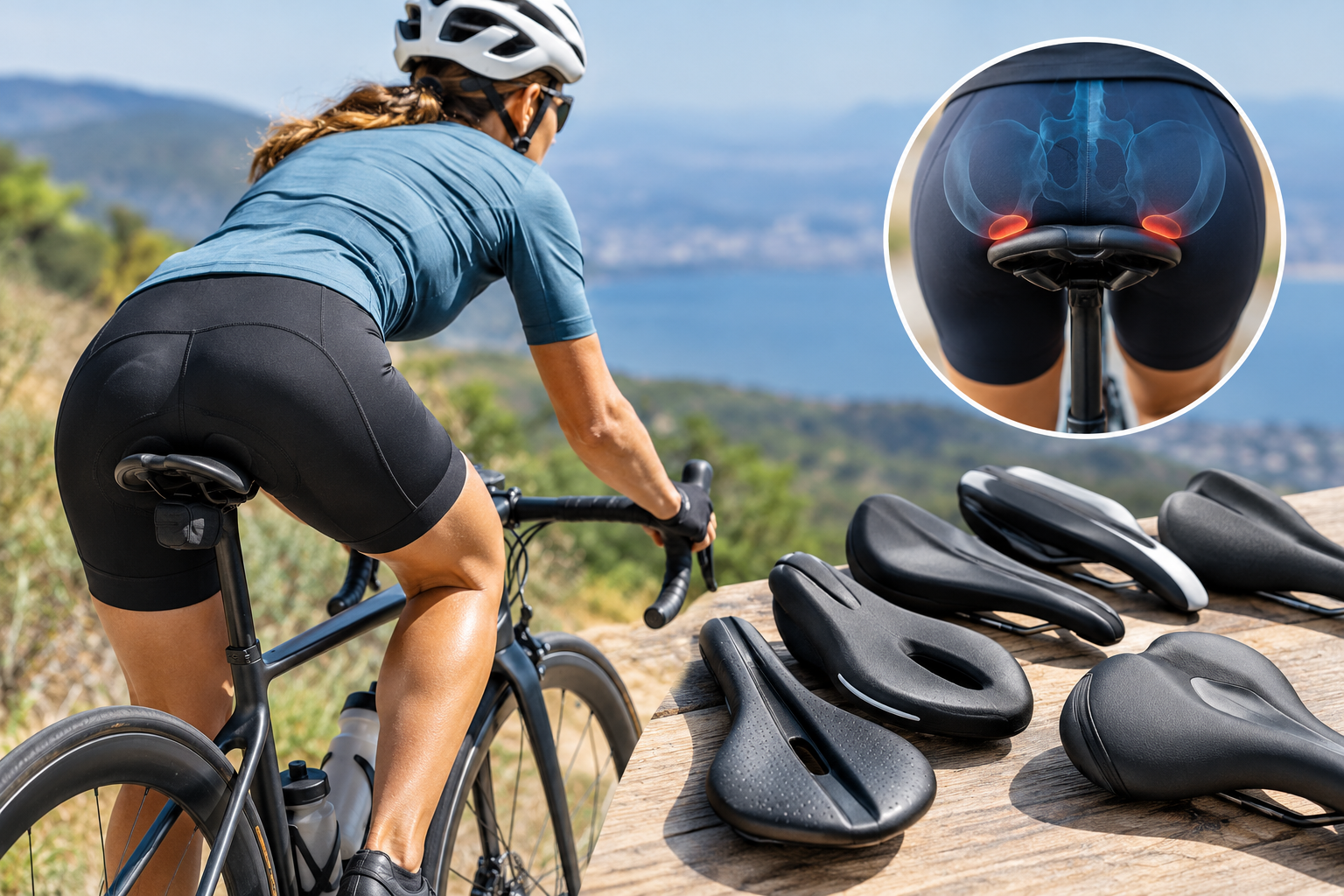
For most cyclists, the goal is to support the body's weight primarily through the ischial tuberosities, commonly called the sit bones. These are the bony points you can feel when sitting on a firm surface.
A properly sized saddle provides a stable platform for these structures while minimizing excessive pressure on the sensitive soft tissues farther forward.
Mild soreness around the sit bones can sometimes occur when increasing riding volume or returning to cycling after a break. Appropriate cycling shorts, a suitable chamois lubricant, and gradual adaptation may help. Persistent or severe pain, however, should not simply be accepted as part of cycling.
Pressure, tingling, or numbness in the perineal area deserves particular attention. These symptoms can indicate excessive pressure or a fit problem and should not be ignored.
Saddle width is a useful starting point. Pelvic anatomy varies considerably, so avoid assuming that body size or sex alone determines the correct width. Many bike shops offer sit-bone measurement tools to help identify an appropriate range of saddle widths.
Saddle Padding, Cutouts, and Shape
One common misconception is that a thicker, softer bicycle saddle will always be more comfortable. Excessive padding can compress under the rider and potentially increase pressure on sensitive tissues. A firmer saddle that supports the sit bones appropriately may feel better over longer rides.
The goal is not to eliminate all padding. It's to find the right combination of support, shape, and cushioning for your anatomy and riding position.
Some saddles feature a central cutout or recessed channel intended to reduce pressure on sensitive soft tissues. For cyclists who experience numbness or discomfort, these designs may help. However, a cutout is not a guaranteed solution, and the wrong shape or width can create pressure around its edges.
Saddles also differ in their overall profile. Some have a relatively flat top, while others are curved or raised toward the rear. Nose shape, saddle length, padding distribution, and the shape of the center channel can all affect how a saddle feels.
Women's-specific saddles are designed around considerations of female anatomy, but individual differences remain significant. The most effective approach is to evaluate the actual fit rather than rely on a label alone.
Ultimately, there is no universally comfortable bicycle saddle. One rider may swear by a particular model while another finds it unbearable. Whenever possible, look for a shop that offers saddle trials, demo programs, or a reasonable exchange policy.
Bicycle Saddle Position: Tilt and Fore-Aft Adjustment
Even the right saddle can become uncomfortable when installed in the wrong position.
Saddle tilt
Saddle angle can influence how your weight is distributed and how stable you feel on the bike. If you continually slide toward the handlebars, the nose may be tilted too far downward. If you find yourself pushing backward to maintain your position, the saddle angle may also need attention.
A nearly level saddle is a reasonable starting point for many recreational and road cyclists, although saddle shape and riding position can affect the ideal angle. Triathletes may prefer a modest downward tilt to accommodate an aggressive aerodynamic position.
Make small adjustments and evaluate the results rather than making dramatic changes all at once. Before adjusting the saddle, mark its original position so you can return to the previous setup if necessary. A digital angle gauge can also help you record and repeat adjustments.
Saddle height and fore-aft position
Saddle height and fore-aft position influence pedaling mechanics and your relationship to the bicycle's bottom bracket, which serves as the center of the pedaling system.
Avoid moving the saddle forward or backward simply to compensate for excessive reach to the handlebars. Reach problems are often better addressed by evaluating stem length, handlebar position, or aerobar setup, although the correct solution depends on the complete bike fit.
Saddle adjustments affect one another, so changes should be evaluated as part of the overall riding position.
Why Triathletes Need Special Saddle Considerations
Triathletes can be particularly susceptible to saddle discomfort because they often spend long periods with their torsos low and their pelvises rotated forward. This position can shift pressure toward the front of the saddle, where a conventional road saddle may not provide the right support.
New triathletes sometimes respond to discomfort by sitting upright, sacrificing aerodynamics and making it difficult to maintain a consistent position.
A professional bike fit is a useful starting point for resolving these issues. The saddle, pelvic rotation, handlebar or aerobar position, and overall reach must work together.
It's also important to adapt gradually. Begin with manageable intervals in the aerodynamic position and increase their duration as comfort and control improve. A more aggressive position is not automatically faster if you cannot maintain it comfortably or produce consistent power.
Persistent numbness, pain, or genital symptoms warrant a change in position and assessment by a qualified professional or healthcare provider, rather than simply trying to ride through them.
Why Your Saddle May Feel Different on an Indoor Trainer
Many cyclists notice that a saddle feels comfortable outdoors but becomes uncomfortable during indoor training. This is often because riding on a stationary trainer involves fewer natural movements and less frequent changes in position.
Outside, small shifts in body weight occur as you corner, climb, descend, and respond to changes in terrain. On a trainer, you may remain almost motionless for extended periods, concentrating pressure on the same areas.
Try standing briefly on the pedals at regular intervals, changing position when appropriate, and avoiding unnecessarily long periods without movement. Check that your trainer setup maintains a suitable bicycle position and that your saddle is adjusted correctly.
Triathletes may also find that maintaining an aerodynamic position indoors is more challenging. If discomfort develops, shorten the intervals in that position and build up gradually rather than forcing yourself to remain low for the entire session.
Finding the Right Saddle Takes Patience
Choosing a comfortable bicycle saddle is a process of matching anatomy, riding style, saddle design, and bike fit. Start with an appropriate width, consider the shape and padding, and pay attention to pressure or numbness rather than assuming discomfort is inevitable.
Make one adjustment at a time and evaluate it over several rides, provided the change does not cause significant pain or concerning symptoms. If you continue to struggle, a professional bike fit and a saddle trial program can save considerable time and frustration.
Once you find a saddle that works exceptionally well, consider keeping a record of the exact model, width, and setup measurements. If that model is discontinued or redesigned, having the details can make finding a suitable replacement much easier.
The right saddle should help you focus on your ride—not on how uncomfortable you are.
Coach Matt Russ enjoyed a professional coaching career spanning over two decades of working with professional endurance athletes. His athletes have achieved numerous regional, national, international and championship titles under his direction. Matt achieved the highest level of licensing by both USA Triathlon and USA Cycling, and was a licensed USA Track and Field Coach. His accomplishments include being named "Team USA" Coach for the Beijing World Championship. Head Coach and founder of The Sport Factory, a USA Triathlon Certified Performance Center, he has authored many articles on a wide variety of endurance related topics.