

Field Testing VS Clinical Testing for Endurance Athletes
Posted by Matt Russ on 21st Sep 2015
by Coach Matt Russ for Performance Conditioning
 There are a great number of clinical and non-clinical tests and protocols
that may be administered to or performed by a runner. Clinical testing offers a
wealth of information. A gas exchange test will provide information such as
peak VO2 and current fitness level, specific energy system development and
utilization (fat vs. sugar burner), aerobic and anaerobic thresholds, return to
homeostasis from peak VO2, even genetic propensity. Blood lactate testing
profiles the athlete's heart rate/speed/power and exertion in relation to blood
lactate (BL) concentration, for accurate assessment of fitness progress and
establishment of training zones. There are standard clinical tests administered
to profile an athlete's overall fitness, but the test equipment is also used in
peer reviewed or clinical studies, which are the foundation for coaching and
training methodology.
There are a great number of clinical and non-clinical tests and protocols
that may be administered to or performed by a runner. Clinical testing offers a
wealth of information. A gas exchange test will provide information such as
peak VO2 and current fitness level, specific energy system development and
utilization (fat vs. sugar burner), aerobic and anaerobic thresholds, return to
homeostasis from peak VO2, even genetic propensity. Blood lactate testing
profiles the athlete's heart rate/speed/power and exertion in relation to blood
lactate (BL) concentration, for accurate assessment of fitness progress and
establishment of training zones. There are standard clinical tests administered
to profile an athlete's overall fitness, but the test equipment is also used in
peer reviewed or clinical studies, which are the foundation for coaching and
training methodology.
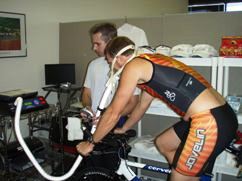
Clinical testing is great for creating a “big picture” comprehension of an athlete's fitness, but also has some drawbacks, the first of which is the cost. The athlete may not be able to afford the cost of the test, or the time needed to schedule it. Additionally, receiving a lot of data without the understanding or application of it is fairly useless to the athlete. I have had athletes bring me stacks of charts, graphs, and numbers from their clinical test results, in which they had found little relevance or application to their training. If the test and results are not explained in detail, in terms the athlete can understand, the athlete will not receive any return on their investment in clinical testing. The tests themselves in some cases can be a bit intimidating. Blood lactate testing requires drawing multiple blood samples, and VO2 testing requires the athlete to wear a mask that captures respiratory gasses. Not every athlete reacts well to these tests and few enjoy them.
For these reasons I recommend clinical testing no more than one to two times per season, preferably after a peak. For the completely unconditioned athlete or person brand new to a sport, I advise a bit more frequency in the first season as fitness levels will change more dramatically in these individuals. We use these clinical tests for accurate overall comparison and contrast, but what about the spaces in between? How do the athlete and coach gauge the efficacy of the training plan throughout the season? This is where field testing comes in.
Field tests will not offer the wealth of information that clinical tests deliver, but they are easy to administer, inexpensive (or free), practical, and can be performed more frequently. The purpose of a field test is two-fold: to accurately gauge progress of fitness, and to establish accurate training zones. It is important to note that some protocols are used to predict clinical values. These are just that - predictions or estimates, not actual clinical results – and should be taken at face value. The great thing about field tests is that you are using actual performance to predict performance, and if executed correctly, field tests can give very relevant and useful information to the athlete. Formula-based training zones (ex. 220-age) can be highly inaccurate and should not be used for athletic training. Field testing generally uses a percentage of the tested value, not an age based formula, to created heart rate training zones. Training zones are moving targets that can fluctuate throughout the season as well as year to year as the athlete ages or becomes more fit.
You may find that there are a number of running field test protocols and training zone systems created from the results. In the case of heart rate training, most field tests are trying to get to the same place- the lactate threshold heart rate, which in itself is a predication of the lactate threshold, defined as 4 m/ml of blood lactate. But some use an entirely different methodology, such as Jack Daniel's VDOT test, or paced-based training zones. All are trying to “divide the performance pie” into pieces to target various energy systems or fitness substrates. Max heart rate tests are not desirable due to difficulty in achieving this number (and the stress on the athlete), but also owed to the fact that max heart rate is not a trainable number. Some zone systems use as little as four zones, while others use as many as seven. Although different tests and training systems may have their pros and cons, I find that coaches can tend to place too much emphasis on the different protocols as being “right” or “wrong” vs. the administration, consistency, and accuracy of the test itself.
I divide protocols into two basic categories- ramp tests and time trial/distance tests. A ramp test requires a consistent increase in stress, usually in 1-minute increments, until the athlete “taps out” or cannot continue. This can be readily performed on a treadmill by increasing speed, incline, or both. A time-trial test calls for the athlete to run as fast as they can for a prescribed time period, and of course a distance test gauges how long it takes to complete a particular distance. My preference is towards time trial tests in which the athlete runs a particular time period, and average heart rate, distance, and perceived exertion are recorded.
A basic time-trial test for lactate threshold is as follows:
- Warm up with 10 minutes of easy running
- Perform 4-5 x 100m run strides at a sub-maximal level
- Run at an endurance level for 2 minutes then increase intensity every 2 minutes until just under 5k pace. Hold slightly under 5k pace for 5 minutes.
- Recover with 8 minutes of easy running.
- Perform a 10 minute time trial, recording distance, pace, heart rate avg./max, and perceived exertion
- Cool down 10 minutes
A basic ramp test for performance is as follows…
- Begin running at 5 mph at a zero grade
- Increase incline 1% after 1 min.
- Increase speed .5 mph after 1 min.
- Continue alternating speed and incline until the athlete “taps out” or can not continue the test.
- Record speed, incline, and heart rate data for the last step that the athlete completed.
A basic distance test for performance and LTHR is as follows…
- Test will be performed on a track or flat course using a GPS
- Warm up 10 minutes
- Perform 4 x 100m run strides
- Take a 400m warm up lap increasing pace
- Objective is to complete 2 miles as quickly as possible
- Record time, max and average heart rate, and perceived exertion
Ramp tests are fairly easy to perform or administer but time trial/distance tests offer a more accurate view of LTHR. In reviewing heart rate data there should not be a wide variance between threshold and max heart rate, or a stochastic heart rate. You may see slight variance in heart rate as the athlete goes into oxygen debt, and a slight increase in heart rate during the last 1-2 minutes of the test as the athlete is anaerobic. Perceived exertion should be very high. It is important to note that the definition of efficiency is higher output (speed or distance) at the same or lower metabolic cost (heart rate).
The “weak link” of any field test can be the athlete themselves. Not every athlete has the focus or ability to push themselves to a maximal level in a non-competitive environment. This may especially be true in the case of a self-administered field test. It is important to note that the purpose of the field test is to mimic or create “race like” conditions in which the athlete is properly rested, fueled, hydrated, and mentally focused. Having the coach administer the test can greatly increase the accuracy of the results, as can testing multiple athletes in a competitive environment. Explain the purpose of the test, the intensity, how it should feel, and perhaps apply a bit of competitive pressure.
The first test is your baseline, and once it established you will have a performance marker to work off of. The athlete will push themselves harder if they have an objective to beat, and subsequent tests may be easier to administer. Most field time-trial tests are under 20 minutes. Even a test this short can be very stressful, and it may be hard for some athletes to achieve a 20 minute time trial effort in a non-competitive setting. For this reason I opt for a shorter test with a more extended warm up.
Consistency of the field test is the most vital consideration. If you are not testing in the same conditions, the tests will not be comparable. Athletes will place a lot of value on the test results, and it requires an “apple to apple” comparison. You must keep the test environment, course, conditions, and protocol the same to the highest degree possible. A change in heat, humidity, wind, slight variations in course or elevation, and even equipment can affect the compatibility to the previous test.
The athlete must be sufficiently rested prior to the test. I recommend testing the week after a rest and recovery week. It is easier to manipulate the environmental factors indoors on a treadmill, especially the temperature, humidity and of course wind. But treadmills will vary slightly, or sometimes significantly, if they are not calibrated. This will affect the distance traveled and speed readings. Try to test on the same treadmill each time and if possible calibrate it prior to the test. The athlete will produce more heat on the treadmill – make sure you have a fan set at the highest setting on them during the test. This in and of itself can affect heart rate data by several beats or more. Safety is also a consideration; especially if the athlete is not used to running fast on a treadmill.
It is important to note that any test, if administered correctly and accurately, only captures an athlete's fitness and performance for a brief period of time on a particular day. The more data points available, the more the coach can “connect the dots.” Testing once per season does not give the athlete and coach a lot of information, but field testing quarterly, clinically testing once per season, and consistently analyzing uploaded training and race data creates a very clear picture.
Each race is a field test in itself. Our athletes submit an online race recap with detailed inputs for pace, power, heart rate, splits, conditions, etc. This information is kept in a database for ready comparison from race to race and season to season. Race data is a great way to check the validity of field test data. For instance, if there is a significant difference between heart rate data garnered from a race, when compared to the last field test, it may mean the athlete was not sufficiently motivated or rested for their field test.
“C” level races or training races are excellent field tests as well. I have found that a few 5k races, sprinkled in throughout the season, are great field tests. A 5k race offers the competitive environment that may pull that extra “x” percent out of the athlete. Remember, you are using field testing to capture a true threshold effort. My protocol is to have the athlete perform a progressive warm up prior to the race. I do not want them to go into the race cold, creating too much oxygen debt. I have them take a split at the 1-mile mark and another in the last 400m (or approx. just before the 3 mile mark). The athlete will likely be super threshold at this point once they “smell the barn” and are sprinting for the finish. The second split can be used to create heart rate training zones based on a percent lactate threshold heart rate.
Today's technology makes field testing very easy, and coach and athlete can graphically compare information. GPS based heart rate monitors allow you to separate out metrics and get accurate pace and distance data without a coach administering the test. Effectively explaining and communicating the significance of the data to the athlete is important. An athlete that recognizes progress and performance will be more invested in their training plan.
Matt Russ has coached and trained athletes up to the professional level, domestically and internationally, for over 15 years. He has achieved the highest level of licensing by both USA Triathlon and USA Cycling, and is a licensed USA Track and Field coach. Matt is head coach and owner of The Sport Factory, and coaches athletes of all levels full time. He is also freelance author and his articles are regularly featured in a variety of magazines and websites. Visit www.thesportfactory.comfor more information or email him at coachmatt@thesportfactory.com