

Shorter Bicycle Cranks of 5-10mm Reduce Knee Pain Without Power Loss
Shorter Bicycle Cranks of 5-10mm Reduce Knee Pain Without Power Loss
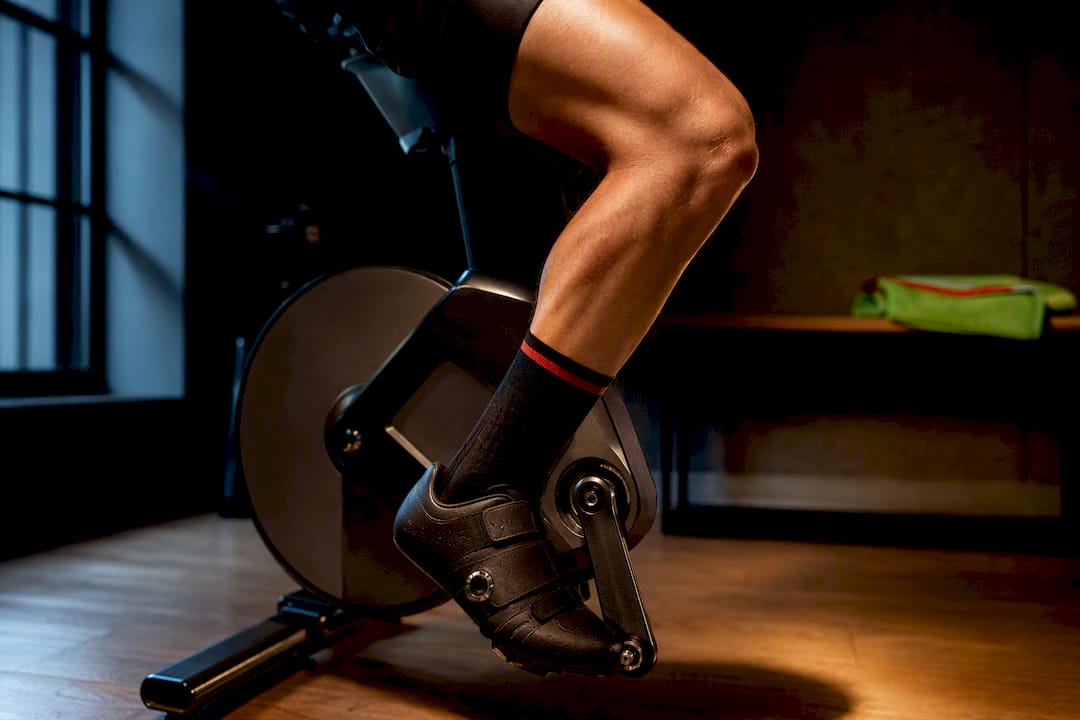
Shorter cranks are the most useful change when your hip or knee pinches at the top of the stroke, you’re chasing a lower aero position, or you need more ground clearance on technical terrain. If none of that applies, keep your current length. When you do change, move in 5–10 mm steps, retune your saddle height, and test on real rides before committing.
TL;DR:
- Shorter cranks of 165 mm or below can reduce knee pinching, improve hip flexibility, and help maintain a lower, more aerodynamic position without sacrificing power.
- Small adjustments of 5 to 10 mm in crank length significantly change joint angles and pelvic motion, offering injury prevention benefits especially for older or overuse-prone riders.
- When switching to shorter cranks, riders should raise saddle height and reassess cleat position and reach to avoid discomfort and inefficiency.
- Research shows perceived exertion drops with shorter cranks, but actual power output remains consistent, meaning comfort and joint stress are the main benefits.
- Choice of crank length varies by discipline and body type, with time trialists and gravel riders often benefiting most from shorter options tailored through professional fitting.
Table of Contents
- What Is Crank Length and How Does It Affect Your Body on the Bike?
- What Does the Research Say About Crank Length and Performance?
- How Do You Choose the Right Crank Length for Your Body?
- What Fit Changes Should Follow a Crank Length Swap?
- How Do You Test a New Crank Length Without Wasting Money?
- Does Crank Length Matter Differently for Road, TT, Gravel, and MTB?
- Does Leg Length Discrepancy Change the Crank Length Equation?
- What I’ve Learned Fitting Riders to the Right Crank Length
- Where to Find Compatible Cranksets and Fit Support
- Sources
- FAQ
What Is Crank Length and How Does It Affect Your Body on the Bike?
Crank length is the distance, in millimeters, from the center of the bottom bracket axle to the center of the pedal spindle. It’s the arm your foot pushes through, and it sets the diameter of the circle your pedal traces with every revolution. Standard road and gravel cranks have historically clustered around 170 to 175 mm, but shorter options at 165 mm and below have become far easier to find as more brands add them to their lineups.
That circle diameter matters more than most riders assume. A longer crank widens the pedal circle, which pushes your knee closer to your chest at the top of the stroke and stretches your hip further at the bottom. A shorter crank shrinks that circle, easing both joints through a smaller range of motion. This is why crank length shows up constantly in bike-fit conversations that start with knee pain or hip impingement rather than power complaints.
The biomechanical chain works like this:
- Hip flexion at the top of the pedal stroke decreases as cranks get shorter, giving more room before the thigh meets the torso.
- Knee flexion follows the same pattern. Riders with a history of anterior knee pain often notice less pinching sensation with a shorter arm.
- Anterior pelvic tilt becomes easier to hold. With less hip closure required at top-dead-center, the pelvis doesn’t need to rock backward to compensate, which helps riders maintain a stable, powerful position.
- Non-sagittal plane motion, meaning the side-to-side rocking and rotation of the pelvis that isn’t part of the “up and down” pedaling motion, drops measurably with shorter cranks. That’s a detail most casual explanations skip, but it’s one of the more consistent findings in recent kinematics research.
Here’s the part that surprises a lot of riders: torque and length are directly linked, but power usually isn’t. A longer crank gives you more leverage, meaning more torque for the same pedal force. That sounds like it should translate into more speed. In practice, cadence and force adjust to compensate, and total power output stays remarkably stable across a normal range of crank lengths. The body appears to self-regulate, spinning slightly faster on shorter cranks and slightly slower on longer ones, netting out to similar wattage. That’s the piece of the puzzle that reframes crank length as a fit and comfort lever first, and a power lever only at the margins.
What Does the Research Say About Crank Length and Performance?
The clearest evidence available right now comes from two directions: randomized crossover trials that swap crank length mid-study, and kinematics research that tracks joint angles frame by frame.
A randomized crossover trial comparing 165 mm, 170 mm, and 175 mm cranks found that riders reported lower perceived exertion on the shorter lengths, even though cycling economy and sprint power showed no statistically significant differences across the three sizes. In plain terms: riders felt like they were working less hard on shorter cranks, without actually producing less power.
Separately, a 2025 study on minor crank length adjustments tested changes in the 5 to 10 mm range and found:
- No measurable change in mean power output.
- Significant reductions in knee and hip flexion angles.
- Reduced non-sagittal pelvic motion, the rotational “wobble” tied to overuse strain.
- Easier adoption of a lower torso angle, useful for anyone chasing an aero position.
Key finding: A 5–10 mm crank length reduction changed joint kinematics enough to matter for injury prevention and aero positioning, without a measurable power penalty in the study’s testing conditions.
The practical read is consistent across both studies: comfort and joint stress improve with shorter cranks more reliably than power output does. If you’re expecting a wattage jackpot from swapping to 165 mm cranks, the data doesn’t back that up. If you’re expecting less knee pinch and an easier time holding a lower position, the evidence supports that far more directly.
Caveats matter here. Sample sizes in this research tend to be modest, and many trials lean on trained male cyclists rather than a broad mixed population. Lab conditions on a trainer also don’t perfectly mirror how your knee behaves three hours into a gravel race with fatigue setting in. Treat these findings as a strong directional signal, not a guarantee for your exact body and riding style.
How Do You Choose the Right Crank Length for Your Body?
Start with a number, then let your body correct it. Calculators give you a reasonable launch point, not a verdict.
- Run a starter calculator. Formulas based on percent of tibia length or total leg length are common, but the published regression equations carry a standard error of roughly ±20 to 25 mm. That’s a wide enough margin that two riders with nearly identical leg measurements can land on very different ideal lengths.
- Check your symptoms against known patterns. Pinching at the top of the stroke, anterior knee pain, or a chronically rounded lower back in an aero position all point toward trying shorter cranks. Feeling disconnected from the pedals, low cadence preference on steep climbs, or a sense of “spinning without pushing” sometimes points the other way.
- Weigh your discipline and goals. A time trialist trying to flatten their torso angle has a different priority than a gravel racer who needs pedal clearance over roots and rocks. Neither is chasing peak power alone.
- Bring in a professional fitter for anything beyond a hunch. Experienced fitters treat calculators as a starting point, then adjust based on injury history, flexibility, and how you actually move on the bike, which a formula can’t see.
Pro Tip: Don’t chase a 2.5 mm change hoping to feel a difference. Most fitters won’t even bother testing anything smaller than a 7.5 to 10 mm jump, because it’s the minimum step that reliably produces a noticeable kinematic shift.
What Fit Changes Should Follow a Crank Length Swap?
Changing crank length without touching anything else is one of the most common mistakes riders make, and it quietly cancels out the benefit you were chasing.
When you shorten your cranks, your foot sits closer to the bottom bracket at the bottom of the stroke. That means your leg isn’t extending as far as it used to at your old saddle height. Riders who forget to raise the saddle end up with a knee that’s more bent than before, which can trade one discomfort for another.
Work through these adjustments in order:
- Raise saddle height to restore proper leg extension at bottom-dead-center. A rough starting rule is to add back roughly the same amount you shortened the crank, then fine-tune from there.
- Recheck cleat fore-aft position. Shifting saddle height slightly changes your effective reach to the pedals, and cleats that were dialed in before may now sit a few millimeters off.
- Reassess reach and handlebar height, especially if the crank change was part of a broader aero repositioning rather than a comfort fix alone.
- Watch your first few rides closely. Track perceived exertion, any new hip or knee discomfort, pelvis stability on the saddle, and whether you’re clipping pedals on turns or curbs you didn’t before.
Pro Tip: Give yourself at least two or three rides before judging the change. The first ride almost always feels strange simply because your body hasn’t adapted its muscle memory yet, not because the new length is wrong.
How Do You Test a New Crank Length Without Wasting Money?
Treat it like a controlled experiment, not a gut decision. A structured test protocol turns a $150 to $300 guess into a documented result.
- Pick a real increment. Go with 7.5 to 10 mm for a change you can actually feel and measure; a 5 mm step is the practical floor, and anything smaller rarely shows up in how the bike feels.
- Lock every other variable. Reset saddle height for the new length immediately, keep cleats, shoes, and pedals identical, and use the same gearing range for your test rides so you’re isolating crank length alone.
- Run at least two ride types. Include one steady endurance ride to judge comfort and joint feel over volume, and one interval or hill session to judge how the new length behaves under load.
- Log objective and subjective data every ride. Track cadence, power if you have a meter, perceived exertion, and any specific joint or pelvis sensations, written down immediately after the ride while they’re fresh.
- Set a decision rule before you start. A reasonable threshold is four to six rides across both ride types. If discomfort is gone, RPE trends down, and power hasn’t dropped, make the change permanent. If nothing improves after that window, the crank length probably wasn’t your real fit issue.
Does Crank Length Matter Differently for Road, TT, Gravel, and MTB?
Discipline changes the priority list, even when the underlying biomechanics stay the same.
- Time trial and triathlon riders often move to shorter cranks specifically to unlock a flatter torso angle. Less hip closure at the top of the stroke means the pelvis can rotate forward further before anything pinches, which is often the real limiter on how low a rider can comfortably hold an aero position.
- Gravel and mountain bike riders get a mechanical bonus that road riders don’t need: ground clearance. Shorter cranks lift the pedal higher off obstacles on technical climbs and rock gardens, reducing the chance of a pedal strike that can unclip you or throw off your line.
- Masters riders and anyone managing joint issues tend to benefit from the reduced knee and hip flexion shorter cranks provide, which lines up with the kinematics research showing less non-sagittal pelvic motion, a common contributor to overuse strain in older joints.
- Junior riders and smaller-framed cyclists often need shorter cranks simply to match limb length, not as a performance experiment, and undersized cranks can actually create awkward, unsafe pedaling mechanics.
Does Leg Length Discrepancy Change the Crank Length Equation?
Standard crank length guidance assumes both legs are roughly equal in length, but a meaningful number of riders have a leg length discrepancy, often small enough to go unnoticed off the bike yet large enough to matter on it. Because both cranks are fixed at the same length, a rider with a real leg length difference is working an asymmetric joint-angle problem with a symmetric tool.
This doesn’t necessarily mean you need a different crank on each side, which isn’t practical or widely supported by fitters. More often, the fix comes through other levers: a shim under one cleat, asymmetric cleat positioning, or a saddle adjustment that splits the difference between what each leg needs. Crank length interacts with this issue mainly by changing how forgiving or unforgiving the joint angles are. A shorter crank gives a discrepancy less room to cause pinching or compensation patterns on the shorter leg’s side, since the overall range of hip and knee flexion is smaller to begin with.
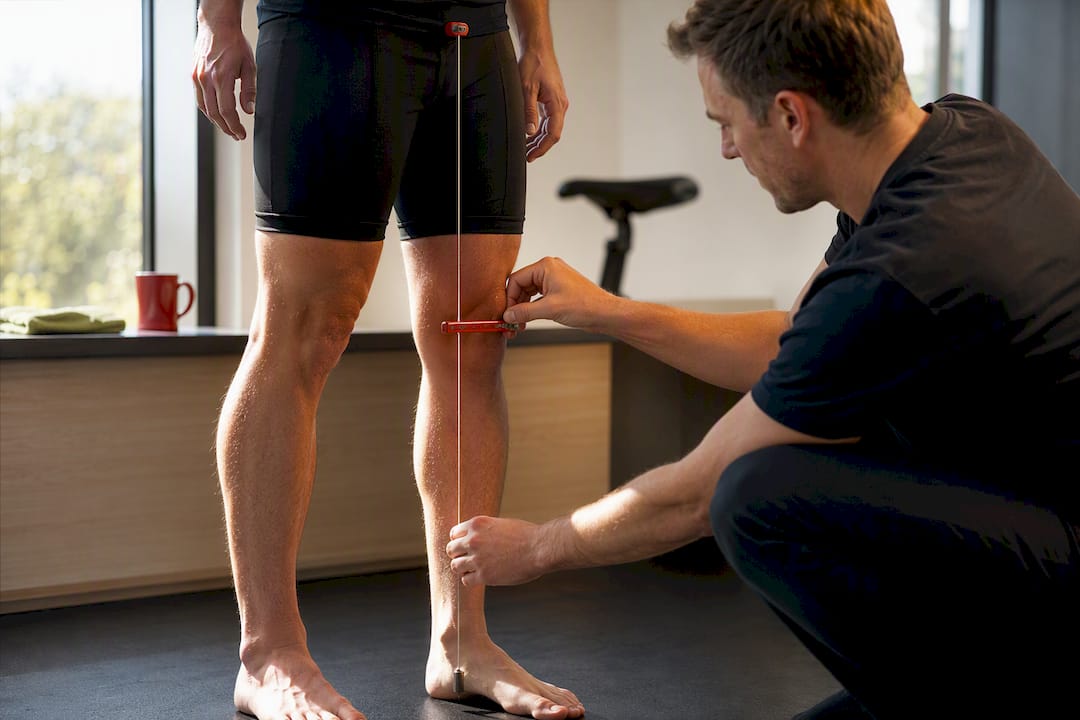
If you’ve been fitted for saddle height and cleat position repeatedly without solving a persistent one-sided knee or hip issue, a leg length discrepancy is worth ruling out before you keep experimenting with crank length alone. A professional fitter with a plumb line or measuring tools can usually spot this in minutes, and it changes the whole conversation about what “correct” crank length even means for your body.
What I’ve Learned Fitting Riders to the Right Crank Length
Crank length gets treated like a power lever far more often than the evidence supports. What actually moves the needle for most riders isn’t wattage, it’s whether their hip closes painfully at the top of the stroke or whether their knee tracks cleanly through the full rotation. Riders chase the numbers pro cyclists ride, not realizing that most of us gain more from a fit-driven change than from mimicking an elite rider’s extreme setup built around a very specific aero or cadence strategy.
Our approach to crank length starts with the same logic this article walks through: identify a real fit problem first, then treat length as one tool among several. Components that make testing a change practical are prioritized, and parts are curated based on performance feedback from riders, not just spec sheets.
— Matt
Where to Find Compatible Cranksets and Fit Support
Once you’ve decided a shorter crank is worth testing, the next hurdle is usually finding parts that actually fit your bottom bracket standard, chainring setup, and Q-factor without a guessing game.

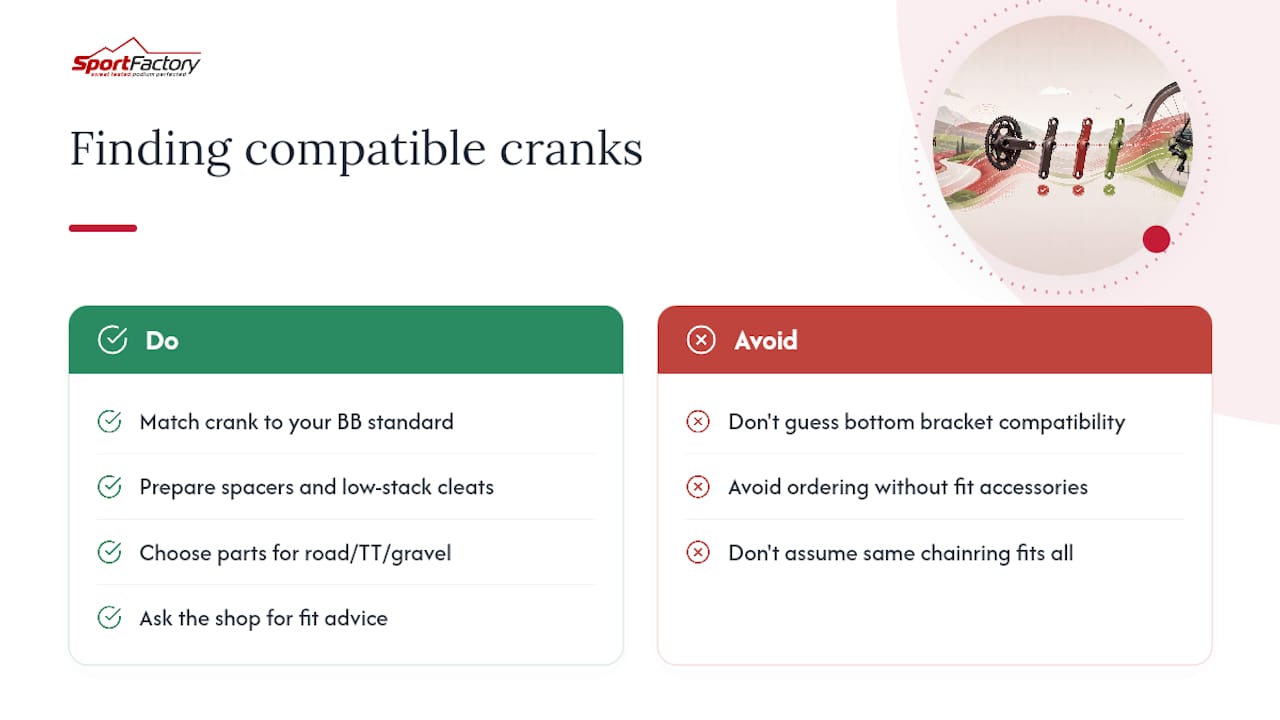
There are cranksets available across the shorter-length range that’s grown more available in recent years, along with smaller supporting pieces that make a swap go smoothly: bottom bracket spacers, low-stack cleat options that fine-tune effective leg extension, and other fit accessories that help avoid a cascade of unrelated adjustments. Having the right spacers and cleats on hand from the start can save a second order and a second delay if saddle height or reach adjustments are needed.
Browse the current crankset and fit accessory selection at Sportfactoryproshop’s cycling gear store to find parts sized for your bottom bracket and riding discipline, whether that’s road, TT, or gravel. If you’re unsure which length or setup fits your situation, reach out through the site for guidance before you order.
Sources
The research and guidance behind this article draws on peer-reviewed kinematics work, randomized crossover testing, and practitioner explainers built specifically for riders making a real decision.
For the underlying science, see the randomized crossover trial on crank length and perceived fatigue and the kinematics study on 5–10 mm crank adjustments. For plain-language fit guidance, BikeTips’ crank length explainer and Cycling Weekly’s guide to calculating optimal crank length both cover the practical side well.
- Effects of crank length on cycling efficiency, sprint performance, and perceived fatigue — PMC
- The impact of minor crank length adjustments on lower body cycling kinematics — Journal article (DOI)
- Crank Length Explained: How to Choose the Right Size — BikeTips
FAQ
What Is the Correct Crank Length for Me?
There’s no single formula that nails it exactly. Start with a calculator based on your leg length, then adjust based on symptoms like knee pinching, hip discomfort, or difficulty holding a low aero position, ideally with a professional fitter confirming the final number.
What Does “Crank Length” Mean?
Crank length is the measurement, in millimeters, from the center of the bottom bracket axle to the center of the pedal spindle. It determines the diameter of the circle your foot travels through with each pedal stroke.
Does a 2.5 mm Crank Length Change Make a Difference?
Usually not enough to notice. Most fitters test changes of at least 7.5 to 10 mm because that’s the minimum jump shown to produce a measurable kinematic difference.
Which Crank Length Is Better for Me, 165 mm or 170 mm?
It depends on your fit symptoms and goals, not a fixed rule. Riders dealing with hip or knee pinching, or those chasing a lower aero position, often find 165 mm more comfortable, while riders with no fit complaints may see no reason to move off 170 mm.