

Triathlon Bike Maintenance: A Pre-Race Bicycle Prep Guide
Posted by Matt Russ on 2nd Oct 2026
Triathlon Bike Maintenance: How to Prepare Your Bicycle for Race Day
I am surrounded by hyper-intelligent people, and I have no problem admitting that I rely heavily upon them. I figure if you surround yourself with brainiacs, some of their smarts may rub off, and your own deficiencies might be less apparent. So far, it seems to be working.
.
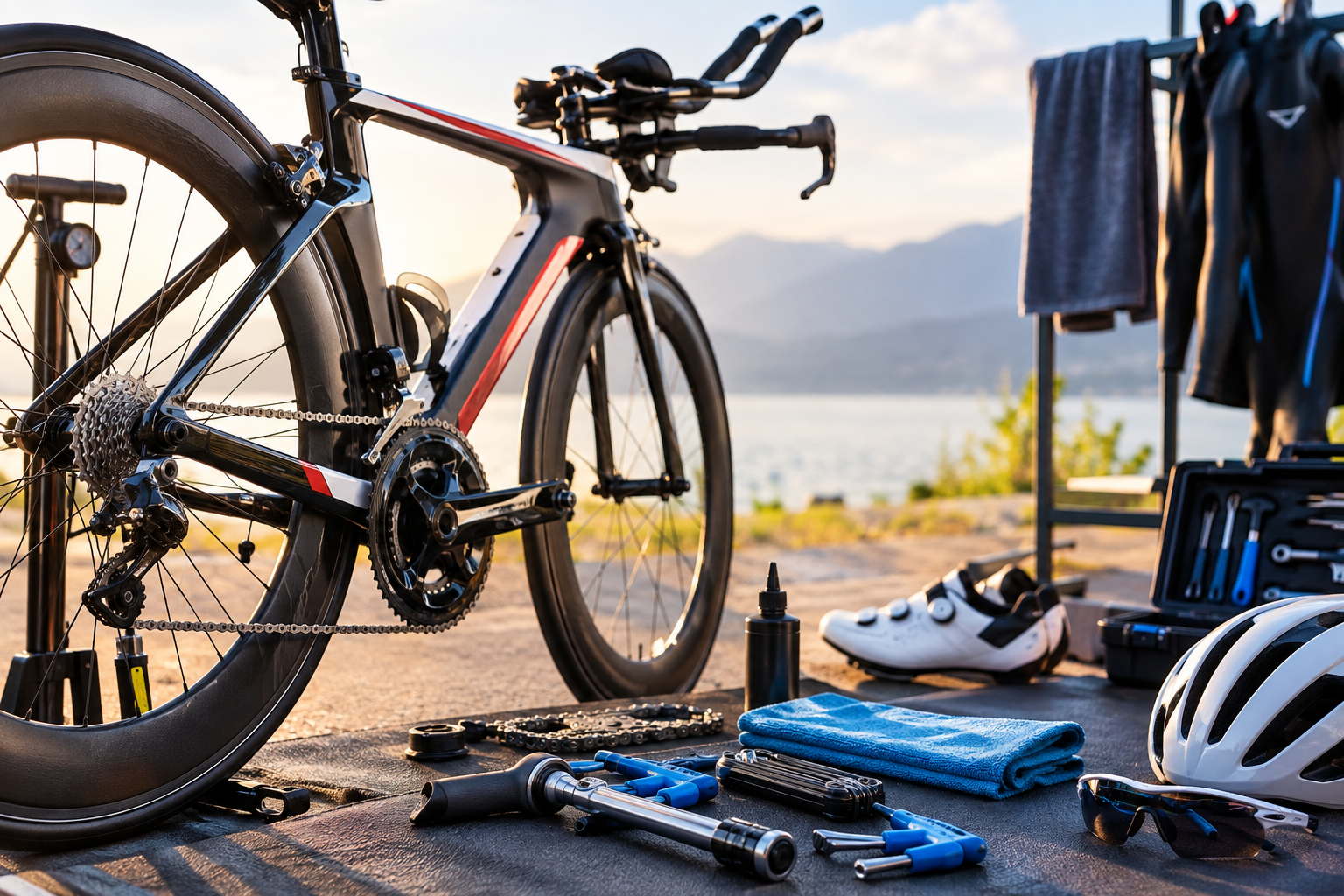
There is one area, however, where I frequently see highly intelligent athletes become surprisingly indifferent: the complex and intricate workings of the bicycle.
I have watched athletes travel thousands of miles and spend thousands of dollars preparing for an important race, only to discover that their bicycle was not properly prepared. Seats fall off. Aerobars drop. Seat posts slide down several inches. Pedals come loose. Brakes rub against wheels. Shifting deteriorates. And occasionally, a seemingly minor mechanical problem ends a race before it really begins.
The frustrating part isn't that bicycle mechanical problems happen. They do.
The frustrating part is that many race-day bicycle problems are preventable.
Your Bicycle Is One of Your Biggest Race-Day Risks
You may struggle to get out of your wetsuit. A shoe may come untied. You might lose a few seconds in transition.
A bicycle mechanical problem is different.
A mechanical can cost you minutes, force you to stop, or end your race altogether.
That makes pre-race bicycle maintenance and preparation an important part of your training—not something to think about the morning of the event.
Your bicycle is ultimately your responsibility. That doesn't mean you need to become a professional bicycle mechanic. It means you should understand enough about your bike to recognize problems, perform basic maintenance, assemble it correctly, and communicate effectively with your mechanic.
Knowledge is power.
More importantly, knowledge reduces the number of things you leave to chance.
Here are the basics.
Get Professional Bicycle Maintenance Before the Race
As much as your bike is your responsibility, most major mechanical work should be performed by a trained bicycle technician.
Don't wait until the day before your race.
Ideally, take your bike in at least a week before the event for a professional inspection. This gives the mechanic time to identify problems and gives you time to correct them and test ride the bike.
A proper pre-race inspection should include checking for potential failure points such as:
- Worn tires or tubes
- Worn cables and housing
- Chain and drivetrain wear
- Brake function
- Shifting performance
- Loose bolts or components
- Bearing condition
- Wheel condition
- Damaged or excessively worn parts
If something needs to be special ordered, you will also have enough time to get the replacement part installed.
This is especially important if you are making changes for race day. Installing different wheels, for example, may require adjustments to the drivetrain, derailleur, cassette, or brakes.
Never make a major mechanical change immediately before an important race without giving yourself time to test everything.
Know How to Assemble Your Bike
If you travel with your bicycle, you should know how to properly assemble it when you arrive.
You don't necessarily need advanced mechanical skills. But you should understand the basic assembly of your own bicycle.
At a minimum, you should know how to:
- Install the wheels correctly
- Install and tighten the pedals
- Install the seat post
- Install and tighten the stem and handlebars when applicable
- Check that brakes operate properly
- Confirm that the drivetrain shifts correctly
- Check that critical bolts are properly tightened
I recommend creating a bike assembly checklist specifically for your bicycle.
Write down anything unique to your setup.
For example:
- Both pedals thread forward
- Skewer or thru-axle goes on the left
- Three spacers under the stem
- Specific torque settings for critical components
Don't rely on memory when you're assembling your bike in a hotel room thousands of miles from home.
A checklist takes a few minutes to create and can prevent a very expensive mistake.
It is perfectly reasonable to have a mechanic inspect the bike after you assemble it. Just remember that race-day mechanics can be extremely busy. They may not have the time to perform a complete inspection of every bicycle that comes through the door.
Eliminate Preventable Points of Failure
Components generally don't come loose for no reason.
Loose bolts are often the result of improper installation or insufficient torque.
This is particularly important with carbon-fiber frames and components. Manufacturers typically specify torque requirements, and those specifications should be followed.
A torque wrench or torque key makes this simple.
Don't guess how tight a carbon component should be. Too little torque can allow a component to move, while excessive torque can damage the component or frame.
If you are experiencing problems with components slipping or moving, products such as carbon assembly paste can sometimes help provide additional grip. However, use the product according to the component and manufacturer's recommendations.
Critical bolts should be checked regularly—not just the night before a race.
Learn Basic Bicycle Maintenance
You don't need to become a professional mechanic, but every cyclist should know some basic bicycle maintenance.
At a minimum, you should know how to change a flat tire quickly and correctly.
That includes understanding the equipment and tire system you actually use.
If you're intimidated by tubular tires, for example, you may decide that a clincher or tubeless setup is more practical for your particular race and level of experience.
You should also understand basic drivetrain maintenance.
Your chain needs regular lubrication, but more lubricant isn't necessarily better. Excess lubricant attracts dirt and creates a grinding paste that can accelerate drivetrain wear.
Apply the appropriate chain lubricant for your riding conditions and wipe away excess lubricant after it has worked into the chain.
Keeping the bicycle clean also makes it much easier to identify problems before they become failures.
A dirty bike can hide worn components, loose hardware, corrosion, and other developing problems.
Poor shifting can sometimes be corrected with a relatively simple adjustment to cable tension or derailleur setup, but don't assume every shifting problem is a simple adjustment. Worn or damaged components may require professional service.
Most bicycle shops can also teach basic maintenance skills. A maintenance class can be one of the most useful investments a cyclist makes.
Knowing how to replace a tube could mean getting back on the road in a few minutes instead of spending hours waiting for someone to come find you.
Schedule a Regular Bicycle Overhaul
How often your bicycle needs a complete overhaul depends on how much you ride, the conditions you ride in, and the type of equipment you use.
For many serious cyclists, an annual professional bicycle service is a reasonable starting point.
During a comprehensive service, the bicycle can be inspected, cleaned, adjusted, lubricated, and have worn components replaced as necessary.
This is particularly important for triathletes because bicycles are routinely exposed to sweat, sports drinks, rain, road grime, and other contaminants.
Sweat is highly corrosive.
It can work its way into areas you cannot easily see, including around bearings, cables, bolts, and other components. Frames are designed to drain moisture, but drain holes can become obstructed.
The damage is often occurring where you can't see it.
If you begin seeing surface rust on bolts or other hardware, don't simply clean up what you can see and assume everything is fine. Have the bicycle inspected.
Your Race Preparation Starts Weeks Before Race Day
Your race doesn't start when you enter the transition area.
It starts weeks earlier.
That's when you should be inspecting your equipment, scheduling professional maintenance, replacing worn components, assembling and testing your race setup, and making sure you understand how your bicycle works.
Work with a qualified bicycle mechanic, but don't completely outsource your responsibility for the machine.
You should know enough about your bicycle to recognize problems, perform basic maintenance, assemble it correctly, and understand whether something feels or sounds different.
A few minutes of bicycle maintenance can prevent a mechanical problem that costs you an entire race.
And remember: drivetrain efficiency matters, too. A poorly maintained chain and drivetrain can increase friction and waste energy over the course of a long bike leg.
Triathlon already gives you plenty of things to worry about on race day.
Your bicycle shouldn't be one of them.
Prepare it properly, understand your equipment, and eliminate as many preventable mechanical problems as possible.
Your race-day bike preparation is part of your training. Treat it that way.
Matt Russ enjoyed a professional coaching career spanning over two decades of working with professional endurance athletes. His athletes have achieved numerous regional, national, international and championship titles under his direction. Matt achieved the highest level of licensing by both USA Triathlon and USA Cycling, and was a licensed USA Track and Field Coach. His accomplishments include being named "Team USA" Coach for the 2011 Beijing World Championship. Head Coach and founder of The Sport Factory, a USA Triathlon Certified Performance Center, he has authored many articles on a wide variety of endurance related topics.