


Peripheral Training for Triathletes: Strength, Cross-Training and Injury Prevention
Posted by Matt Russ on 16th Oct 2026
By Coach Matt Russ for USA Triathlon Multisport Zone
Athletes commonly wonder whether participating in one sport or activity can improve performance in another. As with most training questions, the answer is: it depends.
The first rule of effective training is specificity. You do not become a better runner simply by cycling, or a better swimmer by skiing. The same principle applies to strength training and cross-training. Each activity can either enhance or detract from your overall endurance performance depending on how much you do, how frequently you do it, and when it is incorporated into your training season.
I call training that is not directly specific to your primary sport peripheral training. How you organize and integrate peripheral training can play an important role in the success of your season.
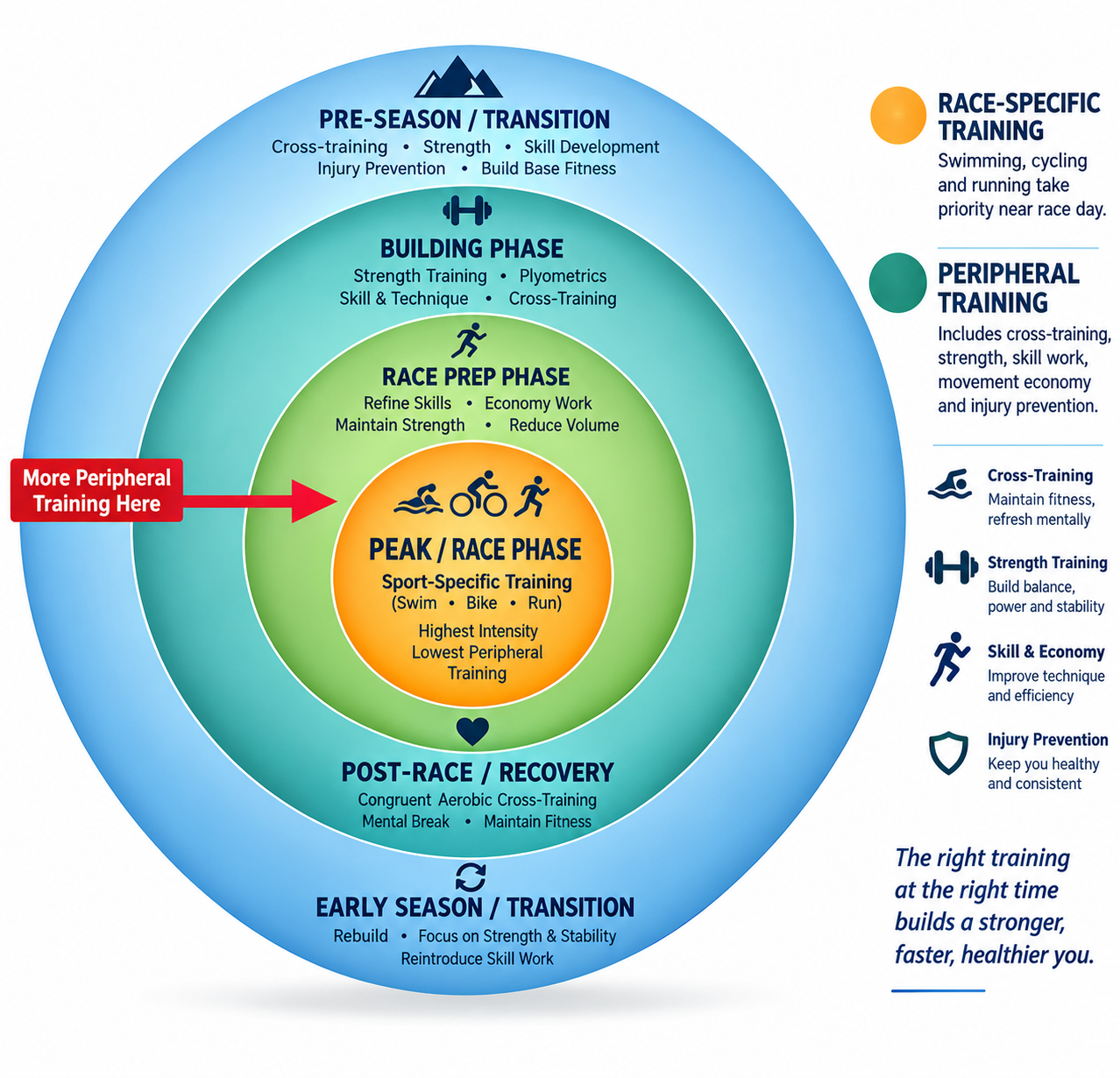
The Role of Peripheral Training in a Triathlon Season
As you approach your peak or goal race, training should become progressively more specific and race-like. For a time-crunched triathlete, there is often very little room in the schedule for anything beyond highly specific training.
So where do strength training, skill development, economy work, injury prevention, and cross-training fit?
Think of your training season as a series of concentric rings, like the ripples created when a pebble falls into a pond. The outer ring represents the preseason or transition phase, while the center represents your most specific peak training.
The farther you are from your goal race, the greater the opportunity to incorporate peripheral training. As you move toward your peak, the emphasis should progressively shift toward race-specific training.
In other words, the closer you get to race day, the less room there should be for peripheral training.
Congruent Aerobic Cross-Training
After completing a peak race, athletes need more than physical recovery. They often need a mental break from highly structured, sport-specific training as well.
I like athletes to put down their primary sport-specific training for a while when possible. However, I don't necessarily want a complete shutdown that requires extensive rebuilding of fitness.
Instead, I encourage athletes to participate in other aerobic activities that help maintain general fitness while providing a mental change of pace.
For a triathlete, this could include mountain biking, cross-country skiing, hiking, rowing, or another activity that essentially keeps you moving.
I am not a fan of immediately incorporating ball sports or activities requiring rapid lateral movements. A triathlete's body is highly conditioned for the repetitive demands of swimming, cycling, and running. A sudden transition to unfamiliar movements can create unnecessary injury risk.
For this reason, I prefer congruent aerobic activity rather than structured cross-training during this part of the season. The goal is to move, have fun, maintain some aerobic fitness, and recover mentally from the demands of the previous race.
Strength and Plyometric Training
Strength training and sport-specific endurance training can sometimes be like oil and water.
Plyometric training, for example, can negatively affect an important running speed workout if it is poorly timed. It can also create a significant injury risk for an athlete who is not adequately prepared.
On the other hand, strength and plyometric training may be exactly what an athlete needs to make a breakthrough, restore muscular balance, or strengthen a weak link in the kinetic chain.
The key is timing and progression.
After an appropriate strength-acclimation period, strength training can be incorporated multiple times per week when sport-specific volume and intensity are relatively low. This typically makes the base phase an appropriate time to emphasize strength development.
The emphasis should be twofold:
- Restore muscular balance and develop strength and power.
- Select exercises and movements that have a meaningful relationship to sport-specific performance.
Consider two exercises that target the latissimus muscles: a one-arm row and an exercise performed with a Vasa Trainer. Both work the lats, which are important to swimming strength and power, but the Vasa Trainer uses a movement pattern much more similar to swimming.
That distinction matters.
Athletes may naturally gravitate toward exercises such as leg extensions or overhead presses because they are familiar gym exercises. But an exercise can make a muscle stronger without necessarily improving the movement patterns required by your sport.
The goal is to choose exercises that complement the balance, movement patterns, and demands of triathlon.
The length of a strength or plyometric phase will vary from athlete to athlete. The important point is that as sport-specific training volume increases, peripheral strength and plyometric training must gradually be reduced.
Strength Maintenance and Injury Prevention
Injury prevention is another important role for peripheral training.
Triathlon requires enormous amounts of repetitive movement, often through relatively restricted movement patterns. Over time, this can contribute to overuse problems and muscular imbalances.
An injury can also become an athlete's weak link long after the original injury appears to have healed. The tissues and movement patterns surrounding a previous injury may remain vulnerable to future problems.
Athletes accumulate these issues over the years. Some muscles become shortened while others are placed under prolonged stress, potentially affecting normal joint function and movement.
A properly designed strength and stability phase can produce significant gains. The challenge is maintaining those gains once swimming, cycling, and running volume begin to increase.
The good news is that maintaining strength and neuromuscular adaptations generally requires considerably less training volume than developing them in the first place.
For some athletes, a consistent routine of approximately 20–30 minutes, two or three times per week, may provide an efficient way to continue addressing vulnerable areas.
Finding that additional time can be difficult for a time-crunched athlete, but a short, targeted routine may ultimately be what helps keep an athlete healthy enough to reach the starting line.
Common problems among endurance athletes can include IT band issues, shoulder problems, patellofemoral pain, and Achilles tendon problems. Athletes with a history of overuse injuries may benefit from maintaining specific strength, mobility, and stability work throughout much of the year.
Older athletes and athletes with a history of recurring injuries may need to place an even greater emphasis on strength maintenance and preventative training.
Speed, Skill and Movement Economy
Many athletes operate under the assumption that simply training harder or more frequently will produce a continual improvement in speed.
Unfortunately, athletic improvement is rarely that linear.
Unless economy and efficiency are addressed, an athlete can eventually reach a plateau. Speed and skill training are often overlooked because they require expertise, additional time, and sometimes professional instruction.
But as an athlete gains experience, physiological limitations may become increasingly difficult to overcome. Improving movement economy can sometimes provide another avenue for performance improvement.
This is particularly relevant to swimming and running.
Running economy, in particular, is frequently overlooked. We receive very little formal instruction in running mechanics during childhood compared with many other sports. Running is generally assumed to be a natural skill.
But watch an experienced, highly efficient runner and compare that athlete with someone who has simply accumulated a lot of running mileage. The differences can be substantial.
Many accomplished runners have spent years working with coaches on drills, speed development, mechanics, and technique.
If you have reached a performance plateau or want to improve the efficiency of your movement, regular speed and skill work may be worth incorporating into your training.
How to Incorporate Skill Work
It is generally best to introduce instruction and technique work before the peak phase of your season.
Overall training intensity should remain manageable, and there needs to be enough room in the training schedule to accommodate the additional work.
In many cases, a small amount of skill work performed consistently is more effective than dedicating an entire workout exclusively to technique.
For example, working on one or two aspects of economical movement during each workout can provide frequent reinforcement without overwhelming the athlete.
There is an important caveat: avoid making major changes to your mechanics immediately before a goal race.
Changing movement patterns takes time. New mechanics place different demands on muscles and connective tissues, and there can initially be a decrease in efficiency while the body adapts.
Trying to completely rebuild your technique during the final weeks before a race is therefore a poor time to experiment.
High-intensity workouts also require significant mental concentration. Trying to simultaneously change mechanics while chasing demanding performance metrics can make both objectives less effective.
I prefer to address significant changes in technique and economy well before the peaking phase.
Sport-Specific Training Takes Priority Near Race Day
Sport-specific training remains a constant throughout most of the season, although its volume and the physiological systems being targeted will change.
For a triathlete, that means swimming, cycling, and running will account for the vast majority of training during most of the season.
One mistake athletes make is trying to find creative ways to increase fitness by introducing different forms of peripheral training during the peaking phase.
This is where specificity becomes especially important.
As race day approaches, your body has become highly adapted to the demands you have been placing on it. Introducing a new class, exercise, or type of cross-training that may have been beneficial earlier in the season can potentially interfere with that progression.
Once you enter the final series of stress-and-recovery cycles leading toward your taper, the focus should be on the demands of race day and injury prevention.
Don't introduce unnecessary new stress during this period.
The closer your training resembles the actual demands of the race—including the course, intensity, environment, equipment, and other relevant conditions—the better prepared you will be for race day.
Structure Peripheral Training Around Your Goal
There are a tremendous number of moving parts in a training season.
Training should continually change, evolve, and progress toward the ultimate goal. Peripheral training is one of the tools that can help make that progression possible.
When properly structured, peripheral training can also provide an important psychological benefit. Training the same way day after day can become monotonous, and boredom can eventually affect motivation.
You can only maintain peak physical condition for a relatively small window of time, and the same is true of your mental state.
Don't underestimate the motivational and social benefits of different forms of training.
Great athletes are seldom developed in a social vacuum. At key points in the season, they may need highly specific training focused on their race goals. At other times, they can benefit from the social interaction, variety, and enjoyment that come from classes, training groups, and cross-training activities.
The goal is not to eliminate peripheral training.
The goal is to put it in the right place within your training season.
Use cross-training when it provides a useful physical or mental break. Build strength when sport-specific volume allows it. Develop skill and economy before your peak phase. Maintain strength and address injury-prone areas throughout the season.
Then, as race day approaches, progressively strip away the peripheral work and focus on what matters most: preparing your body and mind for the specific demands of your goal race.
Coach Matt Russ enjoyed a professional coaching career spanning over two decades of working with professional endurance athletes. His athletes have achieved numerous regional, national, international and championship titles under his direction. Matt achieved the highest level of licensing by both USA Triathlon and USA Cycling, and was a licensed USA Track and Field Coach. His accomplishments include being named "Team USA" Coach for the 2011 Beijing World Championship. Head Coach and founder of The Sport Factory, a USA Triathlon Certified Performance Center, he has authored many articles on a wide variety of endurance related topics.