

Don’t Let a Dirty Drivetrain Cost You Time on Race Day
Posted by Matt Russ on 11th Sep 2026
By Coach Matt Russ
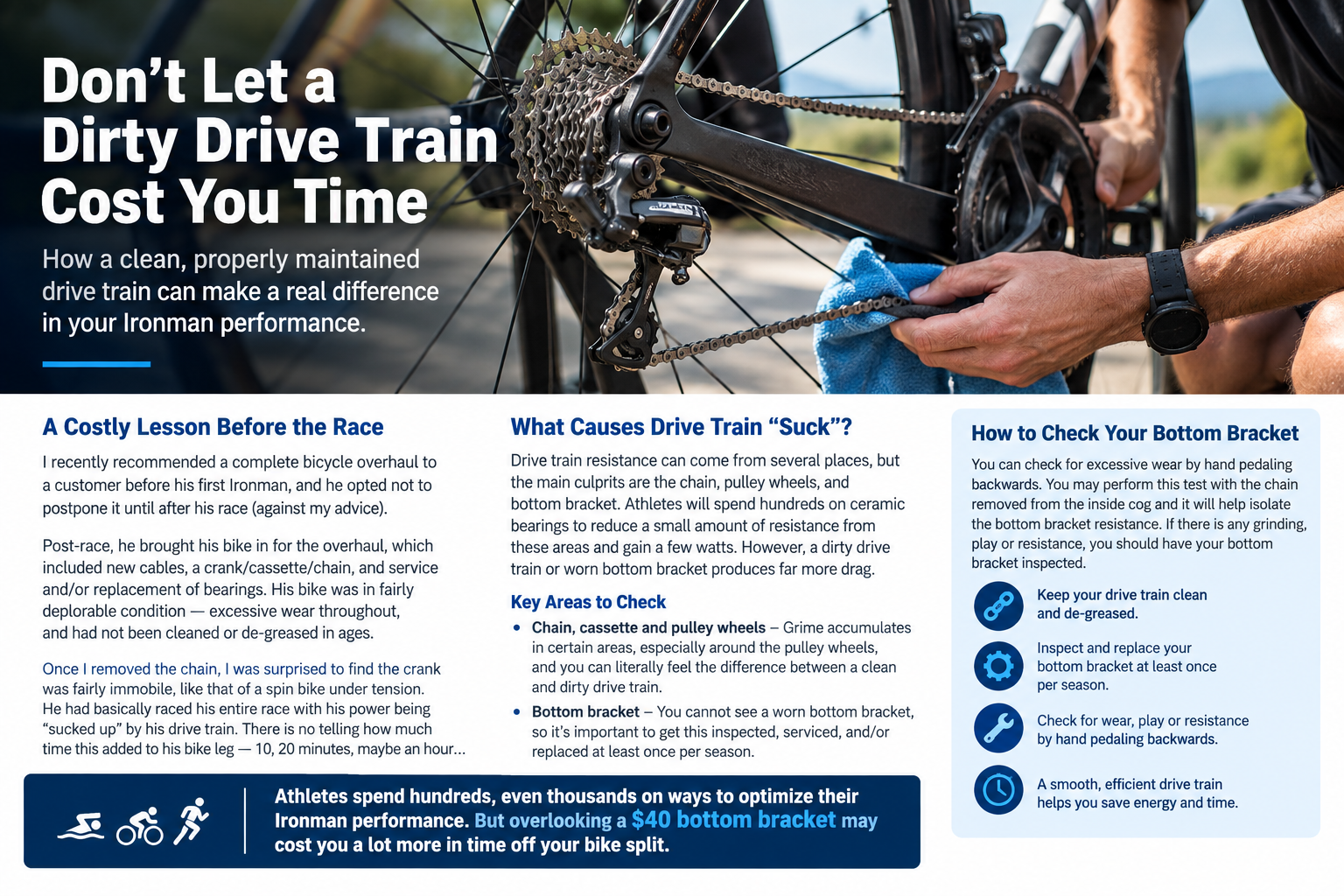
When preparing for an Ironman, triathletes will spend hundreds or even thousands of dollars trying to improve their performance. Aerodynamic wheels, carbon components, power meters, ceramic bearings, professional bike fits and other upgrades can all provide measurable benefits.
But there is one area that athletes often overlook: basic bicycle maintenance.
I was recently reminded of just how costly a neglected drivetrain can be when I recommended a complete bicycle overhaul to a customer preparing for his first Ironman. I strongly advised him to have the work completed before his race, but he decided to wait until afterward.
After the Ironman, he brought the bike in for the overhaul. The service included new cables, a new crank, cassette and chain, along with servicing and/or replacing several bearings.
The condition of the bike was, frankly, deplorable. There was excessive wear throughout the drivetrain, and it had apparently not been properly cleaned or degreased in a very long time.
Then I removed the chain.
I was surprised to discover that the crank was extremely difficult to turn. Without the chain in place, the crank should rotate smoothly with very little resistance. Instead, it felt almost like the resistance on a stationary spin bike.
In other words, this athlete had potentially spent his entire Ironman bike leg fighting resistance in his own bicycle.
How Much Time Can a Dirty Drivetrain Cost?
There is no way to know exactly how much time that excessive resistance added to his race. It could have been 10 minutes, 20 minutes or potentially much more.
The important point is that drivetrain resistance directly affects cycling efficiency. Every watt of unnecessary resistance is energy that isn't helping move you down the road.
And this is where things get interesting.
Athletes will spend hundreds of dollars on ceramic bearings and other marginal equipment upgrades in an effort to save a few watts. Yet a dirty, poorly lubricated or excessively worn drivetrain can potentially create far more resistance than the small gains provided by expensive upgrades.
The Biggest Sources of Drivetrain Resistance
Drivetrain "suck" can come from several areas, but three of the most important places to look are the:
- Chain
- Rear derailleur pulley wheels
- Bottom bracket
A dirty chain can accumulate considerable grime, particularly when lubricant combines with road dirt and debris. The same is true of the derailleur pulley wheels, where contamination can build up over time.
You can often feel the difference between a clean, properly lubricated drivetrain and one covered in grime.
A clean drivetrain isn't just about appearance. Proper cleaning, lubrication and maintenance can help your bicycle operate more efficiently and can also extend the life of expensive drivetrain components.
Don't Ignore the Bottom Bracket
The bottom bracket is particularly easy to overlook because, unlike a dirty chain or pulley wheel, you can't simply look at it and determine whether it is worn.
Bottom brackets contain bearings that can become contaminated, worn or damaged over time. Excessive friction, rough bearings or play in the bottom bracket can rob efficiency and may eventually damage other components.
For serious cyclists and triathletes, I recommend having the bottom bracket inspected, serviced and/or replaced as needed as part of regular seasonal bicycle maintenance.
There is also a simple check you can perform yourself.
With the bicycle in a suitable position, pedal the crank backwards by hand and pay attention to how smoothly it rotates. You can also remove the chain from the chainring to help isolate resistance coming from the crank and bottom bracket.
If you feel grinding, excessive resistance, roughness or play, it's time to have the bottom bracket inspected by a qualified bicycle mechanic.
Your Race Bike Deserves Preventive Maintenance
Ironman athletes obsess over their training, nutrition, aerodynamics, equipment and race strategy. They carefully analyze their power numbers and spend significant amounts of money looking for ways to improve their bike split.
But none of those upgrades can compensate for a bicycle that isn't operating properly.
A neglected drivetrain can create unnecessary resistance, accelerate component wear and potentially cost you valuable time on race day.
So before your next Ironman or long-distance triathlon, don't just ask yourself whether your bike is fast enough.
Ask whether your bike is working efficiently.
Athletes spend hundreds, even thousands of dollars on ways to optimize their Ironman performance. But overlooking a relatively inexpensive bottom bracket or failing to properly maintain the drivetrain could cost you far more in lost time on your bike split.
Clean it. Lubricate it. Inspect it. Service it. Then race it.